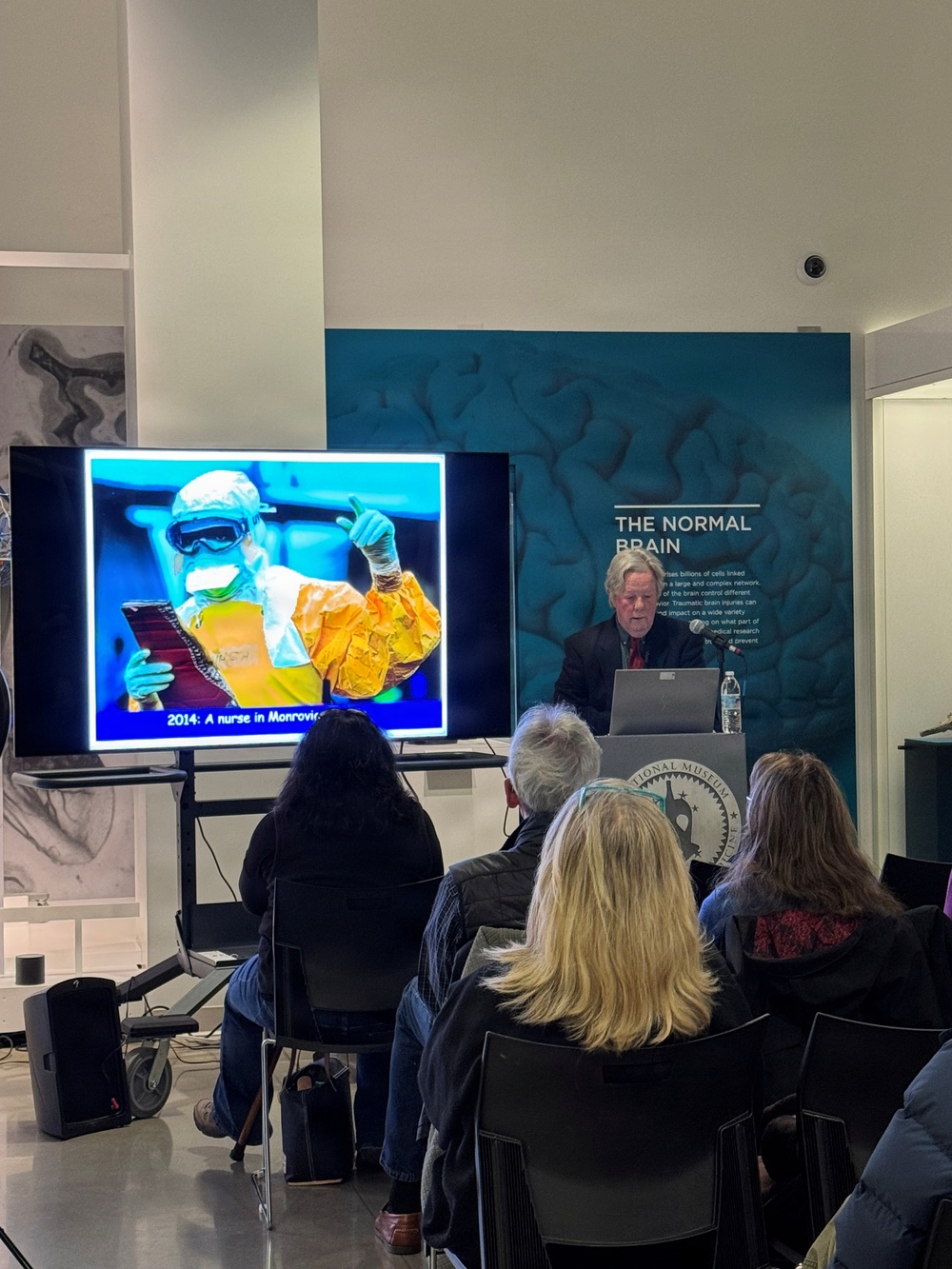
The National Museum of Health and Medicine welcomed visitors on Jan. 11 for a public lecture on Ebola virus disease by Dr. Mike Bray, a former U.S. Army medical researcher and long-time expert in infectious diseases. His talk marked 50 years since the first known Ebola outbreak. He explained how the virus spreads, why outbreaks can grow quickly, and how scientists and medical teams work to control them.
Bray began by explaining what viruses are and why learning about them helps people stay healthy. He said that learning about Ebola also teaches people how infections move from one person to another. “It’s important to understand how things spread, how to avoid infections, how to recognize infections,” he said. “It’s not about Ebola itself—it’s about the basics. Knowing the difference between Ebola, which isn’t airborne, and something like SARS or the flu that is, helps stop the spread.”
Throughout the lecture, Bray explained that Ebola is a severe disease, but it does not spread easily. People usually catch it through direct contact with the body fluids of someone who is already sick. Because of that, quick action can stop outbreaks before they grow. “Finding outbreaks and responding quickly is extremely important in terms of saving lives,” he said.
Using maps, photos and timelines, Bray showed visitors how the large West African outbreak from 2013 to 2016 began and why it grew so fast. Delays in finding early cases played a role. Crowded cities and limited medical resources made the 2013 outbreak worse. He compared it to the smaller 2025 outbreak in the Democratic Republic of the Congo where trained teams, quick lab testing, and ready vaccine stockpiles helped limit the spread.
Bray also talked about the long history of military medicine in studying severe viruses. He shared stories from his own career at the U.S. Army Medical Research Institute of Infectious Diseases at Fort Detrick. “Military laboratories led the way in studying severe infectious diseases,” he said. “Since the time of Walter Reed and the early days of the U.S., military medicine has led the way in the battle against infectious disease.”
The lecture also allowed the museum to highlight its Vickers Aircraft Transport Isolator, a self-contained biocontainment unit that was designed to transport patients with highly infectious diseases, such as Ebola, and to provide in-flight care. This large isolator helps medical workers move a patient safely during an outbreak. Visitors saw how the unit protects health care teams and prevents further spread. Seeing the unit helped connect the scientific concepts from Bray’s talk with real-world innovations used during outbreak response.
Bray said he hopes people walk away with a better understanding of a disease that is often misunderstood. He encourages people to stay informed and learn the facts to help protect their communities.
To learn more about future museum events or plan a visit, go to [medicalmuseum.health.mil](https://medicalmuseum.health.mil/index.cfm/visit/events/index).
| Date Taken: |
01.23.2026 |
| Date Posted: |
01.23.2026 13:14 |
| Story ID: |
556652 |
| Location: |
SILVER SPRING, MARYLAND, US |
| Web Views: |
335 |
| Downloads: |
0 |
PUBLIC DOMAIN

This work, Understanding Ebola and the Tools Used to Fight It: NMHM Hosts Dr. Mike Bray, by Kenya Baylor, identified by DVIDS, must comply with the restrictions shown on https://www.dvidshub.net/about/copyright.