
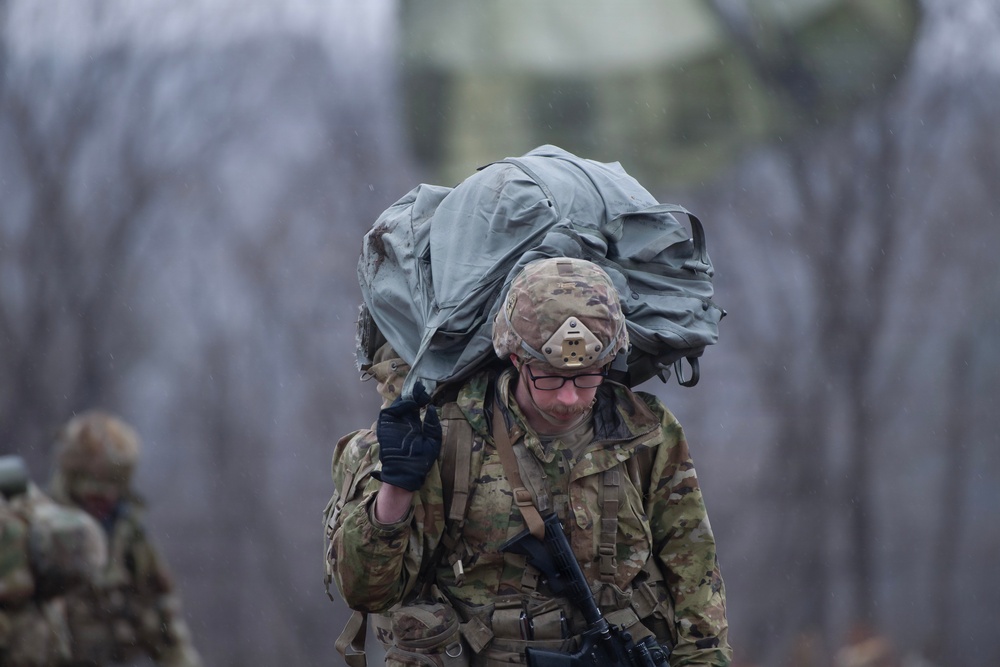
Photo By Yasuo Osakabe | A U.S. Army Soldier assigned to the 11th Airborne Division carries his equipment after...... read more read more
 Subscribe
U.S. Air Force C-130J Super Hercules aircraft assigned to the 36th Airlift Squadron supported a multinational airborne operation Jan. 17 at Ojojihara Training Area, Miyagi Prefecture, marking the first Japan Ground Self-Defense Force-hosted multinational airborne exercise conducted on Japanese soil.
The operation built on the momentum of New Year Jump Indo-Pacific 2026 (NYJIP26), which included participation from 14 nations, and served as the tactical phase of a broader training series designed to enhance airborne operational capability and interoperability among allied forces. While NYJIP26 at the JGSDF’s Narashino Training Area in Chiba Prefecture earlier this month was conducted as a ceremonial public demonstration, training at Ojojihara emphasized combat readiness and operational execution.
Operating from Yokota Air Base, four U.S. Air Force C-130J Super Hercules aircraft assigned to the 36th Airlift Squadron delivered approximately 130 paratroopers from the U.S. Army’s 11th Airborne Division to the drop zone in Miyagi Prefecture. The airborne insertion was conducted in coordination with the Japan Air Self-Defense Force, which employed one Kawasaki C-2 and two C-130H Hercules, both assigned to the JASDF Air Support Command to transport paratroopers from the JGSDF 1st Airborne Brigade.
The combined force conducted an airborne insertion and transitioned immediately to ground maneuver, executing reconnaissance and consolidation actions to validate command-and-control procedures and combined maneuver capabilities.
The operation required detailed coordination among multiple airlift platforms operating in the same airspace. U.S. Air Force aircrews synchronized rendezvous points, altitudes and airspeeds with JASDF C-2 and C-130H aircraft to operate as a single formation prior to the drop. Aircraft spacing and timing were established based on ground force requirements, with all aircraft slowing to a common drop airspeed before paratrooper exit.
“Flying with multiple airlift platforms requires precise coordination from start to finish,” said U.S. Air Force Lt. Col. Stephen Larson, 374th Airlift Wing, C-130J pilot. “Once we establish visual contact, we bring the formation together at the same altitude and airspeed and set spacing based on what the ground force needs for a safe and effective drop.”
Despite low cloud ceilings and reduced visibility, aircrews maintained visual conditions and executed a precise airdrop. The C-130J’s automated systems assisted crews in generating accurate airdrop run-in profiles, allowing pilots to focus on formation coordination, drop zone communication and air traffic control. The coordinated airlift enabled ground forces to execute the operation as planned.
“The transition from the New Year Jump at Narashino to a full-scale tactical drop at Ojojihara is where training translates into operational capability,” said U.S. Army Sgt. 1st Class Kael Jordan, 11th Airborne Division, platoon sergeant. “The rehearsals and coordination we conducted beforehand allowed us to execute safely and effectively alongside our Japanese partners.”
Prior to the Ojojihara operation, participating forces conducted preparatory training at Narashino Training Area, focusing on procedural alignment, joint briefings and coordination drills.
The exercise brought together airborne forces from the United States and Japan to strengthen interoperability and reinforce combined airborne capabilities. The training was conducted as part of a series of linked exercises designed to enhance regional readiness and cooperation in support of a free and open Indo-Pacific.
| Date Taken: | 01.21.2026 |
| Date Posted: | 01.25.2026 17:12 |
| Story ID: | 556584 |
| Location: | YOKOTA AIR BASE, MIYAGI, JP |
| Web Views: | 335 |
| Downloads: | 0 |

This work, Yokota supports first JGSDF-hosted multinational airborne exercise, by Yasuo Osakabe, identified by DVIDS, must comply with the restrictions shown on https://www.dvidshub.net/about/copyright.


No keywords found.




