
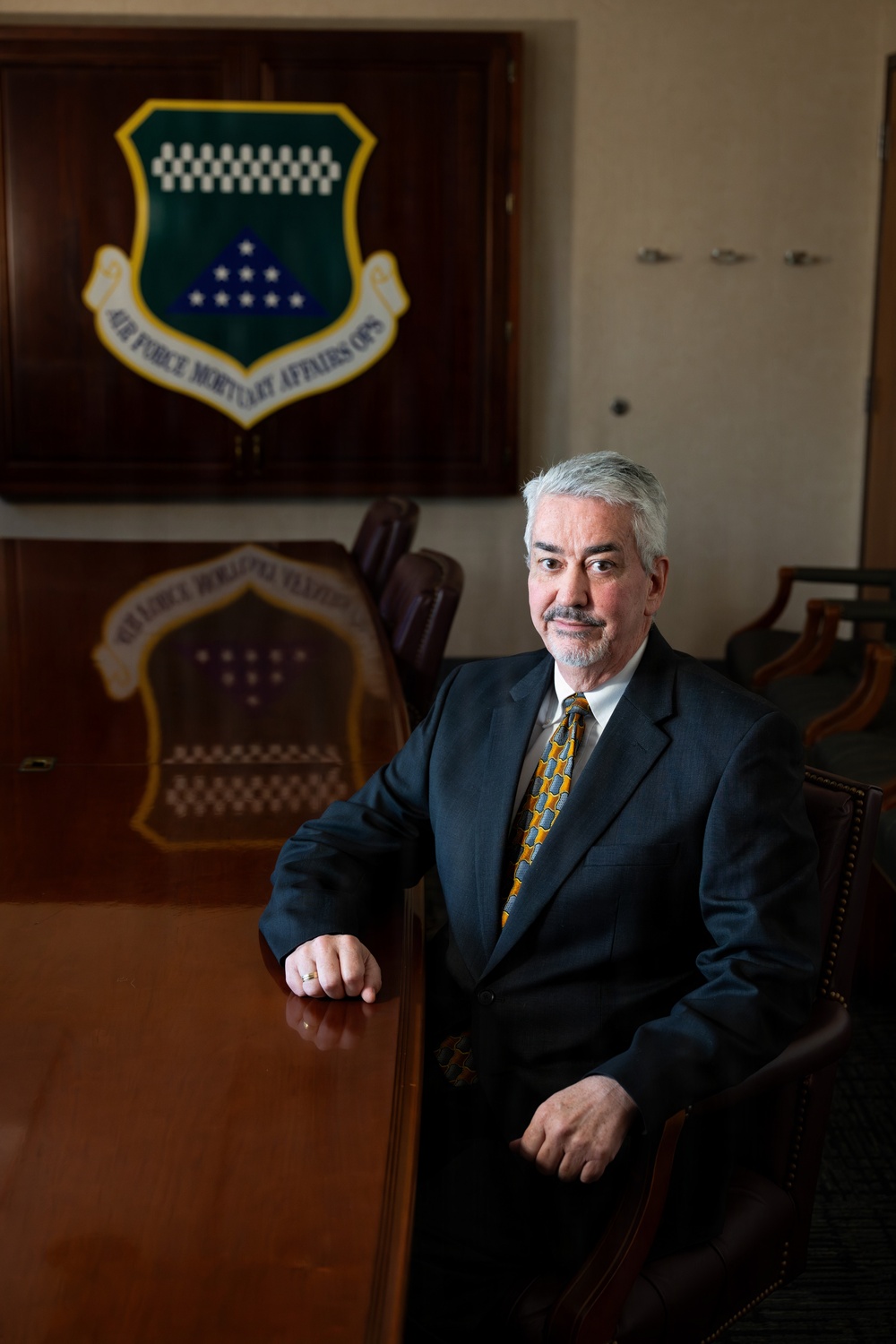
Photo By Jason Minto | Matthew McCloskey, Air Force Mortuary Affairs Operations mortuary affairs specialist,...... read more read more
Matthew McCloskey’s journey into Air Force Mortuary Affairs Operations began with childhood curiosity and grew into a four-decade career marked by compassion, dedication, and an unwavering respect for the fallen. This year is a significant milestone for him, as it marks his 40th anniversary in the field of death care. For the last 22 years, his work in the Department of War's mortuary programs has taken him across three continents. Now, as part of the Past Conflicts and Training team at AFMAO, McCloskey plays a vital role in ensuring that service members from previous generations are remembered with dignity and care.
How did you get into this profession?
I’ve had an interest in this profession since I was a child; I can still recall asking my mother about it at a young age. When I turned 20, I stopped by a local funeral home. The manager, a true southern gentleman, offered me an opportunity to see if the work was a good fit for me. Forty years later, here I am.
How do people initially react when you tell them about your line of work?
Most people are genuinely interested. It isn't every day that one meets a person who does what I do, and many have stories of their own to share. The reactions I've received have ranged from people literally walking away from me to others comparing my work to a ‘calling’ to serve.
What kind of education and training do you need?
The requirements really vary depending on the state where you wish to work. It can range from no formal education, like in Colorado, to needing a four-year degree in a state like Ohio. However, most states require two years of college, some form of internship, and passing the National Conference Exam. Additionally, states will require you to pass an exam on the specific laws and regulations for that state.
Do you think that bearing witness to the fallen makes you live your life to the fullest?
This profession, in general, makes you appreciate the time we have on this earth and reminds you that nothing should be taken for granted. Working with fallen service members means we often deal with young people, which can take it’s toll both mentally and physically. I am incredibly thankful for the support network that the DoW provides for those of us working in this environment.
What has kept you in this profession?
It’s the sense of satisfaction I get from helping others. I find it deeply rewarding to play a small role in helping families through what could be the worst event of their lives. I will keep at this as long as I continue to get this feeling. The day I stop caring is the day I need to retire.
How has being a mortician impacted your view on life?
Working for the mortuary affairs mission and the DoW, in general, has deepened my appreciation for our country. The level of support we provide for our active duty, veterans, and POW/MIA is unmatched. We truly embody the motto of leaving no one behind. We are given the resources and funding to do right by the service member's family and to fully memorialize the life that was lived.
Today, McCloskey serves as a mortuary affairs specialist in AFMAO’s Past Conflicts and Training section. His work involves past conflicts like the Korean War, the Cold War, and the Vietnam War, where his role focuses on ensuring that fallen service members are honored and remembered with dignity and commitment. In addition to this casework, he is responsible for training the next generation of mortuary affairs professionals, conducting mortuary officers and technician training, and passing on decades of experience to instill the values of respect and service. Through his work, McCloskey ensures that no one is forgotten and that the standard of care remains unwavering.
| Date Taken: | 01.22.2026 |
| Date Posted: | 01.22.2026 11:30 |
| Story ID: | 556529 |
| Location: | DOVER AIR FORCE BASE, DELAWARE, US |
| Web Views: | 51 |
| Downloads: | 0 |

This work, Meet a mortician: Matthew McCloskey, by Jason Minto, identified by DVIDS, must comply with the restrictions shown on https://www.dvidshub.net/about/copyright.

No keywords found.





