
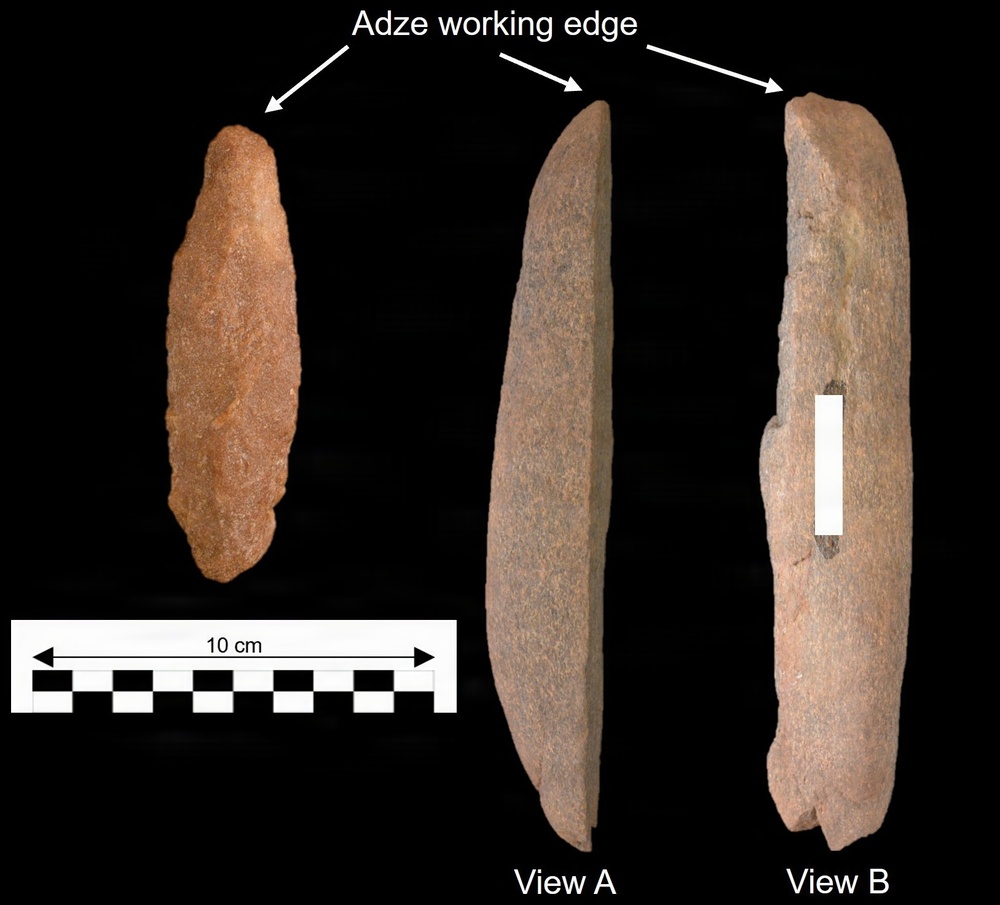
Courtesy Photo | Examples of an adze woodworking tool are shown that were found in past archaeological...... read more read more
 Subscribe
Think of a modern-day carpenter and their woodworking toolkit. Carpentry tools one might find include adzes, axes, chisels, saws, gouges, and woodworking rasps.
A number of these same types of tools could be found in ancient carpenters’ woodworking toolkits, too, especially adzes, axes, chisels, and gouges.
This article will focus on the woodworking tool known as the adze. An adze is a woodworking tool with a primary function of shaping and smoothing wood through chopping/cutting and carving.
An adze is like an axe but has a cutting edge that is perpendicular (at a right angle) to the handle rather than parallel to the handle. An axe is used for chopping or hewing (converting a log into lumber or timber), while an adze is used for shaping wood.
There are two types of adzes — hand adze and foot adze. A hand adze is a short-handled tool used with one hand, while a foot adze is a long-handled tool used with both hands which usually strikes at or just above foot level.
An adze typically has a domed shaped upper side with a bevel (sloping surface or edge) towards the cutting edge and a flat bottom. An adze is made from either ground/polished stone or chipped/flaked stone.
In the past, the adze was used in woodworking to shape wood by cutting, carving, and smoothing. An adze was used to hollow out logs to create canoes, carve bowls, and construct furniture.
Only two stone adzes have been recovered from two separate archaeological sites at Fort McCoy (see picture). It should be noted that numerous stone axes and/or choppers have been recovered at the military installation though.
The adze is a carpentry tool that is still used today for woodworking. Other carpentry tools that can be found at archaeological sites and have stood the test of time include axes, chisels, and gouges. The main difference between the modern adze and that found in the archaeological record is that an adze used today is made of metal rather than stone (ground/polished or chipped/flaked).
All archaeological work conducted at Fort McCoy was sponsored by the Directorate of Public Works Environmental Division Natural Resources Branch.
Visitors and employees are reminded they should not collect artifacts on Fort McCoy or other government lands and leave the digging to the professionals.
Any individual who excavates, removes, damages, or otherwise alters or defaces any post-contact or pre-contact site, artifact, or object of antiquity on Fort McCoy is in violation of federal law.
The discovery of any archaeological artifact should be reported to the Directorate of Public Works Environmental Division Natural Resources Branch.
(Article prepared by the Fort McCoy Archaeology Team that includes the Colorado State University’s Center for Environmental Management of Military Lands and the Fort McCoy Directorate of Public Works Environmental Division Natural Resources Branch.)
| Date Taken: | 01.16.2026 |
| Date Posted: | 01.16.2026 16:29 |
| Story ID: | 556350 |
| Location: | FORT MCCOY, WISCONSIN, US |
| Web Views: | 125 |
| Downloads: | 0 |

This work, Fort McCoy ArtiFACT: Adze woodworking tool, must comply with the restrictions shown on https://www.dvidshub.net/about/copyright.

No keywords found.




