
Photo By Jenae Jackson | Naval Surface Warfare Center, Philadelphia Division (NSWCPD) hosted the 2025 Naval...... read more read more
 Subscribe
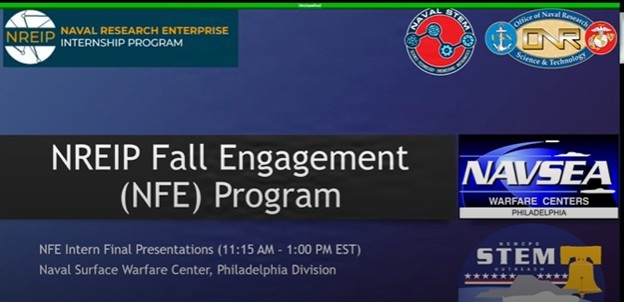
Fourteen college students from 13 universities across the country concluded the Naval Surface Warfare Center, Philadelphia Division’s (NSWCPD) 2025 Naval Research Enterprise Internship Program (NREIP) Fall Engagement (NFE) by giving virtual presentations on four innovative Navy Science, Technology, Engineering and Mathematics (STEM) projects on Dec. 11, 2025.
Over 40 hours this fall, the students remotely collaborated with eight NSWCPD engineers and scientists to address real fleet-focused challenges in mechanical design, data-driven maintenance, additive manufacturing, and computer vision.
NFE provides academically talented students who applied to NREIP but did not complete a summer lab internship with a short-term, classroom-style research project under Navy mentorship. The program is entirely virtual, enabling students from various majors and schools to support NSWCPD’s mission while balancing their regular coursework on campuses nationwide.
“Each year we’re met with a talented group of students who tackle real-world Navy challenges while they are enrolled in very demanding STEM degree fields,” NSWCPD STEM Outreach Program Manager Tristan Wolfe said. “Over the course of the fall semester, these students work in a collaborative nature toward a final deliverable that will provide real technical value to the Department of the Navy."
This year’s cohort came from George Mason University, Kapiʻolani Community College, the University of Michigan, Rutgers University, the University of Virginia, Northeastern University, Villanova University, Virginia Polytechnic Institute and State University, California State University–Long Beach, Washington University in St. Louis, Manhattan College, Alvernia University, and Stevens Institute of Technology. Their fields of study ranged from mechanical, systems, oceanic, aerospace, and electrical engineering to computer science, cybersecurity, robotics, applied mathematics, naval engineering, and business.
NSWCPD’s participation in the NFE program marks a significant contribution to the national NREIP program which places hundreds of students each year at Department of the Navy labs nationwide. By providing undergraduates and graduate students with early exposure to naval research and NSWCPD’s role in shipboard machinery systems, the program helps build the Navy’s future workforce, as well as fosters long-term interest in naval careers.
The “Concept Design of Submarine Control Surface Actuation” team concentrated on mechanical actuation ideas for a retractable control surface on a submarine. The students explored various actuation architectures, performed trade-off analyses, and utilized engineering design tools to confirm their preferred concepts, with each student responsible for a part of the overall actuation system. Team members included Michael Safier, a mechanical engineering major from Washington University in St. Louis; Alexander Mullens, an ocean engineering major with a minor in navalengineering at Virginia Polytechnic Institute and State University; Harry Davies, a mechanical engineering major at Villanova University; Caitlin McCarthy, mechanical engineering major at Manhattan University, and Jaden Shackelford, naval engineering; and aerospace engineering double major at Virginia Polytechnic Institute and State University, and Joshua Cherian, a mechanical engineering major from Rutgers University.
The “Condition Based Maintenance” interns explored predictive maintenance strategies for commercial and naval system components. The team examined available data sets, reviewed literature on predictive and condition-based maintenance, and drafted a white paper outlining best practices, use cases, and a proposed implementation for a conceptual design based in artificial intelligence. Students Saamarth Attray, a computer science and cybersecurity double major at George Mason University; Alexander Clunan, an electrical engineering major at the University of Virginia; Firdvavs Mamadaliyev, a mechanical engineering major at Alvernia University; and Xuan (Jade) Nguyen, an applied mathematics and physics double major at California State University–Long Beach, worked under NSWCPD mentors to connect diagnostic tools, fault-root-cause analysis, and mitigation planning to real-world Navy maintenance challenges.
The “Additive Manufacturing Design Competition” team partnered with NSWCPD’s Advanced Data Acquisition, Prototyping Technologies, and Virtual Environments (ADAPT.VE) Laboratory to create a multi-year national student competition in additive manufacturing (AM). Connor Czap, an industrial engineering and systems engineering double major at Virginia Polytechnic Institute and State University; and Analisa Viterbo, a mechanical engineering major at Stevens Institute of Technology, formed the core of the additive manufacturing (AM) design team. Their recommendations support an Office of Naval Research (ONR) sponsored project to pilot the competition in Philadelphia, providing future participants with a design challenge that will necessitate students to not only learn concepts in additive manufacturing, but physics and engineering more broadly.
The “Computer Vision Workshops & Challenge” project interns researched novel computer vision techniques and developed introductory notebooks to address the lack of computer vision education at the high school and undergraduate levels in this rapidly growing field. The team developed an outline for a future competition. Team members included Erik Bendickson, an electrical engineering major at Kapiʻolani Community College; Preston Chan, a robotics and mechanical engineering double major at the University of Michigan; and Evan Kim, a computer science and business double major at Northeastern University. Their work supports an ONR-sponsored project to pilot a computer vision program in Philadelphia as a pipeline to future fleet analytics and autonomy efforts.
Across all four projects, students adapted and met challenges in regular meetings with NSWCPD mentors, quickly adjusting to the realities of distributed teamwork—coordinating across time zones, managing asynchronous collaboration, and delivering professional-quality technical products.
“The constraints of this program mirror what our engineers face every day—complex problems, limited time, and teammates who might be halfway across the country, if not the world,” Wolfe said. “When students succeed here, they are preparing themselves by developing their technical depth and digital collaboration skills that directly transfer to the Department of the Navy and the Marine Industrial Base.”
NREIP is a competitive program with over 1,000 placements in 59 laboratories around the country in which many participants go on to careers within the Department of War (DoW), federal service, or the Defense Industrial Complex. Interns are selected based upon academic achievement, personal statements, recommendations, and career and research interests. More information is found online at https://www.navalsteminterns.us/nreip/. Applications are open annually from August 1 – November 1. For more information about these projects or mentorships, contact mailto:tristan.m.wolfe2.civ@us.navy.mil
NSWCPD employs approximately 2,700 civilian engineers, scientists, technicians, and support personnel. The NSWCPD team does research and development, test and evaluation, acquisition support, and in-service and logistics engineering for the non-nuclear machinery, ship machinery systems, and related equipment and material for Navy surface ships and submarines. The NSWCPD is also the lead organization responsible for providing cybersecurity for all ship systems.
| Date Taken: | 12.11.2025 |
| Date Posted: | 01.15.2026 16:32 |
| Story ID: | 556298 |
| Location: | PHILADELPHIA, PENNSYLVANIA, US |
| Web Views: | 105 |
| Downloads: | 0 |

This work, NSWCPD NREIP Fall Engagement Projects Shape Future of Navy Design, Maintenance and AI Competitions, by Steven Infanti, identified by DVIDS, must comply with the restrictions shown on https://www.dvidshub.net/about/copyright.

No keywords found.




