
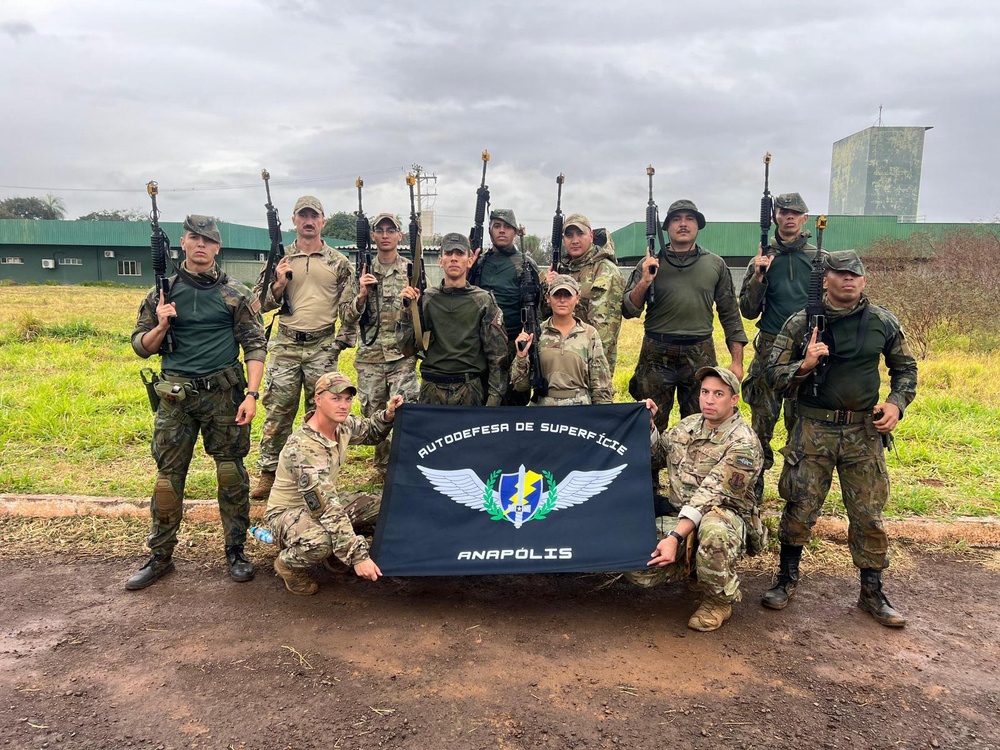
Photo By Capt. Cheran Campbell | New York Air National Guard Security Forces Airmen and Brazilian Air Base Defense...... read more read more
 Subscribe
CAMPO GRANDE AIR BASE, Brazil —Twenty five New York Air National Guard Security Forces Airmen traveled to Brazil for a joint training exercise from July 28 to August 11.
The exercise was designed to strengthen the State Partnership Program relationship between the New York National Guard and the Brazilian military, according to Major Salvatore DiGiacomo, commander of the 106th Security Forces Squadron.
The Airmen, including 20 from the 106th Security Forces Squadron based at F.S. Gabreski Air National Guard Base in Westhampton Beach and four from the 174th Security Forces Squadron in Syracuse, participated in Exercise TAPIO 2025 at Campo Grande Air Base in Brazil.
They integrated with their Brazilian Air Base Defense Security Forces counterparts to form a combined 43-member unit focused on air base defense and combat patrolling, DiGiacomo explained.
The exercise built upon years of previous engagements and was a direct result of invitations from Brazilian leadership for greater security forces involvement, according to DiGiacomo.
While the broader exercise involved search and rescue elements, the security forces’ primary role was to enable those missions, he said.
“For the Security Forces, we had two complementary tactical objectives,” DiGiacomo said.
“The first was to develop the capability to push out to remote airfields and set up hasty security perimeters to enable short duration forward arming and refueling in support of air operations,” he explained.
“The second revolved around combat patrols surrounding these airfields to expand our defensible zone and put more space between threats and our aircraft,” DiGiacomo added.
Immediately upon arrival, the American and Brazilian troops were integrated into mixed operational squads. According to DiGiacomo, the Airmen from New York were uniquely prepared for this integration.
“Our force of 106th Security Forces Airmen come from throughout Long Island and the five boroughs of New York City. Being from this melting pot means most of them already have experience working with people of different cultures and backgrounds,” he said.
“The energy, enthusiasm and professionalism of every single participant made this combined organizational structure successful,” DiGiacomo added.
The biggest obstacle the combined force faced was the language barrier, DiGiacomo explained. Only one of the 19 Brazilian troops spoke conversational English.
The mission’s success was heavily reliant on two Portuguese-speaking Airmen from the 106th, Airman Gabriela Dos Santos and Airman Raphael Tavares.
“Their linguistic skills proved invaluable in bridging the communication gap,” DiGiacomo said. “Without these two individuals or the single English-speaking ADS troop, establishing effective communication enough so to enable complex maneuvering would have been extremely difficult.”
Airman Tavares was honored to help during the exercise.
“I had the privilege of working with incredible individuals while reconnecting with my roots. I was born in Brazil. Serving as the interpreter for my unit and team during this mission was a profound and meaningful experience,” Tavares said.
Training included classroom instruction, drills in tactical movement, and a mission to clear a remote airstrip near the town of Nioaque. The highlight, however, was a culminating 24-hour field training exercise at the Bonito Regional Airport.
The combined force conducted a "hot infill," rapidly exiting a Brazilian C-105 transport aircraft to secure the airfield. For 24 hours, the team conducted day and night combat patrols, cleared the perimeter of simulated enemy fighters, and secured the location for potential Forward Area Refueling Point and Combat Search and Rescue operations.
“Throughout the operation, I was required to communicate and translate under high stress while maintaining situational awareness and weapons control, added Tavares. “The scenario was demanding but demonstrated our team’s training, discipline, and ability to operate effectively under pressure,” Tavares explained.
The training environment’s realism was a key success. The troops operated on a live airfield, interacting with local airport workers and facing the real-world language and cultural barriers they would encounter on a deployment. DiGiacomo said.
“The combined effect of a zero-simulation operating environment, collaboration with foreign air crews for mutual objective accomplishment and nimble air base defense operations allowed the force to sharpen their skills in a training scenario unmatched in its realism,” DiGiacomo said.
The exercise concluded with a “hot extract” from the airfield and a final exchange of unit patches, symbolizing the camaraderie and respect built between the two nations’ forces.
The 106th Rescue Wing, based at Francis S. Gabreski Air National Guard Base in Westhampton Beach, New York, operates and maintains the HC-130J Combat King II search and rescue aircraft and the HH-60W Jolly Green II rescue helicopter. The 106th Rescue Wing is home to a special warfare squadron with pararescuemen and combat rescue officers, specializing in rescue and recovery, and deploys for domestic and overseas operations.
| Date Taken: | 08.16.2025 |
| Date Posted: | 01.12.2026 14:43 |
| Story ID: | 556077 |
| Location: | BR |
| Web Views: | 248 |
| Downloads: | 0 |

This work, New York Air Guard Train with Brazil, by Capt. Cheran Campbell, identified by DVIDS, must comply with the restrictions shown on https://www.dvidshub.net/about/copyright.


No keywords found.




