
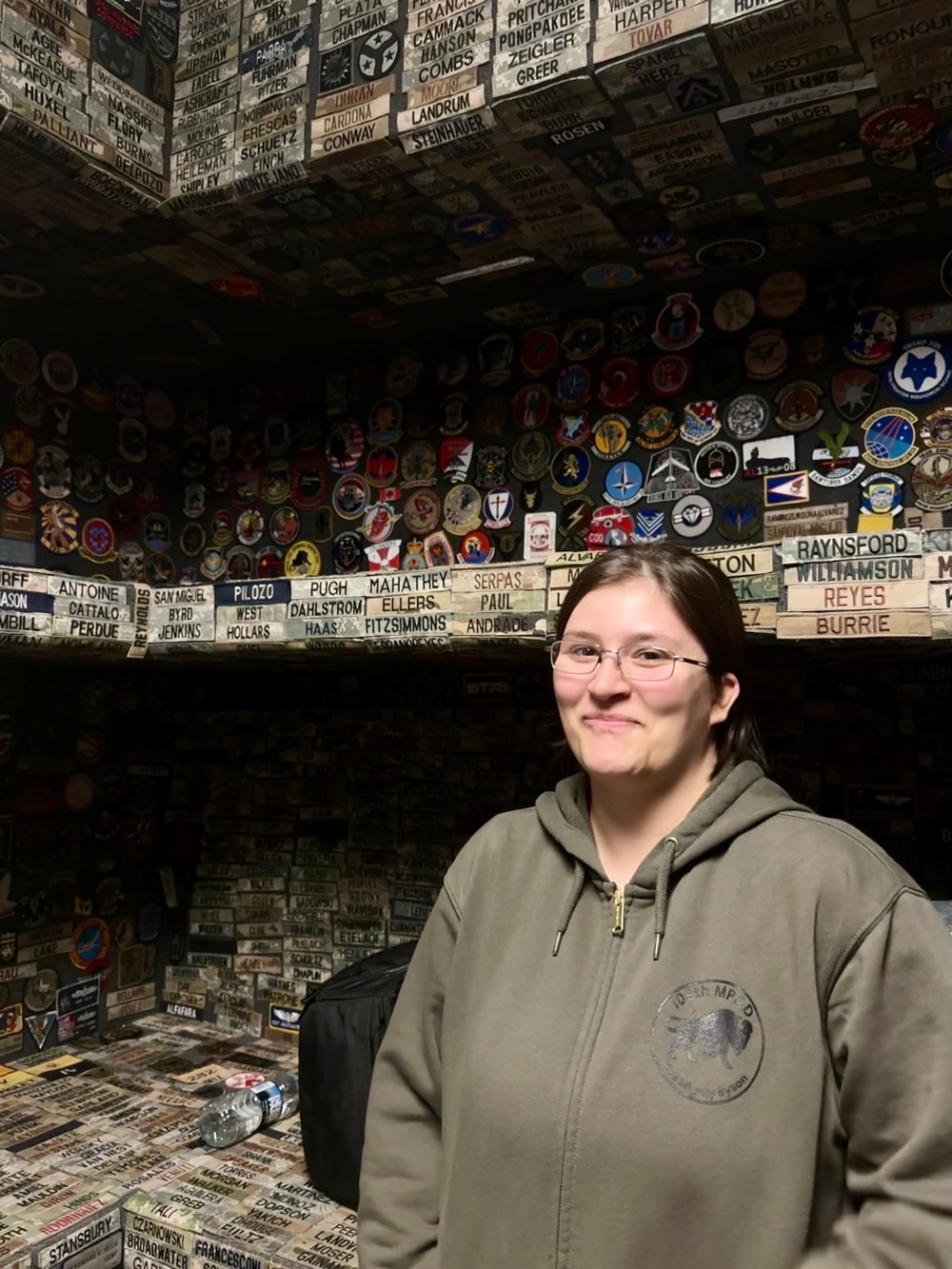
Photo By Staff Sgt. Melyssa Vazquez | U.S. Army Spc. Skylin Simpson, a public affairs specialist with the 109th Mobile...... read more read more
 Subscribe
FORT HOOD, Texas - To the uninitiated, they’re just small badges stuck onto uniforms and gear. In the military community patches are the fabric, pun intended, that bind every service member together.
From cramped cockpits in fighter jets to the special operations teams on the front lines, these patches are the physical manifestation of a connection that reaches across every border. This connection is reinforced by the social art of patch trading, an exchange that turns simple gear into a shared history.
The history of the patch is as strong as the service members who wear them. We can trace the lineage back to George Washington’s authorization of a precursor to the blood chits, notices sewn into uniforms to help stranded Soldiers find their way home, in 1793. In the 19th century, the British army used battle patches to help allies tell friend from foe. But the real soul of military patches was born during World War I near Wildcat Creek at Fort Jackson, South Carolina.
The 81st Infantry Division, Wildcats, created their own wildcat silhouette patch. While this eventually became an official unit insignia, it functioned as a morale patch first. It was born from the Soldiers' own desire for a representation that would boost their spirits and foster unity. Gen. John J. Pershing, commander of the American Expeditionary Force during World War I, saw the spark it created and encouraged it in every division. That was the moment the tradition split in two, the creation of official insignias for every unit and the creation of the morale patch for the person.
By the 1920s, patches became collectable. Today, these patches are everywhere.
It is important to distinguish between official unit insignia, the mandatory patch that shows who you report to, and the morale patch, which is often a customized, unofficial addition. Some service members have made patches with medical info, inspirational quotes or amusing symbolism. These create solidarity by establishing a visual ‘insider language’ that signals shared values at a glance.
By allowing Soldiers to show off unique personalities while still adhering to a collective tradition, these patches balance individuality with a deep sense of belonging. This bond is further cemented through the ritual of patch trading, a tradition among service members and civilians that turns a simple piece of fabric into a tool for building rapport, breaking down social barriers and forging lasting connections across different units and communities.
When I first came into the Army, I was nervous when talking to anyone, worried I'd say the wrong thing and get in trouble. Trading patches has helped boost my confidence. I think that everyone, especially those who aren't the most naturally confident people, could learn a lot if they took up this hobby. You learn how to carry a conversation with someone you just met and find things that you have in common. It would be wonderful if people tried to bridge that nervous communication gap more often. If everyone tried to learn a little more about their fellow Soldiers, I believe there would be less grinding gears in the military machine.
Patch trading is more than a hobby, it is a communication tool. Trading was a way for me to break out of my shell and shake off the nerves that come with being relatively new in the Army.
I started trading patches during my first overseas annual training with my unit in Germany. My readiness noncommissioned officer bought me a pack of our unit's patches and told me they were for trading.
Patch trading overseas is a different experience that presents unique opportunities. The main obstacle I ran into when trading patches overseas wasn't the language barrier, but the nerves tied with being out of the United States for the first time. I didn't want to talk to anyone I didn't already know, but once I took that first step, it became easier. Everyone I had spoken to were all so excited to trade patches and the stories tied to them. The shared enthusiasm was refreshing. It was a great way to learn about different cultures through the simple swap of Velcro-backed embroidery.
In the military, we are taught that communication is a mission-essential task. For a new Soldier, the gap between 'following orders' and 'building rapport' can feel immense. When I first entered the Army, I found myself navigating that quiet space where you want to contribute to the culture but aren't yet sure where you fit in. It wasn't a manual or a briefing that helped me bridge that gap, it was a stack of embroidered fabric.
What started as a simple trade for a piece of gear became my introduction to a centuries-old language of connection.
Today, my collection of over 100 patches serves as a visual record of my professional growth. What began as a simple exchange of fabric has evolved into a class in communication. I’ve learned that being a good listener and having the initiative to approach someone are as vital as any technical skill.
Whether it’s a formal unit insignia or a lighthearted morale patch, these symbols are more than just gear, they are a way to build rapport and strengthen the military community. For any service member looking to bridge the gap between the military and people, I encourage you to start your own collection and see for yourself. You may find that a simple trade is the best way to turn a random encounter into a lasting connection.
| Date Taken: | 12.30.2025 |
| Date Posted: | 01.02.2026 12:48 |
| Story ID: | 555468 |
| Location: | FORT CAVAZOS, TEXAS, US |
| Web Views: | 244 |
| Downloads: | 0 |

This work, Patch trading: The history and importance, by SPC Skylin Simpson, identified by DVIDS, must comply with the restrictions shown on https://www.dvidshub.net/about/copyright.


People
Tradition




