From riverbed to supply chain: how accurate surveys benefit commerce and consumers
Photo By Stacey Reese |
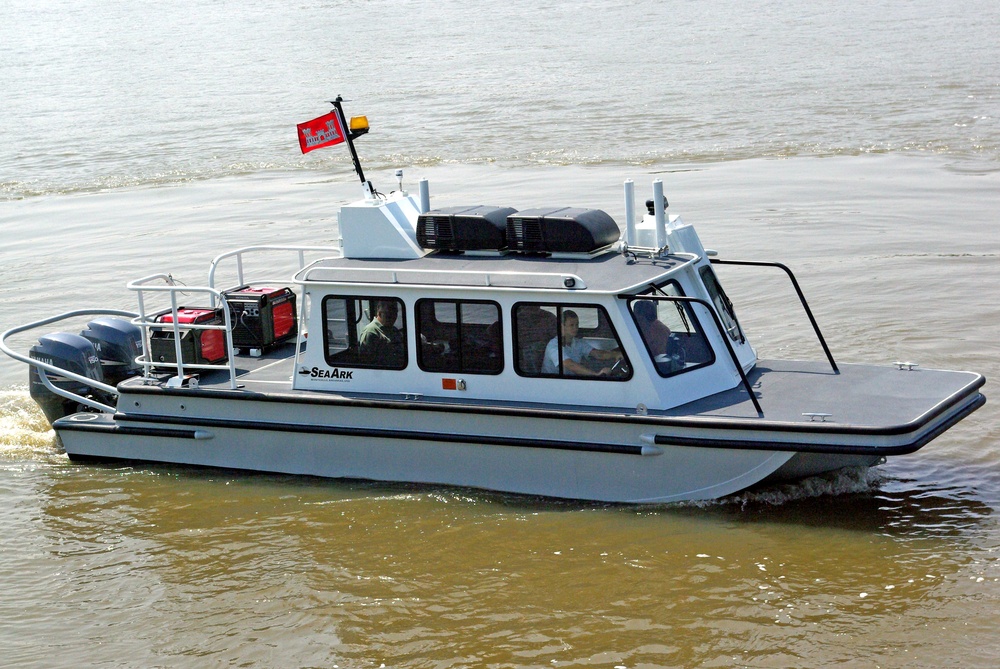
This 23-foot vessel, used by the Tulsa District Navigation Office's survey crew, is......read moreread more
Photo By Stacey Reese | This 23-foot vessel, used by the Tulsa District Navigation Office's survey crew, is equipped with advanced technology used to ensure accurate hydrographic data collection used to maintain the safe navigation of the McClellan-Kerr Arkansas River Navigation System (U.S. Army Corps of Engineers archive photo) see less
| View Image Page
From riverbed to supply chain: how accurate surveys benefit commerce and consumers
SALLISAW, Okla. – Navigation is a key mission for the U.S. Army Corps of Engineers, Tulsa District. Below the surface of the McClellan-Kerr Arkansas River Navigation System, conditions constantly change. As water levels rise and fall, sediment shifts, and unseen hazards can quickly turn a safe passage down the river into a more dangerous journey.
Within the Tulsa District, the Navigation Office leads the mission to keep the river channel safe and open for commerce. Its two-person hydrographic survey team, comprised of Dawn Birth, civil engineer, Tulsa District, and Joe Schmalz, civil engineering technician, Tulsa District, performs work critical to maintaining the channel’s 9-foot depth, as mandated by Congress. Their data is a key component of a coordinated effort with partners like the U.S. Army Corps of Engineers, Little Rock District, the U.S. Coast Guard and the Oklahoma State Department of Transportation that enables the shipping and towing industry to move commerce safely and efficiently along the river system.
“The river is always changing,” said Schmalz. “Every day brings something different; maintaining a safe and reliable navigation system is work that really matters.”
Training, skills and technology
The Navigation Office operates one survey vessel dedicated to hydrographic surveying. The 23-foot vessel runs on twin outboard motors and is equipped with generators to support the onboard equipment needed to conduct hydrographic data collection.
A multibeam echosounder system collects millions of high-resolution data points and helps the duo identify hazards on the riverbed.
How the work happens
While there is no fixed schedule, on average, the team conducts about two surveys per week. They are ready to respond quickly whenever a channel hazard is reported. Surveys address incidents such as vessels running aground, identifying hazards, and assessing lock and dam conditions before scheduled maintenance.
Additionally, the surveyors check known trouble spots prone to sediment buildup immediately following a high-water event.
The survey process starts with careful planning. Before heading out, the crew identifies areas of interest, checks weather, river flows, and lockage availability and prepares survey lines or dredge templates to specifically address planned work. They also inspect the vessel to ensure mechanical, radio and communications systems are operational.
Once on the water, they collect data using the multibeam system, which they continuously monitor to verify accurate readings. They import raw data for processing, clean and edit it and then save it in the required file formats before beginning analysis.
“We use multiple software programs to collect, process and edit the data,” said Schmalz. “A survey is more than just measuring depth. It also involves the collection of data that can be used to create a detailed 3D map of the riverbed.”
Using their survey software, the team collects millions of depth points. This data is integrated with precise GPS coordinates, which pinpoint the location of every measurement on the map. The crew can also use the data to understand the riverbed’s makeup, such as distinguishing between shoaling and hard debris.
“Analyzing the data tells us whether there is soft sediment, a submerged log or a rock,” said Schmalz.
There are multiple methods for verifying data accuracy. Survey software provides real-time accuracy values. If data quality falls below an established threshold, alarms or visual displays alert them, allowing adjustments during data collection to ensure reliable, precise results.
Birth and Schmalz can perform calibration tests, such as a patch test, to assess the sonar’s position in the water. This test requires collecting three separate datasets over specific terrain on the lake or river bottom, using data to ensure the multibeam system values are accurate.
Through data analysis, they can identify hazards, areas requiring dredging, buoy placement issues and channel alignment concerns using hydrographic survey drawings that show features and objects in the surveyed area. They can store the data for future reference and comparison.
The team primarily uses collected data to determine water depths, a critical factor in maintaining the navigation channel’s required minimum depth. While they also document obstructions such as logs and debris, sediment buildup is the most common concern as it can significantly impact navigation safety and channel maintenance operations.
“Without regular, accurate surveys, minor shoaling can become severe enough to restrict traffic,” said Rodney Beard, Tulsa District Chief of Navigation.
The team compiles extracted data into a final survey report that includes maps, charts and other relevant findings. They can distribute these reports to managers, the Coast Guard, dredging crews and other personnel as needed.
Conditions and real-world challenges
Weather conditions play an important role in obtaining accurate survey data. Wind and river flow can push the vessel off its planned path, making it difficult for the crew to remain within the defined survey area. This can lead to gaps or incomplete data coverage and may require follow-up surveys to meet requirements.
While high water levels are generally not ideal for collecting due to increased river flow, they can sometimes reduce overall survey time. The added depth allows for wider beam swath coverage, meaning the team can capture more data with each pass. It also enables them to safely survey over features that would normally be too close to the surface, an option that isn’t possible at normal water levels.
To understand the unique challenges the crew encounters, it is important to know how the Tulsa District lakes were formed and what lies beneath them. Unlike some lakes, the ones within the Tulsa District are man-made reservoirs. They were created by constructing dams across rivers, a process slowly flooded the area surrounding the river valleys. Beneath the lakes is a hidden landscape that was once dry land, forests, fields and creek beds.
“As a result of the way the lakes were formed,” said Schmalz, “the lakebed can be littered with tree stumps, old foundations and rocks which can be hazardous for vessels when water levels fall.”
How accurate surveys benefit everyone
Survey work is essential to keeping shipping costs low on the MKARNS. Because shipping companies depend on reliable schedules, accurate data helps ensure channel conditions are up to date and dependable. This data allows vessels to safely navigate the system’s channel and the approaches to lock chambers, keeping traffic flows running smoothly while reducing waiting times and fuel consumption.
“Without regular, accurate surveying, minor shoaling could become severe enough to restrict traffic,” said Beard. “Their work allows them to address issues earlier, which can result in reduced costs, reduced need for emergency dredging and fewer prolonged channel closures.”
Lower shipping costs not only benefit companies using the navigation system but also affect consumers. Efficient shipping reduces costs across the supply chain. Keeping the navigation channel open prevents disruptions that could drive up prices on everyday goods. Reliable shipping helps stabilize the costs of bulk goods such as grain, fertilizer, fuel and construction materials. The costs of these items can directly impact food prices, energy costs and infrastructure expenses.
“Reliable navigation helps keep the costs of everyday goods down for the consumer,” said Beard.
The Tulsa District and Little Rock District work together to manage the MKARNS. Tulsa District oversees the Oklahoma portion of the system and Little Rock manages the Arkansas section, to ensure safe, reliable and efficient navigation from the Port of Catoosa to the Mississippi River. In 2024, more than 12 million tons of cargo was moved via the system.
Coordination is especially important for water management. Releases from multiple reservoirs in Oklahoma flow downstream into Arkansas, where they can directly impact water levels, towboat traffic and lock operations.
By staying in constant communication, both districts balance hydropower, flood risk mitigation, recreation and navigation needs to keep the system running smoothly.
From lock operations to water-release planning, Tulsa and Little Rock work hand in hand to support a safe, dependable and economically vital navigation corridor.
Flood damages prevented by the Arkansas River Basin system managed by the Tulsa District totaled an estimated $34.4 billion through the end of fiscal year 2024, with $6.5 billion of that prevented in fiscal year 2019 alone.
There are two hydropower plants on the MKARNS in Oklahoma with a total of seven power-generating units, benefiting approximately 700,000 end users. A portion of the revenues is applied to operations, maintenance and construction costs and the rest is deposited into the U.S. Treasury. The MKARNS contributes to 22,000 full- and part-time jobs.