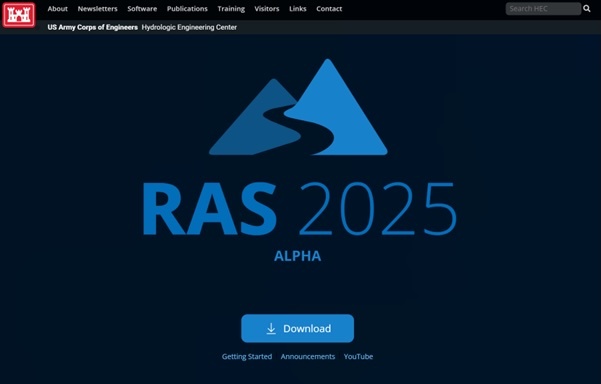
Photo By Kathryne Gest | Image of the new HEC-RAS 2025 Alpha version website. https://www.hec.usace.army.mil/software/hec-ras/2025/ see less
| View Image Page
New Software Signals Shift in the Future of Hydraulic Modeling
By Hunter Merritt
A little over a year ago, the U.S. Army Corps of Engineers’ Hydrologic Engineering Center (HEC) quietly launched new software that provides a whole new way of visualizing river analysis.
This new software is called River Analysis System (RAS) 2025, and it replaces existing water modeling software known as HEC-RAS. RAS 2025, currently released in Alpha version, is faster at processing, better at meshing, and more compatible with various data sets, according to lead developer Alex Kennedy. “We’re really reexamining a lot of the pain points that have happened in past versions as we are rebuilding the software,” he said.
In the year since the 2025 Alpha version was released, the HEC-RAS team has invested heavily in collaboration between modelers, engineers, and computer scientists to reach a broader audience of users with geospatial frames of reference. “A lot of the foundations of the future have been putting time and energy into the bones of what we think that the next twenty years of software development is really going to need for a GIS-aware model,” said Kennedy.
HEC, a leader in water resources modeling since the advent of computer models, first introduced HEC-RAS in 1993 – the same year as Intel’s Pentium processor, the release of Microsoft Windows NT, and the debut of Wired Magazine. Since that time, the center has steadfastly updated the software to incorporate advancing technologies such as two-dimensional modeling and geospatial computation.
The software is used for floodplain mapping and flood studies, floodway analysis, water infrastructure design, and analysis for dam breach, flood routing, sediment, and water quality. The latest iteration, HEC-RAS 6.6, is the final version to be maintained before the complete shift of focus to RAS 2025.
“Technology has drastically changed in the last 30 years,” said Kristy Riley, HEC’s Hydraulics Division Chief. “We have reached a time where we need to move on to meet the needs of today and the future, we need to invest in a new software, which is RAS 2025.”
Hydraulic engineers in USACE district offices are the primary users of this technology, and they have responded enthusiastically to the release of RAS 2025. At the first in-person RAS 2025 training, which was held in December 2025 in Davis, CA, hydraulic engineer Stefany Baron from Savannah District remarked on the transition from HEC-RAS to RAS 2025 and compared it to the paradigm shift from flip phones to smart phones. “Pretty soon, we will all wonder how we ever worked without RAS 2025,” says Baron.
“RAS 2025 has changed the way I build river models,” said Jake Allgeier of the Louisville District, another member of the inaugural training. He appreciated the improvements, applauding the saving of users’ time and energy. “Things that used to take hours and were very tedious are now fast and intuitive. I can focus on how the water behaves rather than fighting to get the model to do what I want. This is a really exciting development in the hydraulic modeling field," said Allgeier.
USACE engineers and modelers aren’t the only users who are excited about this new way of evaluating river hydraulics. The software is available for public use, just as HEC-RAS has been for decades.
Dr. David Maidment from University of Texas at Austin is an authority on Geospatial Information Systems (GIS) as applied in hydrologic processes, and he has taught GIS as applied to water resources to emerging professionals for more than 20 years. When teaching GIS and modeling to new users, he finds that frustration can lead to poor results, so there is little margin for error in the software.
“It’s got to be bulletproof,” said Maidment, who was elected to the National Academy of Science in Engineering for his contributions to the discipline. He complimented the existing HEC-RAS as the dominant model for dynamic river hydraulics simulation, and he shared great enthusiasm for RAS 2025 as a more intuitive, geospatially focused software, as well as his appreciation for HEC. “It is easy to rest on laurels when you’re the market leader, but they haven’t done that, and this new software is going to make it more accessible and transparent for users.”
The RAS 2025 developers wanted to advance this emerging software to meet current demands, so an Alpha version was made public for transparency, in order to invite users to find bugs and collaborate with the team to fix issues and make improvements in real time. This is where HEC-RAS team members and the users themselves can collaboratively shape the 21st century modeling software to meet current and future needs.
Two-way communication is a hallmark of the software, as both user feedback to the team and updates can be pushed through the software platform itself, in an agile, swift manner.
Rapid model development is critical, especially when forecasting potential flood impacts, and RAS 2025 proves to be nimble in responding to user needs and existing data. It allows users to import a variety of existing terrain data layers and critical information from various sources including meteorological data from National Weather Service (NWS), channel bathymetry from National Aeronautics and Space Administration (NASA), and terrain data from US Geologic Survey (USGS). More improvements are anticipated in 2026, such as advanced terrain modifications, advanced structures, mesh enhancements, and improved boundary conditions with rating curves and multi-variate conditions.
Stanford Gibson, USACE sediment expert and a member of the HEC-RAS team, summed up one of the main improvements from his perspective. “We start with a conceptual mesh, and the whole idea is the conceptual mesh is repeatable and transferrable…no more moving little nodes and opening a project, years later and not being able to reproduce it.” Gibson also sees immediate utility of RAS 2025 in his own area of engineering expertise – sediment modeling – as he can build models in the Alpha version and then return to work with more layers in HEC-RAS 6.6.
The team is supporting both HEC-RAS 6.6 and RAS 2025, but the team is emphasizing the imminent shift to the new software. “We have a long road ahead of us, this is thirty years of software we are rewriting, so please be patient with us,” said Riley. “It’s going to take some time before we reach parity.”
The RAS 2025 software is publicly available for download, and instructional videos on how to use the modeling software are released regularly – the software, videos, and a roadmap for the expected future development of this emerging technology are all available on the HEC website: https://hec.usace.army.mil/software/hec-ras/2025/.

 Subscribe






