
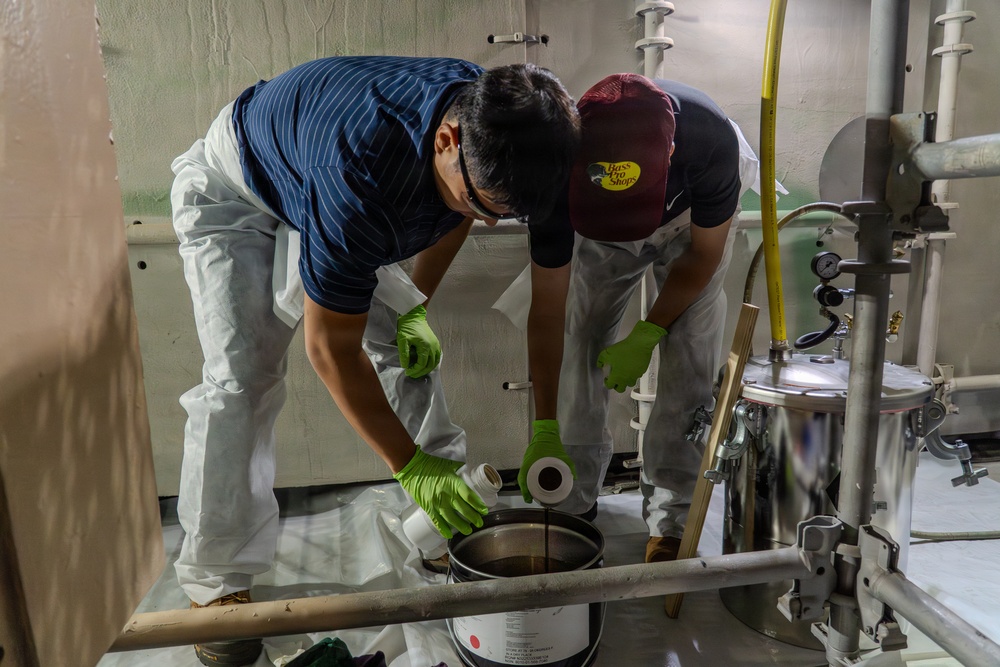
Photo By Kenny Jones | Kody Miyamoto and King Joash (KJ) Rumbaoa, University of Hawaii Manoa students,...... read more read more
PEARL HARBOR, Hawaii – It's 6 a.m., and while most of the island is still waking up, Kody Miyamoto and KJ Rumbaoa are already at work in a tight, cramped training area deep within the confines of Pearl Harbor Naval Shipyard and Intermediate Maintenance Facility.
Under the watchful eye of Larin Masuoka, Preservation and Coatings (C970) Community of Practice (CoP) Lead & Mentor at PHNSY & IMF, they mix and pour a two-part Versathane resin into molds to create custom pieces designed to improve a recurring maintenance procedure.
Miyamoto and Rumbaoa are not shipyard employees but full-time engineering students at the University of Hawaiʻi at Mānoa enrolled in the Cooperative Education Program (co-op), an elective that offers an early look at where their studies can lead.
As the sun rises over Pearl Harbor, Miyamoto and Rumbaoa continue their work before heading off to their other classes. Mornings like this begin to blur the line between student and professional engineers.
The University of Hawaiʻi–PHNSY & IMF Cooperative Education Program is an Educational Partnership Agreement between the university and the shipyard, established in 2018.
The EPA outlines the responsibilities of both the university, which provides academic instruction, and the shipyard, which offers internship opportunities and mentorship. Offered every semester, the program provides students with invaluable hands-on experience in a naval engineering environment.
Marvin Young, a University of Hawaiʻi mechanical engineering professor, said the program provides graduates with a significant head start.
“By the time they graduate, they already understand the shipyard's culture and expectations — that's a huge advantage,” Young said.
That advantage comes from deep immersion in the shipyard environment. Students who participate in the semester-long program split their time between their other classes and hands-on work at the shipyard. For Miyamoto and Rumbaoa, this meant spending eight to 10 hours a week at the yard, all while juggling their studies.
This semester, Miyamoto and Rumbaoa dedicated their time to addressing a recurring engineering challenge: improving the application of specialized materials to ship hulls. These materials are crucial for a vessel's survivability but can degrade under harsh sea conditions. The students focused their project on developing a more resilient solution. They created and tested a new application process using Versathane to engineer a stronger, more durable bond, ensuring that vital systems are protected and that the ship remains mission ready.
The project culminates in a formal presentation on their solution, offering students a valuable opportunity to showcase their work to shipyard leadership. This experience not only hones their public speaking and presentation skills but also provides direct feedback from seasoned professionals in the field. For many students, this presentation is more than just a final project; it's a direct bridge to their future careers.
For Kris Ignacio, the co-op program didn’t just offer experience; it shaped his entire career outlook. Now working in the shipyard's steering and diving hydraulics division, Ignacio credits the program with giving him a competitive edge.
"The co-op was an amazing way to get my foot in the door, which definitely set me apart from my peers," he said. “I’ve gained very meaningful PHNSY connections with the people I have met, and I am very thankful to have had the opportunity to meet and learn from each of them.”
For the shipyard, the program is a direct investment in its future workforce. This investment translates into significant benefits, including reduced training costs and faster onboarding for new hires who are already familiar with the environment.
“Because they have already spent a semester or two here, they know what to expect. There's less of an adjustment period when they start full-time,” Young said.
Since its inception in 2018, the program has had 98 interns participate, of whom the shipyard hired 36. Participation requires enrollment in the UH Mānoa engineering program, good academic standing, and the ability to obtain a security clearance.
“We've had semesters with 35 applicants, but only about seven to nine are accepted; it's very selective,” Young said.
This competitive nature and selectivity underscore the value of the program, in which even highly qualified students may not be accepted, as the number of student opportunities is directly tied to the yard's real-world needs and ongoing projects.
According to Tinamarie Cura, lead for the shipyard's side of the program, students like Miyamoto and Rumbaoa represent a growing generation of engineers shaped by the UH-PHNSY partnership. For students, she explains, the program offers a clear path to a meaningful engineering career. At the same time, the shipyard builds the mission-ready workforce needed to keep the Navy's fleet operating across the Pacific.
"You can see their confidence grow each week," Cura said. "By the time they graduate, they are not just observers, they’re ready to contribute."
PHNSY & IMF’s mission is to keep the Navy’s fleet “Fit to Fight” by repairing, maintaining, and modernizing the Navy's fast-attack submarines and surface ships. Strategically located in the heart of the Pacific, it is the most comprehensive fleet repair and maintenance facility between the U.S. West Coast and the Far East.
| Date Taken: | 12.18.2025 |
| Date Posted: | 12.18.2025 14:14 |
| Story ID: | 554803 |
| Location: | PEARL HARBOR, HAWAII, US |
| Web Views: | 431 |
| Downloads: | 0 |

This work, Engineering the Future - University of Hawai'i students find real-world experience at Pearl Harbor Naval Shipyard, by Kenny Jones, identified by DVIDS, must comply with the restrictions shown on https://www.dvidshub.net/about/copyright.


No keywords found.





