
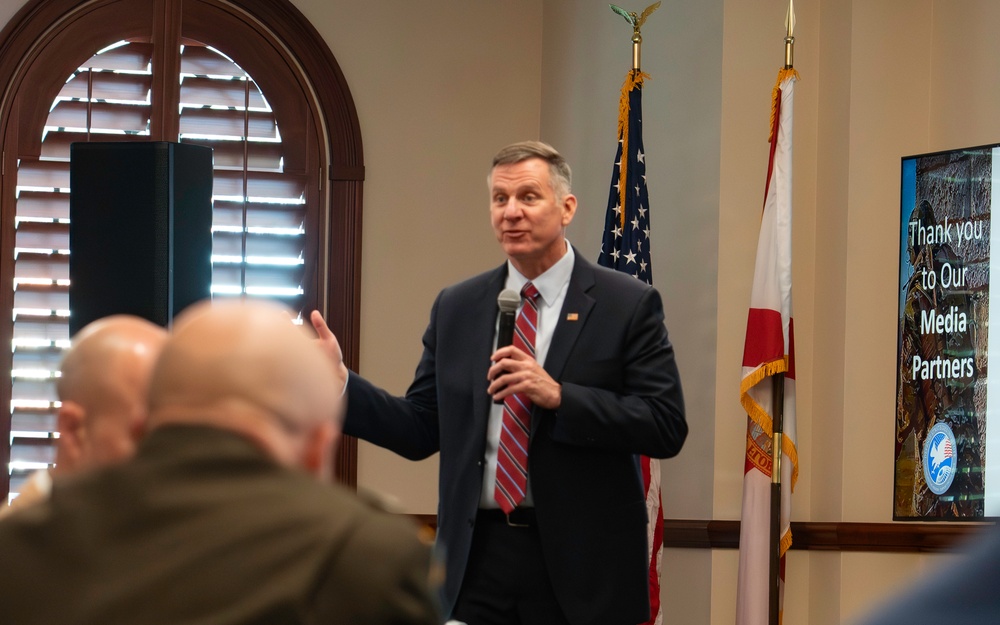
Photo By Capt. Avery Smith | Lt. Gen. (Ret.) Mark Schwartz, former deputy commander of U.S. Joint Special...... read more read more
TAMPA, Fla. — Modern competition rarely begins with open conflict. Instead, it unfolds in the gray zone, the space between peace and war, where influence, access and perception shape outcomes long before force is employed. That reality framed discussions at the 2025 SOF & Irregular Warfare Symposium, December 10 and 11, 2025, at the Chester H. Ferguson Law Center in Tampa Florida, where military leaders, senior defense officials and academic experts examined how the United States is adapting to strategic competition short of armed conflict.
The 14th annual, two-day symposium brought together Department of War professionals, interagency partners, academia and industry to explore the evolving character of irregular warfare. This year’s event was centered on how modern adversaries pursue objectives across what the Department of War describes as the competition continuum, spanning cooperation, competition and armed conflict rather than a simple peace-or-war binary.
On the first day of the symposium, a briefer described the gray zone as the space between peace and war where actors deliberately operate below the threshold of armed conflict. In that space, she explained, adversaries rely on political warfare, information operations, economic pressure and coercive influence to advance national objectives while avoiding a conventional military response.
That framing mirrors Department of War guidance, which depicts competition as a continuous condition that persists before, during and after armed conflict. Rather than episodic crises, competition is ongoing, requiring sustained campaigning and integration across military, diplomatic, economic and informational instruments of national power.
That context set the stage for the second day’s joint session on the role of information in irregular warfare, featuring Col. Sean Heidgerken, commander of the newly activated 1st Theater Information Advantage Detachment, and Dr. Golfo Alexopoulos, professor and director of the University of South Florida’s Institute for Russian, European and Eurasian Studies.
Heidgerken described the 1st TIAD, activated earlier last month in Hawaii, as a formation designed specifically for that competitive space. “This is the Army’s first attempt at creating an organization whose primary purpose is maneuvering the information space,” Heidgerken said.
Rather than preparing for a single decisive battle, the detachment is designed to operate persistently across the competition continuum, supporting U.S. Army Pacific, U.S. Indo-Pacific Command and foreign allies and partners. “My assigned mission, essentially, is to go in in competition to gain and maintain access and basing for land component forces, and potentially for the other joint forces throughout the theater,” Heidgerken said.
He noted that the unit’s early efforts are focused on Oceania, a region increasingly central to strategic competition. “There’s a lot of Chinese activity happening in there, and we’re looking to shore that up,” he said.
Unlike traditional combat formations that seize and hold terrain, the 1st TIAD focuses on shaping conditions, reinforcing partnerships, supporting access agreements and countering malign influence before a crisis escalates. "In the gray zone," Heidgerken said, "success is often measured by continuity, continued access, sustained cooperation and the absence of escalation."
The detachment’s design reflects lessons drawn from years of irregular warfare and special operations experience. “We are borrowing from lessons learned in the SOF community,” Heidgerken said, referencing earlier information warfare task forces that integrated multiple disciplines to address complex human and informational challenges.
A recurring theme in his remarks was the centrality of the human dimension across all phases of competition. “The will is contained in the human,” Heidgerken said, invoking classical military theory to underscore that adversaries and partners are driven by people, not platforms. He cautioned against focusing solely on technology while overlooking the human decisions that determine strategic outcomes.
That focus aligns with irregular warfare doctrine, which emphasizes influence, legitimacy and resilience as decisive factors. Across the competition continuum, shaping perceptions and decision-making can be just as consequential as battlefield effects, particularly when adversaries deliberately operate below the threshold of armed conflict.
Alexopoulos provided historical and contemporary context for how authoritarian states exploit that space. Drawing on her research into Russian influence operations, she described modern campaigns as an extension of Soviet-era “active measures,” driven as much by domestic regime preservation as by foreign policy aims. “Their number one objective is preservation,” Alexopoulos said. “They want to stay in power.”
She explained that these operations depend on networks of allies and sympathetic voices to amplify narratives, blurring the line between state-directed messaging and ideological alignment. Alexopoulos said democratic systems retain key advantages in the competition continuum through transparency, independent institutions and the ability to self-correct, strengths authoritarian systems often lack.
Returning to the military implications, Heidgerken stressed that information competition is not confined to special operations forces or non-kinetic activities. “It is not a SOF-specific thing,” he said, adding that irregular warfare and information maneuver must be integrated with conventional forces and broader national efforts across all phases of competition.
He also addressed the challenge of measuring success in the gray zone, where deterrence and competition are often defined by what does not happen. “You measure deterrence by the lack of action,” Heidgerken said, acknowledging that this can be uncomfortable for organizations accustomed to visible results. Within the competition continuum, preventing escalation is often the clearest indicator of success.
The 1st TIAD, Heidgerken said, exists to help ensure that access, partnerships and stability are preserved across the Indo-Pacific, not just during crises, but continuously. By supporting U.S. forces and allies in the information environment, the detachment contributes directly to irregular warfare objectives aimed at shaping competition and preventing conflict.
As the symposium highlighted, modern conflict is no longer confined to declared wars. It unfolds across a continuum where competition is constant, thresholds are blurred and influence is decisive. In that space between peace and war, formations like the 1st Theater Information Advantage Detachment reflect how the Army is adapting to compete deliberately, persistently and at scale.
| Date Taken: | 12.15.2025 |
| Date Posted: | 12.18.2025 06:02 |
| Story ID: | 554290 |
| Location: | TAMPA, FLORIDA, US |
| Web Views: | 468 |
| Downloads: | 4 |

This work, 1st TIAD Takes on Gray Zone Warfare at SOF and Irregular Warfare Symposium, by CPT Avery Smith, identified by DVIDS, must comply with the restrictions shown on https://www.dvidshub.net/about/copyright.


No keywords found.





