Autonomous barge kits improve logistical capabilities for joint forces
Photo By Jared Eastman |
The U.S. Army Engineer Research and Development Center mounted the Scalable Autonomous......read moreread more
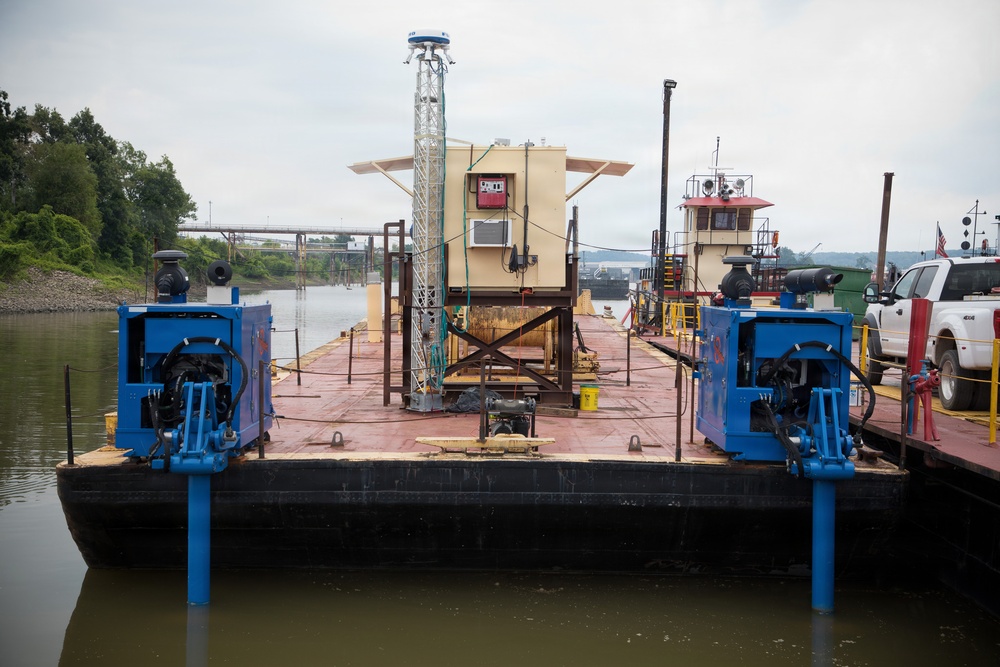
Photo By Jared Eastman | The U.S. Army Engineer Research and Development Center mounted the Scalable Autonomous Modular Propulsion kits for coastal and riverine Operational Logistics, or SAMPOL, to a WWII barge provided by the U.S. Army Corps of Engineers Vicksburg District to demonstrate the kits installation and capabilities, Aug. 28, 2025.
The SAMPOL platform, is an autonomous, or self-driving, system designed to be mounted on a barge to allow the vessel to operate virtually unaided while assisting with military logistics and wet gap crossings. (U.S. Army Corps of Engineers photo by Jared Eastman) see less
| View Image Page
Autonomous barge kits improve logistical capabilities for joint forces
VICKSBURG, Miss. - The U.S. Army Engineer Research and Development Center (ERDC) has partnered with the U.S. Transportation Command to develop Scalable Autonomous Modular Propulsion kits for coastal and riverine Operational Logistics, or SAMPOL.
Historically, U.S. Forces are vulnerable in contested environments due to reliance on easily targeted assets such as large ships, fixed bases and uncertain support from partners for logistics. As such, they lack the robust, adaptable riverine and inland platforms needed to reliably supply dispersed forces when access is denied or limited. This gap requires a modernized, resilient logistics approach that reduces dependence on vulnerable systems.
“Autonomy is a joint issue with the Army, Navy and Marines,” said Thad Pratt, military technical director for coastal and hydraulics engineering at ERDC’s Coastal and Hydraulics Laboratory (CHL). “It's a watercraft issue, and we are figuring out how to plan, practice and improve autonomy systems that are becoming a part of today’s operational landscape.”
For over a decade, ERDC has been at the forefront of autonomous vessel simulation and development. The coastal and hydraulics team has developed uncrewed surface vessels for civil works programs such as the U.S. Army Corps of Engineers Maritime Autonomous Survey System — a full-size survey vessel that can collect and transmit survey data — and has been able to translate these skills into military engineering applications.
“The Joint force is looking for a kit that could be shipped in a single container and added to a floating platform already in theater,” said Pratt.
SAMPOL transforms standard barges into self-propelled, autonomous platforms capable of delivering fuel and supplies across challenging terrain to troops, aircraft and other assets. Working with industry partners, ERDC integrated propulsion technology from Thrust Master of Texas and autonomy by Sea Machines to build kits that provide modular autonomous self-propulsion capabilities, enabling the delivery and storage of supplies throughout the theater.
Leveraging the inherent resilience of barges that are independent of vulnerable infrastructure like bridges and roads while offering substantial cargo capacity, SAMPOL enhances logistical flexibility and eases congestion on main supply routes when integrated into theatre-wide planning. SAMPOL’s shallow-draft design can operate in as little as 32 inches of water while carrying up to 1500 tons, creating a versatile riverine transport solution expediting tactical military river crossings, and can be retrofitted onto existing local barges for rapid port repair.
This versatility was shown during a demonstration of SAMPOL earlier this year as the vessel autonomously operated in complex port and riverine networks along the Mississippi River.
“This has been a collaborative effort that included our U.S. Army Corps of Engineers partners at the Mississippi Valley Division and the Vicksburg District, the U.S. Coast Guard, industry and academia,” said Dr. Ty Wamsley, Director of CHL. “Bringing all these folks together with the additional expertise and access to resources is important from a strategic sense, not just for our military mission, but for our civil works mission as well. Vicksburg is a unique location for this type of work. We’ve got the Mississippi River, the Yazoo River and the Big Black River in our back yard, giving us several inland riverine systems of various sizes that we can leverage.”
Future continued development of the SAMPOL systems will be paired with AI and simulations that will be able to accurately evaluate autonomy algorithms. By evaluating autonomy through simulation, ERDC can save time and costs while ensuring the warfighter gets the most reliable autonomous systems for operations in hazardous watercraft missions. This effort will ultimately be a force multiplier for future forces by offering autonomy in complex regions that typically would require human in the loop operation.
“You don't realize how much your eyes and your ears process when navigating a boat,” said Pratt. “Recognizing a wake and realizing there's a submerged pile, or some submerged pinnacle or something underwater causing that wake and deciding which way to turn or where to go takes training. Training an AI algorithm is not trivial, and capturing good data so you can train it, is the trick. That's what the software allows us to do through introducing those conditions in the simulator and testing how the AI responds to those observations from the sensor array.”
The SAMPOL system offers multiple benefits for military operations, including reduced transportation costs, minimized personnel and equipment risk, significantly improved processing capabilities and stronger protection for the supply chain. ERDC is also exploring how this technology could be leveraged to support civil works projects across the nation’s waterways.
“Turning a WWII era barge into a scalable, autonomous watercraft is truly remarkable,” said Rear Adm. Chris Stone, Director of Strategic Plans, Policy, Logistics, and Warfighting Development, USTRANSCOM. “This collaborative research not only strengthens logistical flexibility but also paves the way for a new era of efficiency and resilience in support of our joint forces.”

 Subscribe






