Nature-Based Mitigation Banking: Beaver Dams at New Melleray Abbey Support Environmental Goals
Photo By Jordan Raiff |
USACE Rock Island District’s Regulatory Division Western Branch Chief Abby Steele......read moreread more
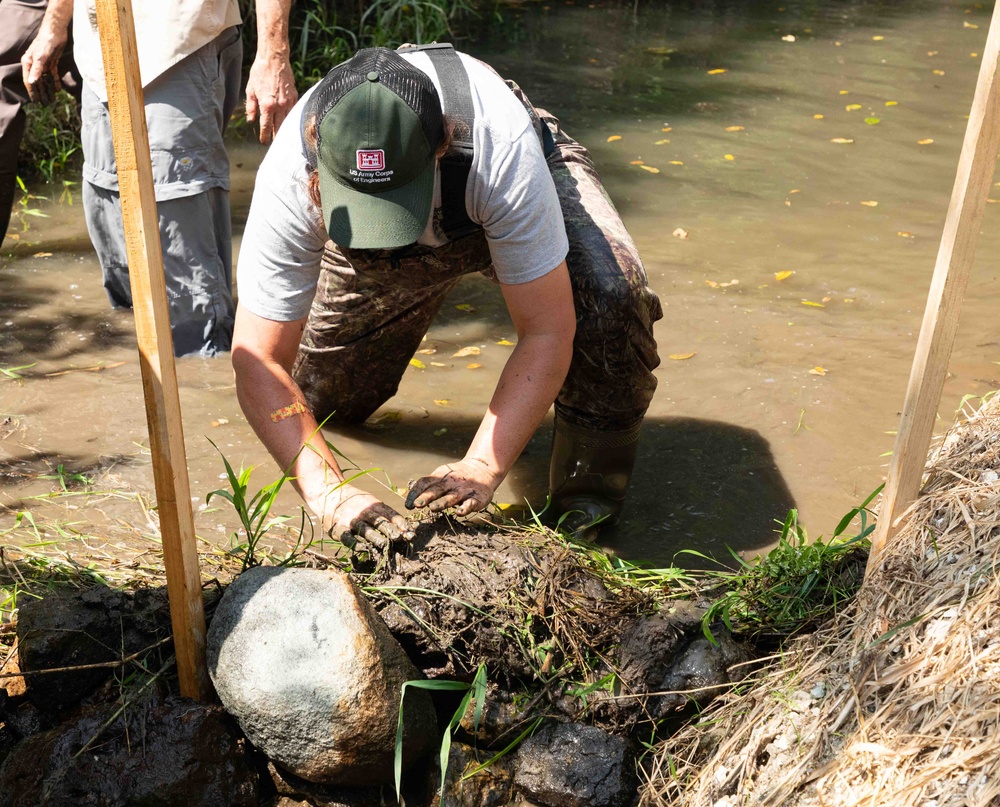
Photo By Jordan Raiff | USACE Rock Island District’s Regulatory Division Western Branch Chief Abby Steele packs a mixture of dense mud and weeds into a man-made structure known as a beaver dam analog. see less
| View Image Page
Nature-Based Mitigation Banking: Beaver Dams at New Melleray Abbey Support Environmental Goals
In a unique collaboration, the U.S. Army Corps of Engineers and New Melleray Abbey have partnered with nature’s engineer, the beaver, to establish a mitigation bank aimed at restoring ecosystems and enhancing water quality. This innovative project harnesses the beaver’s natural ability to shape landscapes, supporting healthy wetlands, improving water quality, and boosting biodiversity. Located just outside Dubuque, Iowa, in the small town of Peosta, New Melleray Abbey is home to a small congregation of Trappist monks who specialize in crafting caskets from wood sourced from their surrounding forests, reinforcing their deep connection to nature.
John Schroeder, the Abbey’s forester, submitted a proposed beaver dam permit application to the Rock Island District’s Regulatory office, which piqued the interest of Abby Steele, the Regulatory Division’s Western Branch Chief.
“I was taking a course at Utah State University on ‘Low-Tech Process-Based Restoration (LTPBR),’ which aligned perfectly with what the Abbey was proposing,” said Steele.
“LTPBR is an innovative, low-cost stream restoration method being implemented in the western U.S. that utilizes beavers. The concept involves installing Beaver Dam Analogs (BDAs) to attract beavers to streams, allowing them to carry out restoration work naturally. I approached John to see if he had considered using these techniques for mitigation banking to create a source to offset impacts to Waters of the U.S,” Steele added.
Steele noted that she had already conducted extensive research on Catfish Creek, which flows through the monastery’s property, and discovered that Schroeder had previously been informed that creating a mitigation bank was not feasible, although not by her office.
Schroeder explained that his primary goal was to implement positive environmental changes on the Abbey’s property, particularly focusing on improving water quality. Eager to explore mitigation banking as a viable option, he stated, “I began considering what steps I could take to help restore the monastery’s streams, which are surrounded by row-crop agriculture.”
Reflecting on his initial years at the Abbey, Schroeder recognized the challenges posed by the streams’ frequent changes. “In the past three years, we’ve experienced significant flooding. A stream needs to function and adapt, so how do we facilitate that? Beaver dams are a natural solution. I wanted to explore options beyond simply introducing beavers into the watershed,” he said, which led him to learn about LTPBR.
Despite previous setbacks, Schroeder submitted a new permit application to the U.S. Army Corps of Engineers and discovered that mitigation banking was indeed a viable option. Both he and Steele were committed to the project’s success, ultimately engaging Dr. Emily Fairfax from the University of Minnesota to help advance their efforts.
“I ran a beaver restoration workshop at the University of Minnesota during the ‘Partnership for River Restoration in the Upper Midwest’ annual conference a few years ago, where I met Nicole Church from Snyder and Associates,” Dr. Fairfax explained. “The Abbey had reached out to her to facilitate a mitigation banking project. We discussed building BDAs and implementing restoration in a more nature-focused, self-sustaining manner, rather than relying on constant human intervention. Nicole later contacted me about the monastery project and inquired about BDAs as a potential solution.”
To kickstart the project, Dr. Fairfax spent time at the Abbey for on-the-ground planning. “We organized a ‘Build Like a Beaver Day,’ where I helped identify optimal locations for the BDAs based on mapping existing natural beaver dams in the watershed and observing local beaver behavior,” she said.
Determining the best locations for the BDAs required understanding beaver behavior.
Dr. Fairfax sought answers to critical questions: Where do beavers prefer to dam? Do they favor small tributaries or main streams? How do they cluster their dams? By answering these questions, she aimed to capture the ecological fingerprint of beavers in northern Iowa’s driftless region. With this knowledge, Dr. Fairfax and her team could replicate these conditions in the streams, increasing the likelihood that other beavers would perceive the Abbey property as an ideal habitat for dam-building.
“I want the environment to be as familiar to them as possible,” Dr. Fairfax emphasized.
However, such land use changes can raise concerns among farmers regarding potential impacts on their land. Steele acknowledged that while beavers are abundant in Iowa, their presence can conflict with agricultural interests. “Beavers dam up streams, flood areas, and can inundate crop fields, leading to trapping or dam removal in many cases,” she explained. Fortunately, beaver populations have begun to recover, thanks to improved land management practices, their natural adaptability, and conservation efforts like those underway at the Abbey.
As these initiatives progress, farmers and local residents can expect to see positive changes in the ecosystem.
“Mitigation banking takes on a new dimension when employing nature-based solutions like LTPBR,” Steele noted. “This approach has been successfully used in the West, particularly to address drought issues. Beavers are a keystone species; their dam-building activities reshape entire ecosystems, creating wetlands, restoring water flow, and providing critical habitats for a variety of plants and animals at risk in Iowa. Their presence supports species such as fish, amphibians, birds, and other mammals, making them essential for enhancing biodiversity and overall ecosystem health.”
NEWS INFO
Date Taken:
12.15.2025
Date Posted:
12.15.2025 12:40
Story ID:
554195
Location:
PEOSTA, IOWA, US
Web Views:
443
Downloads:
0
PUBLIC DOMAIN
This work, Nature-Based Mitigation Banking: Beaver Dams at New Melleray Abbey Support Environmental Goals, by Jordan Raiff, identified by DVIDS, must comply with the restrictions shown on https://www.dvidshub.net/about/copyright.