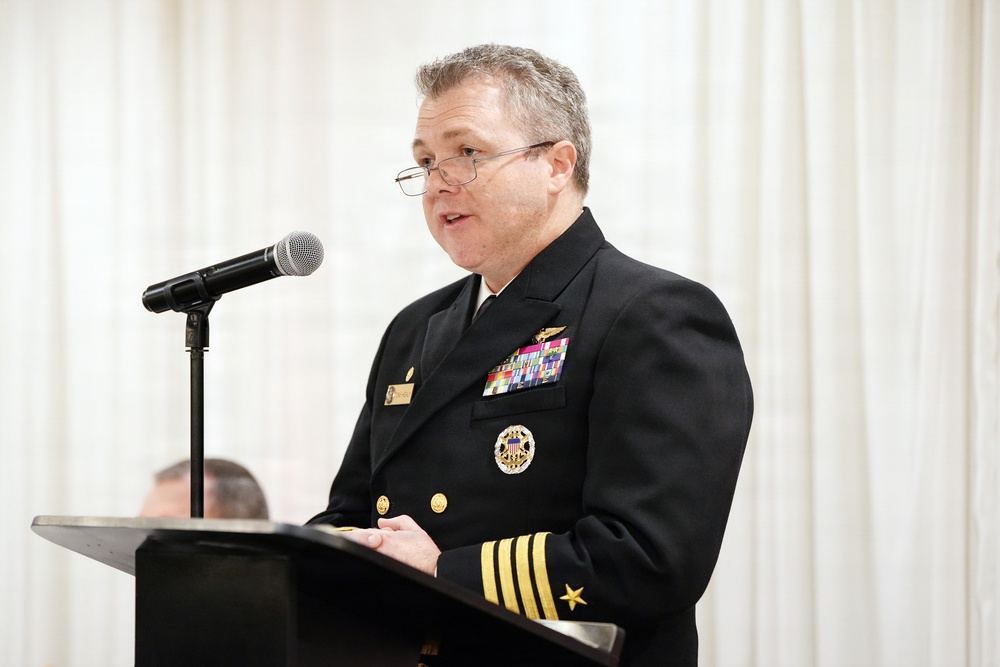
Photo By Cmdr. Jeffrey Gray | (Dec. 8, 2025) – Capt. Thomas H. Healy, commanding officer of Navy Reserve Center Great Lakes, speaks from the lectern, urging vigilance and sustained readiness as enduring lessons of Pearl Harbor during the Navy League Aurora Council’s annual observance. (U.S. Navy photo by Cmdr. Jeffrey S. Gray) see less
| View Image Page
The Watch That Never Ends: At Aurora’s Pearl Harbor Day Luncheon, Capt. Thomas Healy Warns That Readiness—Not Nostalgia—Secures the Nation
BATAVIA, Ill.—Dec. 8, 2025—The Lincoln Inn filled early Monday afternoon as more than 250 guests settled into their seats for the Navy League of the United States, Aurora Council’s 56th Annual Pearl Harbor Day Luncheon, a civic ritual that has outlasted presidents, conflicts, and generations. But the heart of the gathering belonged not to the ceremony itself, nor even to the four centenarian World War II and Korean War veterans in attendance, but to a stark warning delivered by Capt. Thomas H. Healy, commanding officer of Navy Reserve Center Great Lakes.
Healy, the keynote speaker, opened with an admission both humble and telling.
“I briefed the Chief of Naval Operations. I briefed the Chairman of the Joint Chiefs of Staff,” he said. “But talking about the attack on Pearl Harbor in front of some World War II veterans is probably the most intimidating speech I’ve been asked to give.”
Healy added a reflection that deepened the moment, “It was an honor, and no small challenge, to speak about Pearl Harbor in the presence of men who lived its aftermath. Their example reminds us that we can prepare for much, but we cannot predict everything.”
He continued, “At any moment, the world can shift. These veterans know that truth. Their lives testify to how swiftly a nation can be thrust into a fight it never sought.”
For the next 15 minutes, the room listened as Healy fused history, strategy, and moral clarity into a message that felt less like an anniversary reflection and more like a national imperative.
He began with the image America cannot forget.
“On that fateful Sunday morning in 1941,” he said, “the quiet of a Pacific dawn was pierced by the roar of Imperial Japanese aircraft sweeping low over the island of Oahu.”
He described Sailors jolted awake, some just returning from liberty, others rubbing sleep from their eyes, only to meet fire, chaos, and collapsing steel. Their bravery, he said, “transformed a moment of devastation into the opening chapter of a vast national effort.”
Quoting President Franklin Roosevelt, Healy reminded the audience that America’s triumph in World War II stemmed not from inevitability but conviction—the belief that free citizens, when pressed, would choose duty over despair.
But Healy’s real focus lay not in 1941, but in what that morning reveals about today.
He argued that Pearl Harbor teaches lessons far beyond naval history.
“It revealed that adversaries act with intention,” he said. “It revealed that strategic misjudgments have consequences, and that complacency, no matter how justified it may appear in peacetime, is a danger all its own.”
The difference between survival and catastrophe, he insisted, often hinges on “the quiet, unglamorous work of preparation.”
He then delivered the line that framed the rest of his remarks: “This lesson taught at Pearl Harbor is not an artifact of history. It is a living caution.”
To drive the point home, Healy asked two pointed questions.
“Were we prepared for September 11, 2001? Were we prepared for the COVID-19 pandemic?”
Preparation, he explained, can address “known knowns” and even “known unknowns,” borrowing the language of former Defense Secretary Donald Rumsfeld. But it is the “unknown unknowns,” he said, that make vigilance so difficult.
“We inhabit a world marked by shifting power centers, contested waterways, proliferating weapons technologies, and strategic competitors who seek advantage through speed, ambiguity, and audacity.”
Deterrence, he said, must be credible, capable, and continuous.
Despite discussing strategy, Healy insisted the center of readiness is not machinery, but character.
“Preparedness is a people issue,” he said plainly.
He stressed that tomorrow’s crises, whether cyberattacks, disinformation campaigns, or conventional conflict, will test Americans in ways unlike the past.
That led to the heart of his message: the role of the U.S. Navy Reserve.
The Navy Reserve, Healy explained, was activated even before Pearl Harbor. By the end of World War II, 3 million Reserve Sailors had served—“roughly 84 percent of all Navy personnel during the war.” Adjusted for today’s population, he said, that would be 7.8 million Americans.
Today, he said, there are fewer than 50,000 drilling Selected Reservists.
“Imagine that kind of strategic depth,” Healy said. “Millions of combat-experienced Reservists available.”
Since 9/11, more than 100,000 Navy Reservists have mobilized globally. Nearly 10 percent serve on active duty on any given day.
“These men and women do not wait for crises; they prepare for them,” he said. “They live dual lives—balancing families, careers, and community obligations—yet they remain ready whenever the Navy calls.”
He then underscored that readiness with a pointed reminder, “For more than twenty years, the Navy Reserve has been answering unexpected demands. Over 100,000 individual activations since 9/11 reflect a force built for disruption, not routine.”
Healy followed with a sharper line, “No reserve component has adapted more quickly than the Navy Reserve. That adaptability must endure as we refocus on preparing for a high-end fight.”
“The Navy Reserve is not a supplement to the fleet,” he said. “It’s an extension of the fleet—deployed, engaged, and integral to deterrence every single day.”
Healy revisited the courage of heroic Pearl Harbor sailors like Doris “Dorie” Miller, Lt. Cmdr. Samuel Fuqua, Joseph Leon George, and Chief Watertender Peter Tomich. They were not prepared for an attack, he said—but they were prepared to serve.
Their readiness, forged long before Dec. 7, 1941, came from training, discipline, and a culture that placed duty above comfort.
“The enduring lesson,” Healy said, “is unchanged. Readiness is our shield, and vigilance is our duty.”
He closed with a call that seemed to settle over the room like a charge, “The price of peace is preparation, the price of security is vigilance, and the price of freedom is the willingness to stand the watch.”
Though Healy’s remarks defined the afternoon, the luncheon also honored nine outstanding youth as Ted Brattin Civic Youth Award recipients and recognized four World War II veterans: Dick Williams, 99; Duane Stevenson, 102; Al Centofante, 100; and Lou Ebrom, 98.
Presiding over the ceremony was Col. Richard Todas (USA, Ret.), the Aurora Council president, who reminded attendees why the gathering endures after more than five decades.
“We do this not only to commemorate the event on December 7,” he said, “but also to remind people that there are duties that you assume just as a citizen of the United States.”
As the final notes of “God Bless America” faded, the message of the day remained clear: the past offers lessons, but the future demands readiness—and the watch never ends.
NEWS INFO
Date Taken:
12.12.2025
Date Posted:
12.12.2025 16:20
Story ID:
554075
Location:
BATAVIA, ILLINOIS, US
Web Views:
132
Downloads:
0
PUBLIC DOMAIN
This work, The Watch That Never Ends: At Aurora’s Pearl Harbor Day Luncheon, Capt. Thomas Healy Warns That Readiness—Not Nostalgia—Secures the Nation, by CDR Jeffrey Gray, identified by DVIDS, must comply with the restrictions shown on https://www.dvidshub.net/about/copyright.