Fort McCoy supports December 2025 meeting with local county natural resources committee
Photo By Scott Sturkol |
Members of the Monroe County (Wis.) Natural Resource and Extension Committee meets in......read moreread more
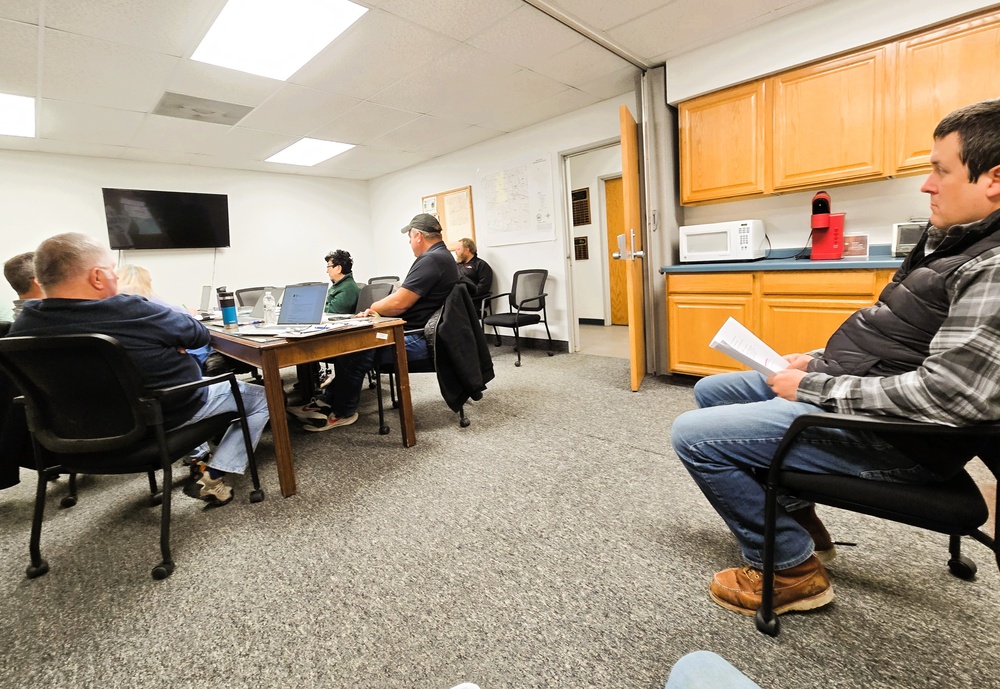
Photo By Scott Sturkol | Members of the Monroe County (Wis.) Natural Resource and Extension Committee meets in Sparta, Wis., on Dec. 8, 2025. The mission of the Monroe County Natural Resource Committee is to manage, conserve, and protect our natural resources. The committee will facilitate wise, sustainable land use and outdoor recreation through information and education while supporting technical and financial assistance to landowners of Monroe County and encourage all residents of Monroe County to be stewards of our natural resources keeping in mind the generations to follow. Fort McCoy personnel regularly support the committee. (U.S. Army Photo by Scott T. Sturkol/Fort McCoy Public Affairs Office) see less
| View Image Page
Fort McCoy supports December 2025 meeting with local county natural resources committee
Fort McCoy personnel once again provided updates about the installation’s natural resources-related efforts Dec. 8 during the December 2025 meeting of the Monroe County (Wis.) Natural Resource and Extension Committee.
The monthly committee includes members Nodji VanWychen, Joey Esterline, Cedric Schnitzler, Doug Rogalla, Todd Sparks, and Paul Zastophil from areas within the county. According to the Monroe County webpage for the committee at https://www.co.monroe.wi.us/government/county-board-of-supervisors/boards-committees/natural-resource-extension/-folder-2344, the committee has a diverse mission.
“The mission of the Monroe County Natural Resource Committee is to manage, conserve, and protect our natural resources,” the website states. “The committee will facilitate wise, sustainable land use and outdoor recreation through information and education while supporting technical and financial assistance to landowners of Monroe County and encourage all residents of Monroe County to be stewards of our natural resources keeping in mind the generations to follow.”
As part of Monroe County, Fort McCoy has a part in supporting the committee. The post does so through the Fort McCoy Directorate of Public Works Environmental Division Natural Resources Branch (NRB) as well as the Fort McCoy Public Affairs Office.
During the December meeting, NRB Fisheries Biologist Steve Rood served as one of the Fort McCoy representatives where he reviewed recent accomplishments completed by NRB and related Fort McCoy personnel.
Among those accomplishments in natural resources management Rood mentioned from November 2025 were:
— In fisheries at Fort McCoy, personnel collected water samples from one runoff event in November. Conducted base flow water sampling for baseline monitoring.
— Fisheries personnel also continued instream temperature monitoring at 11 locations to assess winter temperature and the relationship with trout overwinter habitat. The conducted four creel surveys. Zero anglers were interviewed this month, which is not uncommon for November.
— Updated fishing regulations and signs on lake information kiosks.
— Team members removed six beaver dams that were blocking trout spawning migration or that were blocking culverts.
— Fisheries personnel conducted 36 redds (trout spawning beds) surveys. Overall, most sites contained average or above average amounts of spawning trout. This should lead to good trout recruitment in 2026.
— They performed maintenance on lake aerators and made sure they were ready for winter.
— Personnel measured water levels on three occasions at Sandy, West Sandy, and Big Sandy Lakes. Water levels were at the lowest points so far in 2025, although they were similar to the month of November in past years.
— Forestry personnel administered contract oversight on four timber sales on the installation.
— Forestry personnel also participated in a wildland fire working group’s spring planning meeting with the U.S. Forest Service.
— In invasive species management, with treatments, personnel treated 102.5 acres and surveyed 266.4 acres.
— In wildlife management, personnel had wrapped up deer dusk/spotlight surveys that took place from September to early November. These surveys are used in conjunction with truckbook surveys that run from July through August. The survey data helps determine buck-doe and doe-fawn ratios which are plugged into the SEX-AGE-KILL model to estimate the size of the deer herd.
Estimated deer herd size prior to hunting seasons was at 24-25 deer per square mile, or roughly 1,800 deer on the installation. To meet the goal of 15-20 deer per square mile or 1,100-1,500 deer on the installation, the harvest goal over the fall/winter would be roughly 300-700 deer over all seasons (excluding cantonment archery).
— Gun-deer season statistics: 313 total deer harvested. There were 167 Chronic Wasting Disease samples (54 percent of harvest) taken. Permit quota for 2025 was 1,800. Permits issued were 1,798. Permits purchased were 1,364. Bonus antlerless tag quota was 450 tags. Bonus antlerless tags issued were 450 tags. Bonus antlerless tags purchased were 244.
— Fort McCoy Hunting, Fishing, and Trapping Rules and Regulations (Fort McCoy Regulation 420-29) were signed and approved on Nov. 17. The regulations have been distributed and made available to the public.
— Wildlife management personnel attended the Wisconsin Department of Natural Resources (WDNR) Wild Turkey Advisory Committee meeting to set spring turkey tag levels for the seven wild turkey zones in Wisconsin. The committee is continuing to update the WDNR 2025-2035 Wild Turkey Management Plan.
— The WDNR approached Fort McCoy about the possibility of Fort McCoy allowing elk hunting on the installation. Talks will be ongoing but no definite decision has been made. If McCoy would allow elk hunting, it would not be for another couple years as approvals are received and details hammered out.
— Some wetland habitat work took place in Training Area D-4 in removing encroaching woody plants from the wet sedge meadow/marsh. Woody plants included buckthorn, maple, white pine, etc.
— In endangered species management, they continued work on bat data; two bat deployments reported and uploaded to a national database.
— Personnel also found hibernation locations for snakes and turtles; assisted in finding an injured black bear; submitted Monarch tagging data; and completed other general data management.
The Fort McCoy personnel who support the Monroe County committee help the entire county have its best possible support for effectively managing natural resources and supporting education for natural resources, cultural history, and more, officials said.
Fort McCoy’s motto is to be the “Total Force Training Center.”
Located in the heart of the upper Midwest, Fort McCoy is the only U.S. Army installation in Wisconsin.
The installation has provided support and facilities for the field and classroom training of more than 100,000 military personnel from all services nearly every year since 1984.
Learn more about Fort McCoy online at https://home.army.mil/mccoy, on Facebook by searching “ftmccoy,” on Flickr at https://www.flickr.com/photos/fortmccoywi, and on X (formerly Twitter) by searching “usagmccoy.”
Also try downloading the My Army Post app to your smartphone and set “Fort McCoy” or another installation as your preferred base. Fort McCoy is also part of Army’s Installation Management Command where “We Are The Army’s Home.”
(The Fort McCoy Directorate of Public Works Environmental Division Natural Resources Branch contributed to this article.)

 Subscribe






