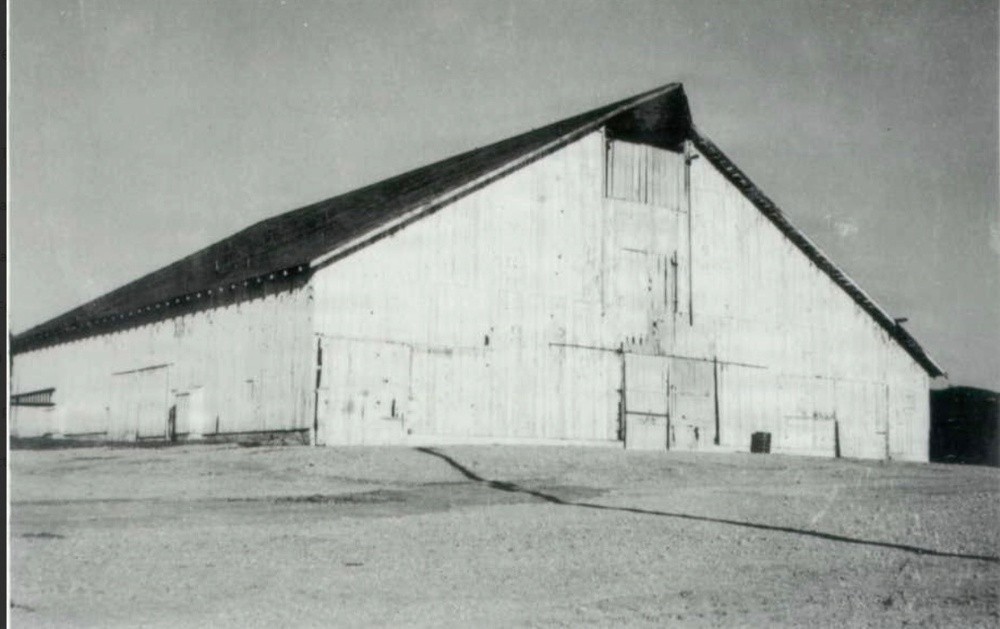
FORT HUNTER LIGGETT, JOLON, CALIF. − Built to weather any storm, the Tin Barn at
Fort Hunter Liggett (FHL) held its post for decades before completing its final mission in
November. The structure was disassembled on 17 November as part of the installation’s
ongoing effort to modernize and support long-term mission readiness.
Despite its basic structural appearance, the barn’s journey began long before the U.S.
Army claimed ownership. Originally linked to the James Brown Cattle Company and,
according to installation historical records, purchased as salvage from the 1915
Panama-Pacific International Exposition in San Francisco, the barn later became part of
ranchland owned by magazine Mogul William Randolph Hearst in the 1940s. Over the
years, it held various roles and became a familiar landmark to generations of FHL
Soldiers, employees, and community members.
Long-time staff remember the barn for its practical use, reminiscing on the days it
served as a hot spot for events and social gatherings, and how its presence tied into
some of their best years working at FHL.
Integrated Training Area Management Coordinator Art Hazebrook, who’s been at FHL
since 1995, reminisces, “Some of my best memories are tied to that structure,
especially the gatherings we used to hold in the old fire engine bays on the west side. It
really was a good time to be working here, and the barn was the center of it all.”
Those memories are shared by the installation’s firefighters, who called the barn home
for years.
“The Tin Barn supported our mission for decades, from 1990-2020,” said Assistant Chief
Michael Callahan. “It served as our station, dispatch center and response point for the
community. Many of us spent years of our careers there, and it was a home away from
home that holds a lot of good memories for our families.”
Before becoming part of the installation, the Tin Barn lived an entirely different life.
According to historical records, the barn was constructed in 1915 for the Panama-
Pacific International Exposition in San Francisco. It was later purchased as salvage and
moved to Milpitas Ranch in 1919 to support cattle operations, when Hearst took over
much of the surrounding ranchland in the mid-1920s, to include the barn.
When the U.S. War Department acquired the property in 1940, the barn adapted once
again, this time in support of Soldiers. Over the next several decades, the structure
served as a post exchange, theater, snack bar, clothing store, barber shop, laundry,
library and even a gymnasium before eventually being integrated into the fire station
complex in the 1970s and later becoming home to the FHL Fire Department in the
1990s. Its purpose changed many times, but it remained a useful part of everyday life
on the installation.
Like many older facilities across the Army, the barn had reached the end of its service
life. Modern missions require updated infrastructure, and the space it once occupied will
now support future improvements aligned with FHL’s long-term plans.
“The area formally occupied by the Tin Barn will continue to serve the garrison
community and Army mission,” said Garrison Commander Col. Jason McKenzie. “The
expanse of the space is ideal for large-scale events hosted by the historic Hacienda,
providing continuity of the Hearst legacy for decades to come.”
As the Army invests in new infrastructure, FHL continues to evolve in ways that
strengthen training and readiness for the future. The Tin Barn may be gone, but the
mission moves forward, supported by decades of dedicated workers and the facilities
that helped them do their jobs.
| Date Taken: |
12.11.2025 |
| Date Posted: |
12.11.2025 17:44 |
| Story ID: |
553954 |
| Location: |
FORT HUNTER LIGGETT, CALIFORNIA, US |
| Hometown: |
FORT HUNTER LIGGETT, CALIFORNIA, US |
| Web Views: |
535 |
| Downloads: |
2 |
PUBLIC DOMAIN

This work, Fort Hunter Liggett Honors History, Makes Way for Future Modernization, by Augusta Vargas, identified by DVIDS, must comply with the restrictions shown on https://www.dvidshub.net/about/copyright.