
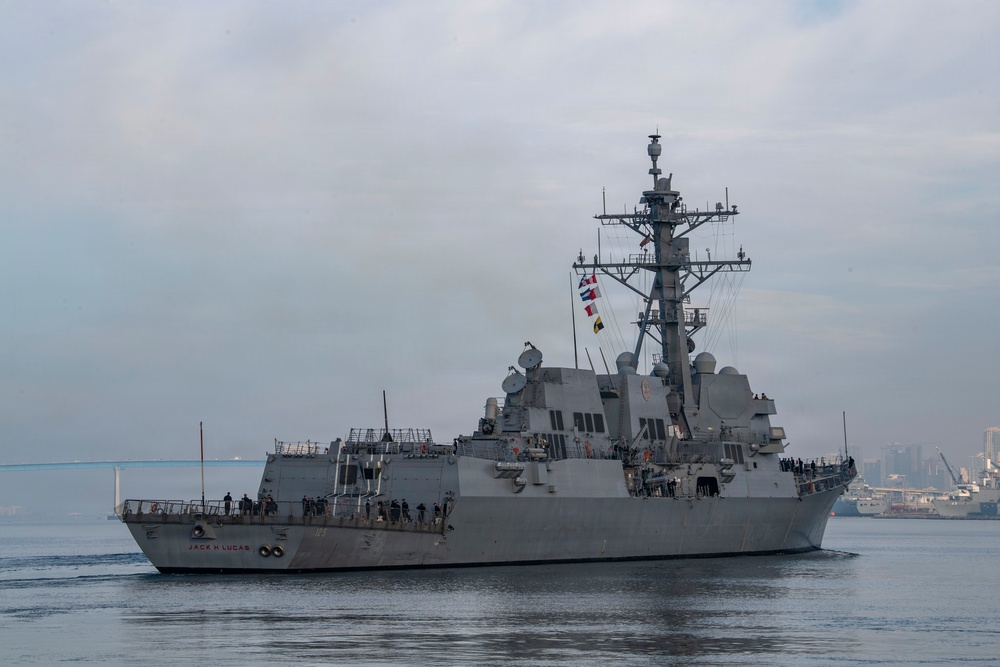
Photo By Petty Officer 1st Class Sara Eshleman | SAN DIEGO, Ca. (Nov. 12, 2025) - The Arleigh Burke-class guided-missile destroyer USS...... read more read more
 Subscribe
The Arleigh Burke-class guided-missile destroyer USS Jack H. Lucas (DDG 125) is the first Flight III warship in the U.S. Navy, marking a significant evolution in surface force combatant capabilities.
“Jack H. Lucas is the Chief of Naval Operations designated initial operational test and evaluation (IOT&E) campaign ship,” said Capt. Andy Bucher, the ship’s commanding officer.
An IOT&E campaign ship is responsible for building requirements for the technological advances that maintain the fleet’s lethality and war-fighting advantage on the seas.
“In order to rapidly transition this technology to the fleet and to get it out on the front line, Jack H. Lucas was designated as the IOT&E campaign ship, and we push on a very aggressive schedule to test underway while going through different scenarios,” Bucher continued. “Jack H. Lucas is tasked with taking the technology to sea, to test it, and then to rapidly and iteratively build on that so that we meet the requirements to maintain that war-fighting edge.”
Commissioned in 2023, Jack H. Lucas introduces a suite of advanced technologies centered around the new AN/SPY-6(V)1 Air and Missile Defense Radar (AMDR) — the most powerful radar ever fielded on a U.S. Navy surface warship. Compared to the SPY-1D(V) array on earlier Arleigh Burke variants, the SPY-6 provides dramatically increased sensitivity, allowing the ship to detect, track, and discriminate smaller, faster, and more complex threats across longer ranges.
“It's like going from a flip phone to an iPhone,” said Chief Sonar Technician (Surface) Nicholas Cederblom. “It does the calling, it does the texting, but it does so much more. And moving from that system into the advanced capabilities build, what we have right now, definitely is a lot more. No one else has done this.”
The Flight III configuration required substantial redesign of the destroyer’s power and cooling systems. Jack H. Lucas incorporates an upgraded electrical plant, improved chilled-water capacity, and strengthened structural elements to accommodate the AMDR’s power demands and higher displacement.
“USS Jack H. Lucas looks like every other destroyer,” continued Cederblom. “We have the same weapon systems outside, but it’s the internal component, and it’s the people itself that make it different. We are training the next generation to go forward with our new SPY-6, with our Baseline 10, with our engineering plants having to supply everybody on board the ship to get where we need to go.”
Operationally, Jack H. Lucas retains the proven Aegis Combat System, here integrated as Baseline 10, enabling enhanced ballistic missile defense (BMD), integrated air and missile defense (IAMD), and improved reaction time against emerging hypersonic threats.
“To come here and see what this ship can do is truly impressive,” said Bucher. “And it makes me proud as an American. And I hope that it makes the taxpayer proud that their capital investment is well spent. And then it is crewed by 300 citizens that are absolutely giving what they've got to make this platform, and this campaign and this class succeed. It is an engineering marvel. The things that this ship can do are truly impressive. I’ve been here about 18 months now and watching the technology evolve and watching it meet requirements - it's amazing. I would say that the capacity in the war-fighting capability that it brings are remarkable.”
Jack H. Lucas commissioned on October 7, 2023. The ship is named after Capt. Jacklyn Harold "Jack" Lucas, a U.S. Marine who became the youngest recipient of the Medal of Honor at age 17 during World War II. The mission of Commander, Naval Surface Force, Pacific Fleet is to man, train, and equip the Surface Force to provide fleet commanders with credible naval power to control the sea and project power ashore.
| Date Taken: | 12.10.2025 |
| Date Posted: | 12.11.2025 18:18 |
| Story ID: | 553788 |
| Location: | SAN DIEGO, CALIFORNIA, US |
| Web Views: | 1,106 |
| Downloads: | 1 |

This work, Navy's Flight III Destroyer Brings Significant Combatant Capabilities, by PO1 Sara Eshleman, identified by DVIDS, must comply with the restrictions shown on https://www.dvidshub.net/about/copyright.


No keywords found.




