
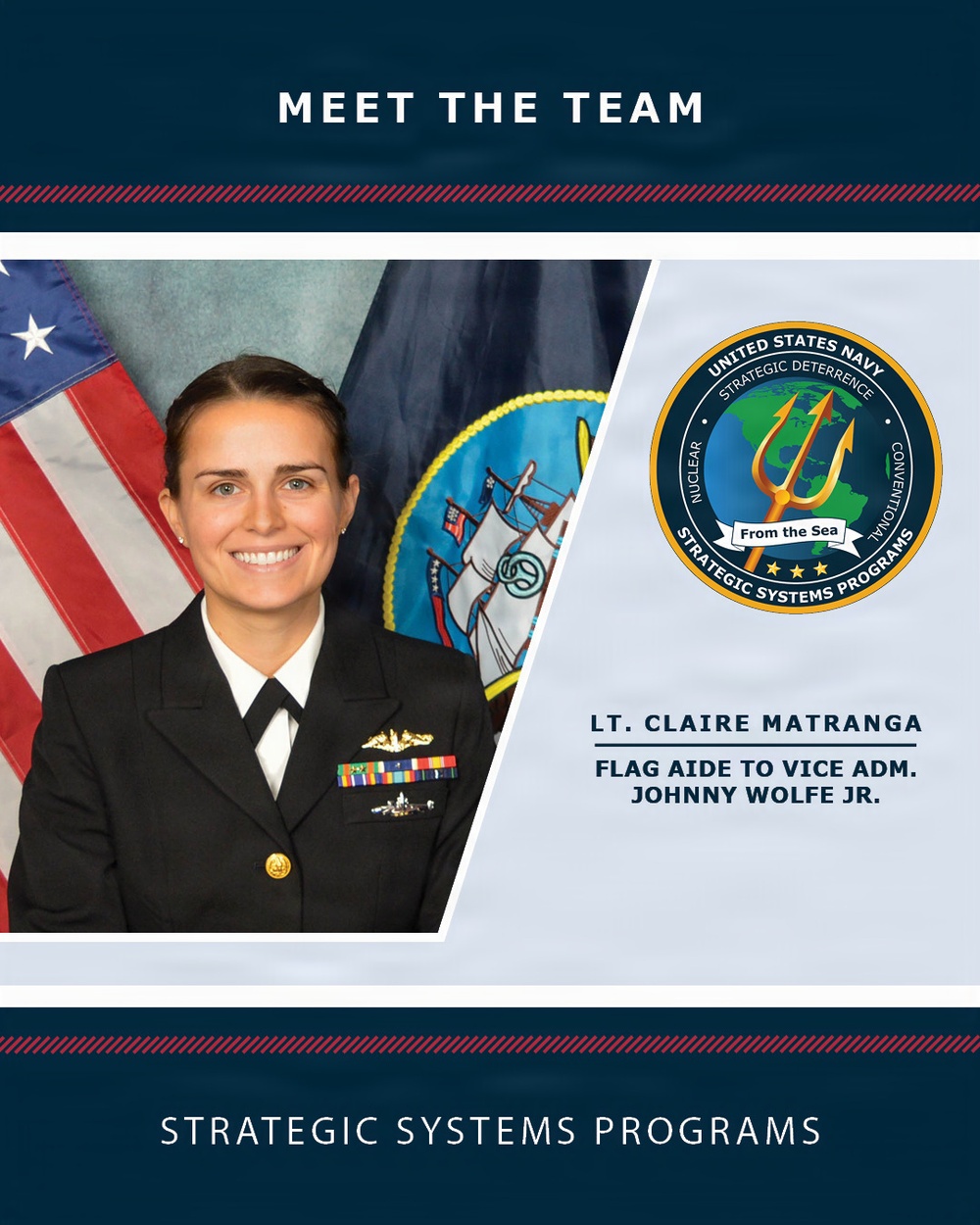
Photo By Edvin Hernandez | Lt. Claire Matranga, flag aide to Vice Adm. Johnny Wolfe Jr., the director of...... read more read more
Meet Lt. Claire Matranga, the flag aide for Vice Adm. Johnny Wolfe Jr., the director of Strategic Systems Programs in Washington, D.C.
Matranga’s family comes from a proud Navy town: Groton, Connecticut. When she was younger, she often strolled through town with her grandparents, watching the Navy’s most lethal submarines cruise through the frigid waters.
“Growing up, I would visit my grandparents who lived outside of Groton, so we’d see a lot of boats coming in and out,” she said. “I always thought submarines were cool and that stuck with me. No one in my family had military experience and it wasn’t until about high school that I thought about joining a service.”
When her lab partner in chemistry class encouraged her to explore the military, Matranga thought about it and was interested in learning more. Her curiosity led her to sign up for the Summer Leaders Experience at the United States Military Academy in West Point, New York, a weeklong immersion experience into the life of a cadet’s academic, military and social life. She also signed up for a similar experience at the U.S. Naval Academy in Annapolis, which reinforced her decision to seek a commission.
“I thought going into it that it would definitely be a reach for me just because I don’t have that military influence in my family,” Matranga said. “Once I went to the Naval Academy, I just loved it. It was great; the sense of community, belongingness, working toward something bigger – it all appealed to me.”
She attended Duke University in Durham, North Carolina, and pursued her bachelor’s degree in biomedical engineering. While studying, Matranga joined the Reserve Officers’ Training Corps on campus and had her submarine interview during her senior year of college. After being selected as a submarine officer – completing a full circle from her childhood – she commissioned in May 2021 and was immediately sent to Charleston, South Carolina, to attend Naval Nuclear Power School.
“I did a lot of learning about nuclear power and how the reactor works while I was over there,” she said. “After that, I went to another school house that specialized in prototype, where you’re gaining experience in rotating ship work, standing watch on one of the decommissioned submarines, and other things of that nature.”
After spending six months at Nuclear Power School, Matranga traveled to Connecticut for Submarine Basic Officer Course. While there, she learned how to read sonar screens, operate the periscope, and drive the boat. After completing that training in 2022, she landed down south at Naval Submarine Base Kings Bay in Georgia and went on her first sea patrol.
“Being on a submarine is a lot bigger than many imagine,” Matranga said. “I spent months at sea with a crew of about 170 people. I had the opportunity to lead a division of Sailors, which was really interesting and rewarding. On top of all of that, it was a major responsibility because you’re standing watch, operating a nuclear reactor on a multi-billion-dollar warship.”
Matranga first learned about SSP at the naval base in Kings Bay. After completing her sea-based tours, she was handed a list of shore-based jobs that were open. On that list were openings in SSP’s Operations, Evaluations, and Training Branch.
“I ranked each of them as my top three choices because of all the things I had heard about SSP,” she said. “I heard about the strong workplace culture. I wanted to keep the strong sense of purpose, and the command is in line with national defense priorities, so it seemed like the right shore tour for me.”
She was accepted and assigned to a branch assignment until another unique opportunity came calling.
“After finding out I was going to SSP, I went on my last patrol; and two weeks before we were supposed to come back home, my captain called me into his stateroom,” she said. “They asked me if I would be interested in interviewing to be Vice Adm. Wolfe’s aide. I told my captain I was very interested to learn from a flag officer, which led to an interview. Not long after that, I received a call from Vice Adm. Wolfe letting me know I got the job.”
Although Matranga had some familiarity with SSP, it was centered on the command’s Trident D5 Life Extension program. However, shortly after arriving to headquarters in D.C., she learned about the other advanced nuclear and non-nuclear regional strike capabilities SSP is pioneering, including Conventional Prompt Strike (CPS) and the Nuclear – Sea Launched Cruise Missile (SLCM-N).
As a flag aide, Matranga had to learn and adjust to her new role quickly. She said her leadership responsibilities aboard a submarine prepared her well for her current position and pointed at several skills that transferred over seamlessly, including quick thinking, prompt response to dynamic situations, attention to detail and more. She added that in many ways, she see’s the flag aide position as a natural progression in her career.
“I’m learning a lot about military acquisition, which is completely new to me,” she said. “It’s an area I wasn’t previously exposed to, so seeing this side of the work has been beneficial and has offered a new perspective on everything that needs to be done to support the mission.”
One of Matranga’s proudest achievements was serving as the tactical systems officer during one of her sea tours, overseeing torpedomen, sonar technicians, and fire control men. When her boat returned to port, Matranga oversaw scheduling maintenance; however, she did not have the full team due to some reassignments. Instead, Matranga completed a complex maintenance schedule with a junior torpedo division.
“There was quite a bit of technical knowledge required,” she said. “Planning and managing that complex maintenance period was a learn-on-the-fly experience, but I would say I grew the most during that time on the submarine. I developed my managerial skills and really took the time to study more to bolster my own technical knowledge.”
SSP is responsible for sustaining strategic weapon system (SWS) on the Ohio-class ballistic missile submarines (SSBN) and supporting the integration of the D5LE weapon system on the new Columbia-class SSBNs. Looking to the future, SSP is actively modernizing the sea-based leg of the nuclear triad through development of the D5LE2 SWS and pioneering regional strike capabilities of the future through development of the nuclear-armed sea launched cruise missile and the non-nuclear hypersonic conventional prompt strike system.
| Date Taken: | 12.09.2025 |
| Date Posted: | 12.09.2025 14:45 |
| Story ID: | 553571 |
| Location: | US |
| Web Views: | 139 |
| Downloads: | 0 |

This work, Meet the Team: Lt. Claire Matranga, Flag Aide, Strategic Systems Programs, by Edvin Hernandez, identified by DVIDS, must comply with the restrictions shown on https://www.dvidshub.net/about/copyright.

No keywords found.





