
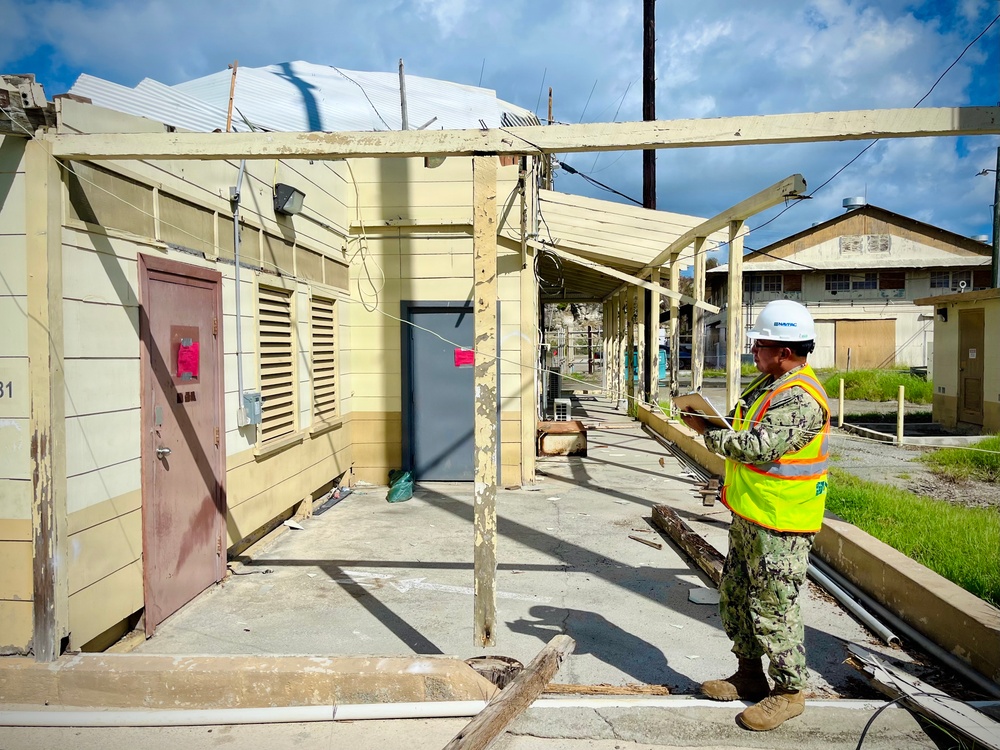
Photo By Jennifer Richard | Construction Electrician Second Class Gerardo Gonzalez performs damage assessments to...... read more read more
As the operational environment becomes more unpredictable, Naval Facilities Engineering Systems Command (NAVFAC) plays a critical role in ensuring resilient infrastructure to meet future challenges.
At the heart of this strategy is the application of Poseidon’s Corollary, a leadership principle introduced by NAVFAC Commander Rear Adm. Jeff Kilian. This philosophy empowers NAVFAC to tap into its diverse capabilities—from the operational expertise of the U.S. Navy Seabees to the technical prowess of NAVFAC Systems Commands and the vital partnership with industry contractors—to restore and enhance critical infrastructure that supports Navy operations from shore-based facilities to expeditionary environments.
From August to November 2025, NAVFAC Southeast effectively implemented this approach, drawing on all available resources. From responding to Hurricane Melissa’s aftermath to addressing a critical water line failure at Naval Station Guantanamo Bay (NSGB), NAVFAC Southeast demonstrated how a unified approach ensures operational continuity and long-term infrastructure recovery.
Hurricane Melissa Recovery at Naval Station Guantanamo Bay
Following Hurricane Melissa's Category 3 impact on Oct. 28, NAVFAC Southeast quickly mobilized its resources, demonstrating how Poseidon's Corollary supports both immediate crisis response and future preparedness.
The storm prompted the evacuation of 865 personnel, including 74 from the Public Works Department (PWD) and their dependents. In the immediate aftermath, those individuals who remained at the PWD provided the initial response, addressing urgent needs and stabilizing key operations. Once the storm passed, NAVFAC Southeast swiftly deployed a 24-person Contingency Engineering Response Team (CERT), consisting of Seabees, civilian employees, and contractors. This highly skilled team assisted the PWD, conducting damage assessments, stabilizing critical infrastructure, and ensuring the rapid restoration of vital facilities.
The CERT team leveraged advanced technologies, including Unmanned Aerial Systems (UAS), Geographic Information Systems (GIS), and Starshield, a secure government satellite network that uses Starlink technology, to conduct 1,490 damage assessments. These assessments were submitted to the Cost Estimating Team via the command’s Emergency Operations Center (EOC) at Naval Air Station (NAS) Jacksonville, focusing on mission-critical facilities and family housing units. Additionally, NAVFAC Southeast used contracting tools such as Base Operations Support (BOS), Job Order Contracts (JOC), and Multiple Award Construction Contracts (MACC) to efficiently integrate contractors, enabling swift repairs and stabilization efforts.
The Officer in Charge (OIC) deployed with the CERT was a warranted contracting officer, which provided a significant advantage. With the authority to approve contracts on-site, the OIC was able to expedite contracting actions, reducing delays and ensuring that the necessary resources and contractors were brought in quickly. This direct, on-the-ground decision-making capability was instrumental in maintaining the momentum of the recovery effort and ensuring the timely restoration of vital infrastructure.
"Our ability to respond quickly and effectively was made possible by the collaboration of our Seabees, civilian employees, and contractors, who worked together to stabilize mission-critical infrastructure and restore services for personnel and families," said NAVFAC Southeast Commanding Officer Capt. Matthew Williams.
Water Line Failure at Naval Station Guantanamo Bay
In another example of Poseidon's Corollary in action, NAVFAC Southeast responded to the failure of the cross-bay water line at NSGB on Aug. 28. This 50-year-old, 12-inch diameter iron pipe, spanning 10,000 feet from Windward to Leeward, caused a significant disruption to water service. In response, NAVFAC Southeast swiftly initiated a task order, leveraging the combined forces of Seabees, civilian personnel, and contractors to provide a rapid and effective response. This response included use of the NAVFAC Global Contingency Services Contract (GCSC) less than 24 hours after the failure.
Key to the recovery effort was the deployment of a contracted dive team and a team from Underwater Construction Team 1 (UCT-1) to investigate the damage to the water line. These teams worked alongside contractor personnel to locate the issue, determine its scope, and begin necessary repairs.
Meanwhile, Seabees and contractor teams worked together to truck potable water to the leeward side of the island, transporting up to 60,000 gallons of water daily. A Reverse Osmosis Water Purification Unit (ROWPU) was also deployed, producing an additional 132,000 gallons per day.
"By integrating the operational forces of the Seabees with contractors and NAVFAC civilian personnel, we were able to deliver immediate solutions while also planning for long-term infrastructure replacement," said Williams.
A $12.5 million project to replace the cross-bay water line has been approved, with design work completed and the Request for Proposal (RFP) issued on the Guantanamo Bay Multiple Award Construction Contract (GTMO MACC) on Oct. 3. This long-term solution project is expected to be awarded in March 2026.
A Unified Approach to Crisis and Recovery
In both the Hurricane Melissa response and the water line failure, NAVFAC Southeast demonstrated the power of Poseidon's Corollary by effectively integrating its resources to stabilize critical infrastructure and swiftly restore mission-critical services, while also setting the foundation for long-term solutions.
"As Poseidon controlled both calm and turbulent seas, NAVFAC Southeast's ability to plan strategically while responding to immediate needs highlights the strength of our integrated teams," said Capt. Williams. "This collaboration ensured our success in maintaining operational readiness and addressing these challenges."
NAVFAC Southeast remains committed to supporting recovery efforts at NSGB, addressing both immediate and long-term infrastructure needs to ensure ongoing mission success.
About Naval Facilities Engineering Systems Command Southeast
Naval Facilities Engineering Systems Command Southeast, headquartered in Jacksonville, Florida, provides planning, design, construction, contracting, environmental services, public works, real estate and facility maintenance for the U.S. Navy, Marine Corps, Army, Air Force, Space Force, and other federal agencies across the Southeast. Its area of responsibility covers installations from Charleston, South Carolina, to Corpus Christi, Texas, and extends south to Guantanamo Bay, Cuba.
| Date Taken: | 12.08.2025 |
| Date Posted: | 12.09.2025 08:10 |
| Story ID: | 553414 |
| Location: | JACKSONVILLE, FLORIDA, US |
| Web Views: | 296 |
| Downloads: | 1 |

This work, NAVFAC Southeast Leverages Full Spectrum of Resources in Hurricane Melissa Recovery and Water Line Failure at Guantanamo Bay, by Jeffrey Hamlin, identified by DVIDS, must comply with the restrictions shown on https://www.dvidshub.net/about/copyright.

No keywords found.





