
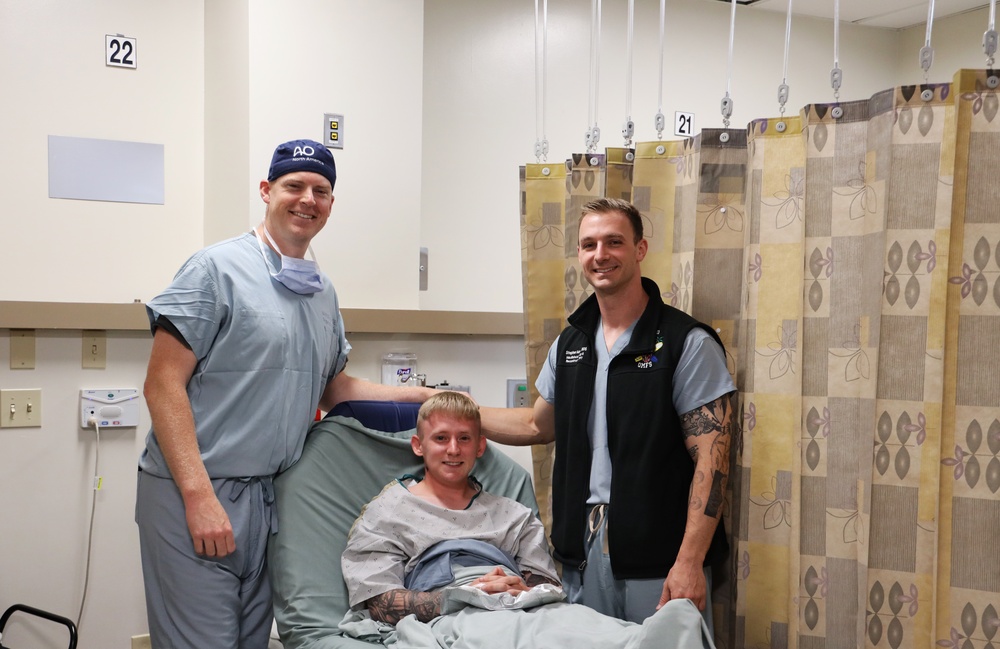
Photo By Regena Kowitz | Army Spc. Grant Dickerson poses for a photo with Cmdr. Daniel Hammer, left,...... read more read more
SAN DIEGO — When Army Spc. Grant Dickerson felt a sharp pain in his jaw after drinking something cold during a deployment earlier this year, he expected a routine dental issue. Instead, an X-ray revealed a dark lesion in his lower jaw.
U.S. Army Lt. Col. Christopher Chang, an oral maxillofacial surgeon at Evans Army Community Hospital in Fort Carson, Colorado, where Dickerson was stationed, ordered additional 3D imaging to determine the nature of the lesion.
"We saw a very large growing tumor," said Chang.
The diagnosis was a central giant cell granuloma, which is a benign but aggressive tumor that forms within the bone and grows. It threatened not only Dickerson’s health but his ability to continue serving in the Army.
For his family, the word “tumor” was alarming.
“As a mom, when I heard the word tumor, I was just in shock,” said Jennifer Dickerson. “I think I was just scared and afraid that it could be cancer.”
His father, Craig Dickerson, recalled preparing for the worst while focusing on next steps. “Everybody always goes worst case,” he said. “But we worried, and we just said, let’s work through the process, see where we end up.”
The process meant surgery to remove the tumor that had destroyed two-thirds of Dickerson’s lower jaw and rebuild the damaged portion.
“As much as I would like to do the surgery here, it takes a surgeon who has specialized training in doing microvascular surgery,” said Chang. “It also requires the support staff to be knowledgeable and to be able to manage a patient like that after the surgery in recovery, in the ICU.”
Ultimately, Chang chose to refer Dickerson to Naval Medical Center San Diego (NMCSD) where surgeons with their Maxillofacial Restoration Program have been treating patients requiring comprehensive facial restoration since November 2020.
“He reached out and did the biopsy and the initial workup,” said U.S. Navy Cmdr. Daniel Hammer, a maxillofacial surgeon and director of NMCSD’s Maxillofacial Restoration Program. “We worked as a team between Colorado and San Diego.”
The goal was to restore not only Dickerson’s jaw, but also his medical readiness.
According to Hammer, the damage the tumor had done was so extensive that had Dickerson been hit in the face, he would likely have broken his jaw.
“My hope for Grant with this surgery is that he keeps going with his career,” said his mother. “He wants nothing more than to be in the Army, to be a Soldier.”
Standard reconstructive surgery for a tumor the size of Dickerson’s typically requires a long, multi-stage recovery. After surgeons remove the jaw and transplant bone, patients typically wait 18 months to two years before they can receive dental implants and teeth.
For a service member, two years of limited function—unable to eat solid foods or deploy—can mean a medical separation. The Maxillofacial Restoration Program team has changed that timeline dramatically.
"The primary goal for Dickerson was a return to duty," said U.S. Navy Lt. Cmdr. Kyu Choi, chief resident of oral maxillofacial surgery. “He wanted to continue to serve his country, and he wanted to return to the job he had left behind at Fort Carson. After a long discussion, we consented him for the one-time, one-surgery to restore everything.”
Instead of spreading surgeries out over years, the jaw-in-a-day procedure consolidates them into a single surgery that takes place in one day.
"Really, the big difference between jaw-in-a-day and traditional reconstruction is that you get your dental rehabilitation immediately," Hammer said. "The bone, the teeth, and your function—so your speech and swallowing—all come back that same day.”
Cross-Service Collaboration
Before surgery could take place, a significant amount of coordination was required to ensure the procedure went smoothly. Through virtual surgical planning, the teams coordinated across state lines. They used scans of Dickerson’s mouth and 3D imaging to map the surgery and fabricate custom titanium guides before Dickerson even arrived in California.
“All the pre-op appointments, all the planning was done virtually on video communication,” said Chang.
Lt. Cmdr. Aaron Barto, a maxillofacial prosthodontist at NMCSD and member of the Maxillofacial Restoration Program team, gathered digital scans, photos, and Dickerson’s CT images.
“Using that information, we can actually virtually plan the surgery, the implants, and the teeth before the patient ever comes into the OR,” Barto said.
The seamless collaboration between Evans Army Community Hospital and NMCSD showcases how the Defense Health Agency (DHA) is integrating healthcare delivery across the military health system. By streamlining processes and removing traditional barriers between services and facilities, DHA enables providers to deliver coordinated care to warfighters like Dickerson regardless of location or branch of service.
"We worked as a team," Hammer noted. "We were able to be so collaborative between the Army and the Navy and the entire military health system."
Restoring Form and Function
The surgery involved a complex series of steps orchestrated by NMCSD’s multidisciplinary Maxillofacial Restoration Program team. First, surgeons harvested a section of the fibula from Dickerson’s leg and shaped it to match his jawline using the pre-planned guides.
“The next step is the inset, and that’s where we take our rebuilt jaw and we use metal plates to connect it to the patient’s mouth so that it fits in place,” said U.S. Navy Cmdr. Samuel Frasier, department chair, ear, nose, and throat at NMCSD and one of Dickerson’s surgeons.
Once the bone was set, the team performed microvascular anastomosis, which means they connected blood vessels together using a microscope to ensure the transplanted tissue would thrive. Finally, they placed the dental implants, immediately restoring Dickerson’s ability to smile and chew.
The day after Dickerson’s surgery, he was up walking. Within a week, he was discharged from the hospital and eating without a feeding tube.
Hammer attributes the program’s success to the nine integrated clinical care pathways that include pain management, speech and physical therapy, and mental health support, which focuses not on reconstruction, but on restoration of the whole patient.
“Reconstructive success is finite,” said Hammer. “I did a procedure. I got a good outcome. Patient’s okay. Moving on. But if your outcome is longitudinal in process, and it is as audacious as restoring the overall health of the patient rather than myopic of one procedure, that is how we restore form, function, and purpose.”
The ultimate goal for NMCSD’s Maxillofacial Restoration Program is the comprehensive restoration of health, especially for warfighters so they can get back into the fight. By reducing recovery time from years to months, the Maxillofacial Restoration Program does more than treat patients—it preserves the force.
“What Cmdr. Hammer and his team are doing at NMCSD demonstrates the true potential of our integrated military health system,” said Rear Adm. Kevin Brown, director of Defense Health Network Pacific Rim, which has oversight of NMCSD. “When we can turn what traditionally would be a career-ending diagnosis into a months-long recovery with full return to duty, we're fundamentally changing the equation for military readiness. This level of clinical innovation and collaboration across services is exactly what our warfighters deserve.”
A Return to Duty
Dickerson’s results speak for themselves. Within a month of his surgery, he was walking, speaking, and swallowing.
“The fact that Grant, after 30 days following his surgery, is able to function at this level is amazing,” said Chang. “I have no doubt that he’s going to fully recover in a short amount of time and be able to do the job that he loves.”
A diagnosis that leads to having two-thirds of your lower jaw removed is devastating, said Hammer. “But our hope is that his diagnosis, his experience, his recovery is just a chapter in his life, and not his story.”
Today, Dickerson is back with his unit and well on his way to a full recovery, supported by the teams in San Diego, Evans Army Community Hospital, and a military health system committed to improving health and building readiness, ensuring warfighters receive the care they need, when they need it.
“This case exemplifies what we strive for every day at Naval Medical Center San Diego—delivering world-class care that not only heals our nation’s heroes but ensures they are ready to meet the mission,” said NMCSD Director Capt. Elizabeth Adriano. “Our team has truly innovated by focusing on restoration of the whole patient, not just reconstruction, and they consistently achieve extraordinary outcomes. The Maxillofacial Restoration Program is fulfilling our fundamental responsibility to our warfighters, getting them back to full readiness so they can return to the fight. That's the standard we hold ourselves to, and that's the promise we make to every warfighter who walks through our doors.”
About Naval Medical Center San Diego: The mission of NMCSD is to provide a superior experience for our patients, staff, and warfighters. NMCSD employs more than 5,000 active-duty military personnel, civilians, and contractors in Southern California to deliver exceptional care afloat and ashore.
About Defense Health Network Pacific Rim: Defense Health Network Pacific Rim (DHN-PR) is one of the Defense Health Agency’s nine networks of hospitals and clinics that deliver high-quality health care to more than 140,000 enrolled beneficiaries, supporting major operational units through the Indo-Pacific. The DHN-PR headquarters is located in San Diego, overseeing military hospitals and clinics along the U.S. West Coast and overseas in Guam and Japan.
| Date Taken: | 12.04.2025 |
| Date Posted: | 12.08.2025 12:02 |
| Story ID: | 553146 |
| Location: | SAN DIEGO, CALIFORNIA, US |
| Web Views: | 939 |
| Downloads: | 0 |

This work, The New Face of Readiness: One Soldier’s Story of Restoration and Return to Duty, by Regena Kowitz, identified by DVIDS, must comply with the restrictions shown on https://www.dvidshub.net/about/copyright.


No keywords found.





