
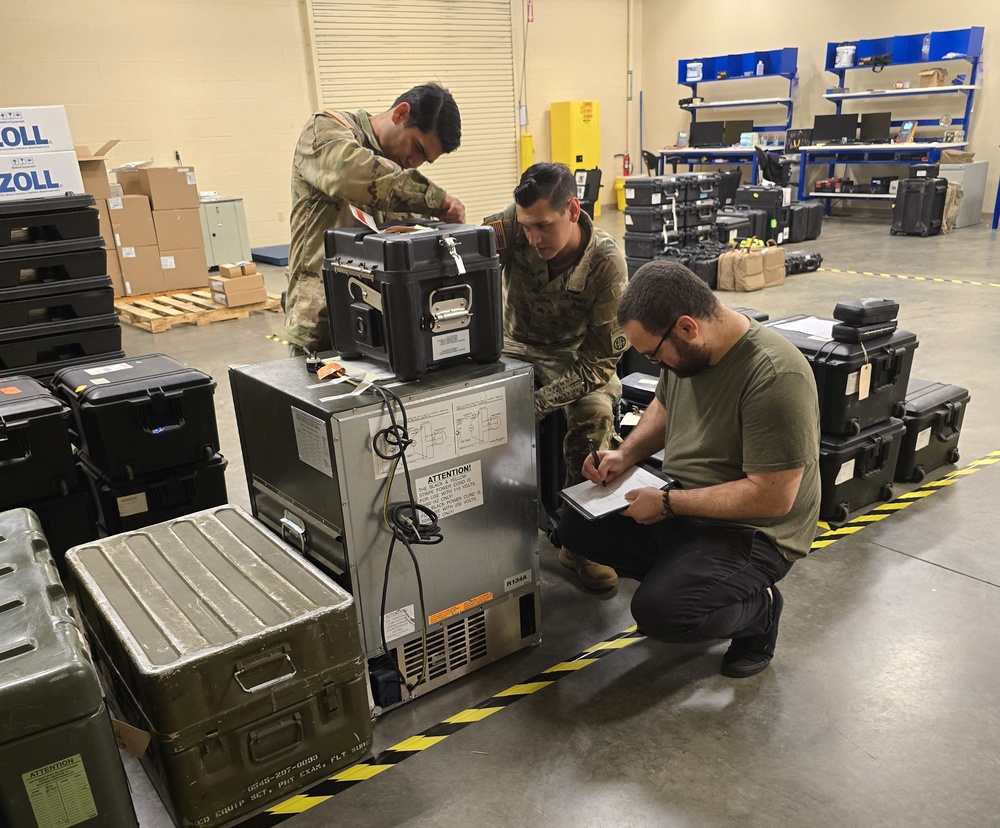
Courtesy Photo | Radames Feliciano, a biomedical equipment technician with the U.S. Army Medical...... read more read more
FORT DETRICK, Md. – Looking back on the past 12 months, U.S. Army Medical Logistics Command took part in numerous global exercises and continued to hone its capabilities to support a medically ready and lethal fighting force.
AMLC led the integration of medical support during several large-scale training exercises in 2025, including DEFENDER in Europe and several others around the world.
MEDLOG leaders also completed the first wave of a transformational multi-phase effort known as Medical Logistics in Campaigning, or MiC, which aims to better integrate medical logistics into the broader Army sustainment enterprise. AMLC has been tapped as the lead organization for the initiative.
MiC’s first wave included the launch of a new program called Home-Station Medical Maintenance Support. HMMS in short, the effort aims to close critical maintenance gaps that affect readiness.
“Working with our higher headquarters and Army leaders, we are getting after the challenges we face in the MEDLOG enterprise and actively working to address those needs, all the while continuing to provide first-class support to our warfighters anywhere in the world,” AMLC Commander Col. Deon Maxwell said.
“I’m proud of the progress we’ve seen in 2025, but we know there’s still more work to do,” he added. “We will continue getting after these goals as we enter 2026.”
EXERCISE SUPPORT
In multiple locations across Europe during DEFENDER, AMLC team members worked to support the medical supply chain, as well as provide hands-on training and logistics assistance during the military’s largest annual training exercise this past spring.
The exercise brought together about 12,000 U.S. service members and 13,000 troops from 29 allied and partner nations, focusing on the strategic deployment of U.S.-based forces, the use of Army Prepositioned Stocks, or APS, and several follow-on exercises that demonstrate lethality and interoperability.
AMLC and its direct reporting units assisted in the draw and retrograde of medical materiel for arriving units, as well as setup and support for equipment in the field in multiple locations during the nearly three-month operation.
Elsewhere, AMLC supported the setup of a 32-bed field hospital and provided over-the-shoulder training during Operation Orient Shield in September, the largest bilateral field training exercise with Japan Ground Self-Defense Forces. The exercise also included Australian forces for the first time this year.
Primarily through its subordinate unit, the U.S. Army Medical Materiel Agency, AMLC worked closely with the 528th Field Hospital in the preparation, issuance and setup of equipment from forward-positioned stocks in Japan.
Additionally, AMLC provided valuable on-site training for the 528th FH, including medical maintenance guidance, and served as a “sensor” in the field for unforeseen issues during the exercise.
Other highlights included MEDLOG support during Ulchi Freedom Shield in Korea this past August and the rapid mobilization of assets in June to support an emergency deployment readiness exercise, or EDRE, in Kuwait.
Ulchi Freedom Shield is an annual exercise that enhances joint defense capabilities and alliance between U.S. and Republic of Korea forces through field training events. AMLC’s direct reporting unit, the U.S. Army Medical Materiel Center-Korea, serves as the lead integrator for medical materiel to deploying units.
During the EDRE in Kuwait, AMLC and personnel from the U.S. Army Medical Materiel Agency issued sets from Army Prepositioned Stocks in Southwest Asia, known as APS-5, in support of a forward resuscitative surgical detachment deploying to sustain medical operations during the exercise.
The exercise was a true test of AMLC’s readiness and agility as the team juggled the surprise mission requirements as it supported ongoing DEFENDER operations.
MEDLOG IN CAMPAIGNING
The first phase of MiC, spanning October 2024 to May 2025, focused largely on integrating medical logistics operations into the Army’s sustainment system of record, Global Combat Support System-Army, or GCSS-Army.
Using GCSS-Army for medical materiel procurement reduces IT system requirements, unifies the operational picture for senior leaders, enables data-driven decisions, enhances tracking of medical materiel consumption and improves demand forecasting through precision logistics.
Another challenge tackled medical materiel integration into supply support activities, consolidating commodity flow within organic Army capabilities and reducing dependency on medical treatment facilities.
Additionally, the campaign worked to streamline the unit-level ordering process through the development of a centrally managed catalog that enables more efficient materiel management and improved integration with supply channels.
MEDICAL MAINTENANCE
The first wave of MiC also laid the foundation for expanding the HMMS program, which provides regional maintenance support to units without assigned biomedical equipment specialists in accordance with AR 750-1. This capability enhances equipment readiness while reducing costs.
Since its launch at Fort Bragg in 2024, HMMS has received nearly 1,000 medical device work orders, leading to measurable improvements in readiness and overall cost reduction for the Army.
Minimizing downtime and increasing overall readiness are two primary drivers of the HMMS program, with the initial site supporting over 100 units, including active-duty and National Guard, in North Carolina during wave one. Through the first wave, AMLC determined the HMMS model aligned closely with Army Materiel Command’s Forward Repair Activities, or FRAs, which provide support to the operational force from the sustainment level.
“The FRA concept allows for a regional support structure rather than an installation-specific concept,” said Jorge Magana, director of Medical Maintenance Management at AMLC. “With the future in mind, it was decided to change the name to Forward Repair Activity-Medical, or FRA-M.”
Additional sites proposed in the future include AMLC’s three Medical Maintenance Operations Divisions in Pennsylvania, Utah and California, as well as at Fort Benning, Georgia, Fort Campbell, Kentucky, Fort Carson, Colorado, and Joint Base Lewis-McChord, Washington.
| Date Taken: | 12.05.2025 |
| Date Posted: | 12.05.2025 10:02 |
| Story ID: | 553115 |
| Location: | FORT DETRICK, MARYLAND, US |
| Web Views: | 313 |
| Downloads: | 1 |

This work, Year in Review: AMLC supports global Army exercises, MEDLOG improvements in 2025, by C.J. Lovelace, identified by DVIDS, must comply with the restrictions shown on https://www.dvidshub.net/about/copyright.


No keywords found.





