
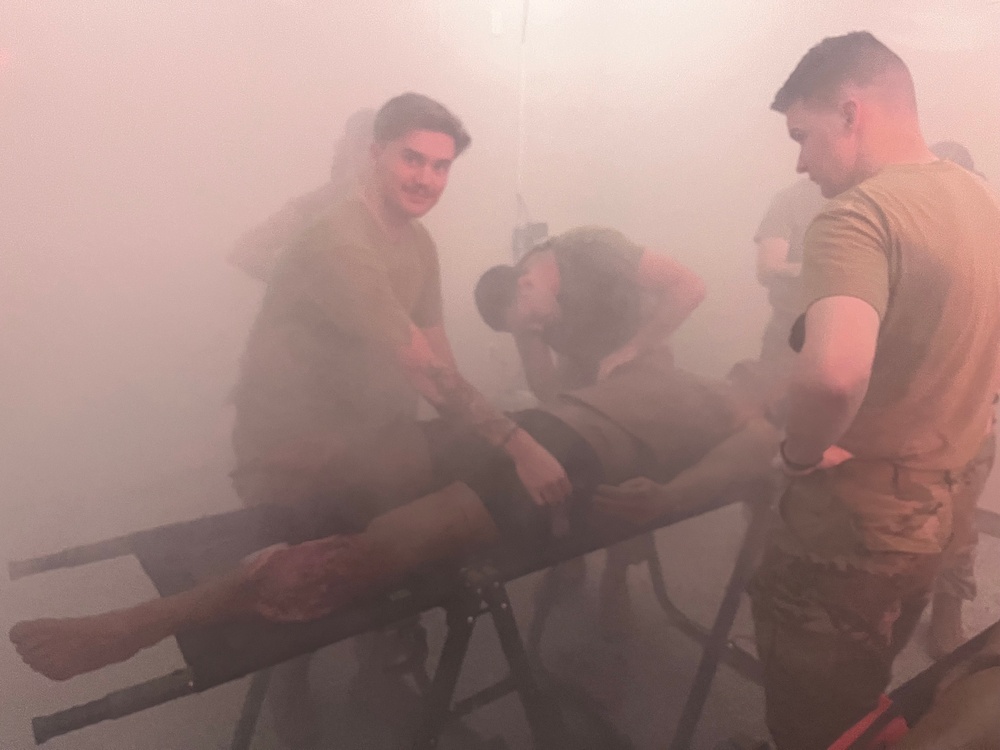
Photo By Keith Garner | Utah National Guard Airmen perform medical evacuation training at the state-of-the-art...... read more read more
 Subscribe
The Utah Army National Guard is rapidly evolving in combat medicine. With the introduction of one of the most advanced medical training facilities in the country, the Medical Simulation Training Center (MSTC), commonly called the “Mystic.” Centrally located at Camp Williams, the new center is already being praised as the finest MSTC in the nation by the contractors and subject-matter experts who helped stand it up.
Maj. Aaron Roberts, Deputy Commander of the 97th Troop Command, spearheaded the multi-year project to bring a MSTC to the Beehive State. “This is a game-changer for medical readiness in Utah,” Roberts said. “We’ve never had the ability to conduct this level of tough, realistic trauma training in-state before. Soldiers used to travel to places like Fort Carson, Joint Base Lewis-McChord, or the National Training Center in California. Now the Mountain West has its own world-class facility right here.”
The Utah MSTC began to take root five years ago in Florida. The Army Medical Department and the Medical Simulation Command identified a need for greater simulation capability in the Mountain West region. Camp Williams was selected because of its existing training areas, proximity to the Wasatch Front, and ability to support helicopter and large-scale field exercises.
Construction began in 2022 as the former range control building on Camp Willians was completely gutted to the studs. New concrete floors with central drains were poured, commercial grade HVAC and fire systems were installed, and the entire configuration of the building was altered to accommodate the MSTC.
By late 2024, the Utah MSTC became the fifth National Guard MSTC nationwide and one of only 26 total across the Active Army, Guard, and Reserve.
While every MSTC uses high-fidelity mannequins that breathe, bleed, and respond to treatment, Utah’s facility incorporated several unique features due to the building’s original footprint and deliberate design choices:
• 20% larger training rooms than standard MSTCs
• Linear layout with two independent control rooms instead of the usual single control room/four-room “box” design, allowing greater scenario diversity and simultaneous but different training lanes
• Expandable trauma bay with a roll-up door that can combine two rooms into one large four-bed medical treatment facility
• Direct exterior double doors for rapid patient loading from helicopters or ground ambulances. This decision was deliberately made, due to the building’s direct proximity to the PT field on Camp Williams. This capability allows MEDEVAC helicopters to land on the field, and litter teams to carry ambulatory patients directly into the MSTC facility
• Extra-robust construction: ¾-inch plywood backing, 5/8-inch drywall, FRP paneling, and commercial epoxy floors built to withstand years of intense, realistic, training
• Full sensory immersion: programmable smoke, strobe lights, combat sounds, and scent machines that can release odors associated with biohazard material, sewage, and other unpleasant smells
While the upgraded facility brings added capabilities that Utah has never had before, the real star of the show is the medium and high-fidelity mannequins that can bleed, move, lose pulses, dilate pupils, accept real IVs and medications, and even “die” if interventions fail. They respond in real time to treatment, and react accordingly. Instructors in control rooms monitor every action both on screen via multiple high-definition and infrared cameras, and through signals from each mannequin. Training sessions are recorded for immediate after-action reviews.
The new facility takes Utah’s medical training to a completely new level, said Sgt. 1st Class Joey Whaley, the MSTC’s non-commissioned officer in charge. “Before, we trained on our battle buddies acting hurt. You can’t actually pack a bleeding wound with real pressure or stick needles into a live person.” he explained. “Here, the mannequin bleeds real simulated blood. If you don’t stop the hemorrhage, the patient dies in your hands—and the system records exactly how much blood was lost and how long it took.” he said.
Training can range from one-hour tactical combat casualty care refreshers to 72-hour delayed-evacuation casualty management (DECM) scenarios, formerly called prolonged field care.
Although primarily an Army asset, the Utah MSTC is joint and community oriented. Air Force medics from Hill Air Force Base, local fire/EMS agencies, SWAT teams, and law enforcement K9 units have already participated in testing and are welcome to schedule training.
“Strengthening interoperability with our civilian partners is part of the National Guard’s domestic mission,” Roberts emphasized.
The current iteration of the MSTC is built to accommodate growth. Future plans include pursuing additional accreditations for National Registry EMT refreshers, life saver courses, and even more advanced special operations medicine lanes tailored for the 19th Special Forces Group (Airborne) based in Utah.
“This is only the beginning,” said Whaley. “Every unit that’s come through has immediately re-booked for more time. The feedback has been overwhelmingly positive—and honestly, this has re-energized me as a combat medic.” he said.
The Utah National Guard’s Medical Simulation Training Center at Camp Williams is now fully operational and accepting training requests from units and partner agencies across the state and region. We will host a community open house on January 10, 2026, at 2:00 p.m.
For scheduling or more information, units should contact the 97th Troop Command Medical Detachment or the MSTC staff directly. Press and community agencies should direct inquiries to ng.ut.utarng.list.pao@army.mil.
| Date Taken: | 12.03.2025 |
| Date Posted: | 12.15.2025 12:07 |
| Story ID: | 552962 |
| Location: | CAMP WILLIAMS, UTAH, US |
| Web Views: | 239 |
| Downloads: | 0 |

This work, Utah National Guard Opens State-of-the-Art Medical Simulation Training Center at Camp Williams, by SFC Tim Beery, identified by DVIDS, must comply with the restrictions shown on https://www.dvidshub.net/about/copyright.


UTNG- Medical Simulation Training Center (MSTC) Op
No keywords found.




