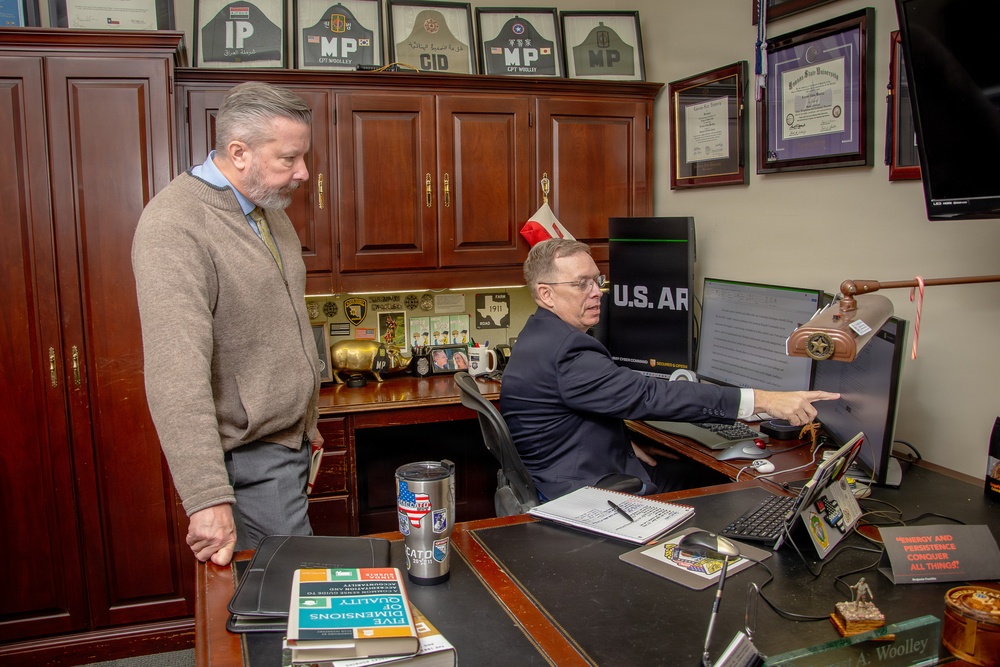
Command and General Staff College is spearheading new practices and technologies to ensure America’s warfighters receive the most relevant and rigorous professional military education possible.
The Quality Assurance Office is leading several initiatives, revolutionizing the ability to maintain and improve the curriculum through critical, data-driven insights for informed decision-making across the institution.
A significant advancement is the introduction of new artificial intelligence data workflows, designed internally by QAO.
These substantially decrease the time it takes to analyze large amounts of data from surveys and student writing, validated through testing by the Department of Distance Education in leadership and history common core courses.
Using the AI workflows has enabled ongoing program improvements through quick identification of trends in large data sets obtained through curriculum outcome surveys.
Further, they reduce human bias in analysis, allowing accurate sentiment analysis, predictive analyses, and optimization of resource allocation.
The tool has enabled the expansion of feedback reach for a more holistic view of the impact and effectiveness of the curriculum.
“We do a 2- and 4-year graduate survey, reported twice a year to the command so they understand the impact of the curriculum has had at those career milestones,” said Dr. Forrest Woolley, director, QAO. “We also gather feedback from senior leaders and general officers, as well as pre-command course battalion and brigade commanders to understand their perceptions of CGSC graduates: their strengths and weaknesses, and how we can enhance the curriculum to better prepare them to lead effectively.”
The new program analyses and efforts to streamline surveys increased response rate to over 90% for the first time.
“We gather enough good information to make data-informed recommendations to the command for improvements,” Woolley explained.
Acknowledging that people often fear AI will replace their jobs, he emphasized the importance of human touch.
“We still have to read and review all of the outputs to validate AI is giving us the correct narrative and findings,” he said.
This is also true of the Guided Analytical Recommended Feedback tool or GARF, which was developed in-house by Woolley and Dr. Thom Crowson, a CGSC Assistant Professor.
GARF, which was launched and piloted in August, helped military instructors double their grading output in a single course during the furlough, with that number expected to increase over time.
While not a grading program, GARF’s recommended feedback, which is nested in the course rubric, decreased the time it took to analyze and grade papers by approximately 55%.
It generates 2-3 pages of curriculum-based, individualized feedback in roughly six seconds, which instructors tailor to the individual student.
Instructors that used GARF found that it gave them the ability to provide more detailed, accurate, and relevant feedback to students more quickly, freeing up time for mentoring, engaging with students, and class preparation.
“It’s still the instructor’s responsibility to read the feedback, review the paper, and then adjust the feedback before determining the grade,” Woolley stated.
The prompts, designed by Crowson and Woolley, are critical to the quality, accuracy, and relevance of the output and enable GARF to deliver more accurate and useful assessments which have been found to be 90-95% accurate.
“Information generated by GARF should be treated as a resource rather than definitive guidance. GARF is just one tool in the instructor’s toolkit. When the output is paired with the critical thinking and experience provided by a seasoned military professional, it becomes a powerful tool to support student learning,” Crowson said.
He emphasized that the more personalized and relevant feedback helps students develop the critical skills required of field grade officers.
“This integration is especially valuable as the military faces resource constraints and expanding mission requirements,” he said.
Other initiatives by QAO this year include the launch of a new Army-wide survey system, the development of the Army’s first Triennial Program Review, and establishment of rigor factors for leader information to facilitate a common understanding of how to measure, review, and analyze data-driven assessments for continuous improvement.
For more detailed information on GARF, read Achieving cognitive overmatch through human AI teaming, which will be published in the [Field Artillery Professional Bulletin](https://www.dvidshub.net/publication/1332/field-artillery-professional-bulletin/page/1) on December 17, 2025.
| Date Taken: |
12.03.2025 |
| Date Posted: |
12.03.2025 12:49 |
| Story ID: |
552822 |
| Location: |
FORT LEAVENWORTH, KANSAS, US |
| Web Views: |
224 |
| Downloads: |
0 |
PUBLIC DOMAIN

This work, U.S. Army Command and General Staff College Quality Assurance Office drives continuous improvement, educational excellence through AI innovations, must comply with the restrictions shown on https://www.dvidshub.net/about/copyright.