
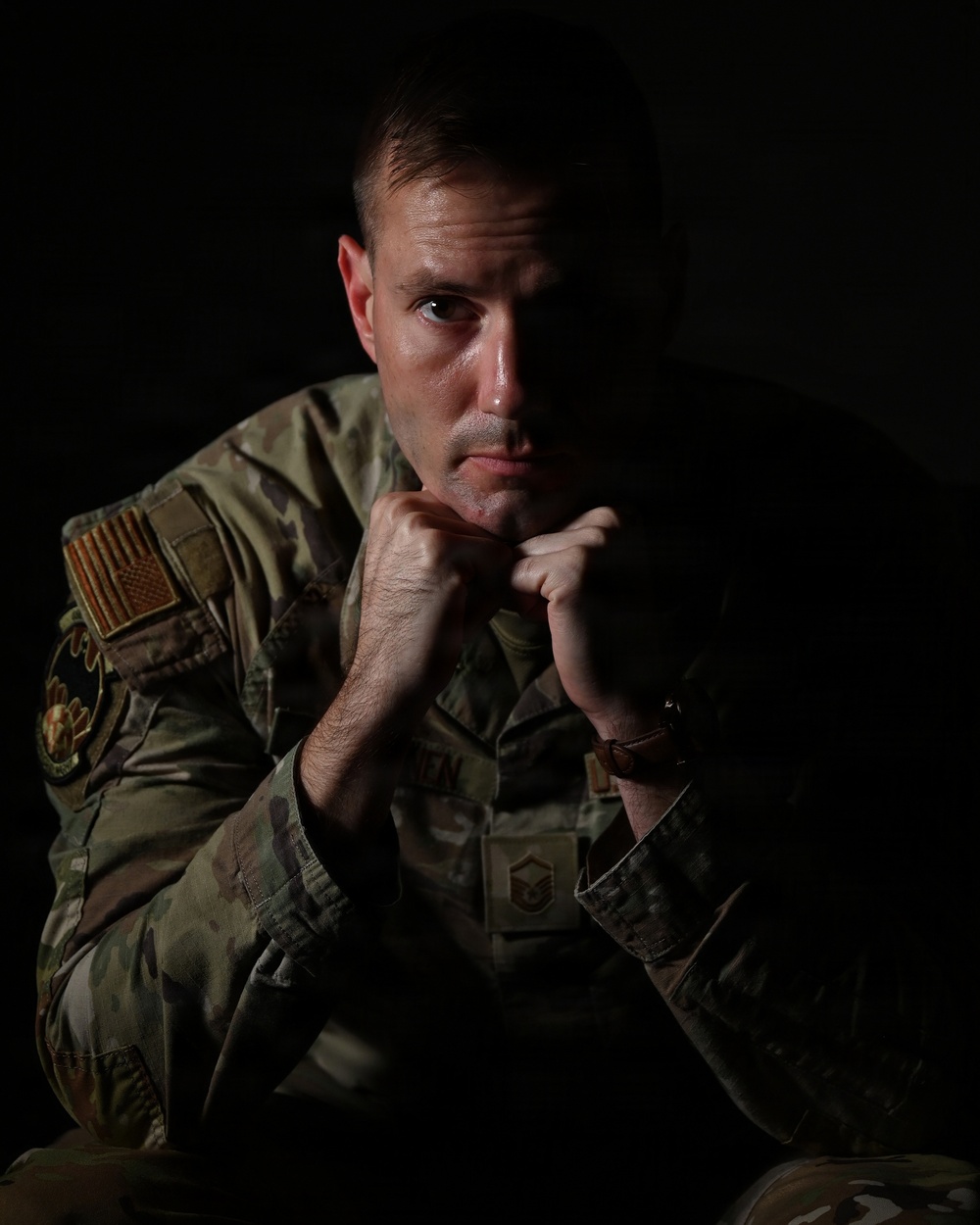
Photo By Karen Abeyasekere | U.S. Air Force Master Sgt. Timka Peltonen, 488th Intelligence Squadron, poses for a...... read more read more
 Subscribe
Editor’s note: This is the first in a three-part series highlighting a Team Mildenhall member’s personal journey through alcoholism and out the other side. Look out for Parts Two and Three, coming soon. Having sunk to rock bottom after suffering from alcoholism for several years, then self-referring three times within a four-year span with the Alcohol and Drug Abuse Prevention and Treatment program, Timka Peltonen worried that his career – and more importantly, he – wouldn’t survive. But with the help of supportive leadership and others around him who stepped in to help, he found light at the end of the tunnel and a zest for life he’d thought was gone forever. Peltonen, a master sergeant with the 488th Intelligence Squadron at RAF Mildenhall, was born in Finland and moved to Los Angeles with his family when he was 5 years old. “I joined the Air Force because I was tired of living with my parents and working in a pizza place while also doing other odd jobs. I graduated school at 18 and carried on those jobs until I was about 20 years old,” he said. The youngest of four children, Peltonen joined the military in 2007, following his eldest sister’s footsteps into the Air Force, rather than joining the Army like his eldest brother. In at the deep end Prior to becoming part of the cyber security career field, he joined as a missile maintenance technician and went through four months of tech school, before being assigned to Minot Air Force Base, North Dakota, in 2007. As a brand-new, young Airman, Peltonen immediately started working 12 to 14-hour shifts for three months straight. That was when he began to learn what stress looked like; what he didn’t realize at the time was that it was about to become much worse. And so, the stress begins “During that time, I turned 21 and started drinking. It became normal for me – I would go to work, do my job, come home to my dorm room, and there I would have either vodka or rum while playing video games. That was the cycle,” he said. Working long shifts and closing out the week at the bar with the Airmen from his squadron soon became the norm for Peltonen. It was during this constant cycle that he met a staff sergeant named Doug, who turned out to be someone who would have a significant impact on him later in life. “At the time, I was a quiet Airman, kind of reserved, and Doug was the complete opposite. He was an A-type personality, and everyone loved and respected him; he’s the person I wanted to be like in my career. He was also the one I would go out drinking with and would often invite me and other Airmen over to his house to play cards.” When he was 24, Peltonen got married but said even then, the regular drinking with his friends continued. “I was at Minot for seven years before getting orders to Barksdale. That was a little different because I’d just got to a new unit and didn’t feel like I fitted into the squadron when I arrived. That turned out to be the consistent feeling throughout,” When getting home from work every day, he would immediately start drinking and it soon began impacting both his marriage and his job. Opening up about his alcoholism, Peltonen explained how he was using it as a coping mechanism to numb himself to the things around him. “I felt like an outcast at the time. It just seemed like I was constantly trying to do my best at work, but it wasn’t being recognized. I was put in a negative limelight, and it felt like I was trying to dig myself out of a hole but couldn’t. On the marriage side, that wasn’t too great either,” he recalled. Seeking help, finding ADAPT The next stumbling block came when Peltonen failed an evaluation, which resulted in his leadership making the decision to move him elsewhere. “It was the straw that broke the camel’s back,” he recalled. “I just felt defeated and overwhelmed by work; nothing was working out. That’s when I went to ADAPT for the first time, voluntarily, in 2016. I told them, ‘I think I have a drinking problem’”. The ADAPT program is a six-month-long program, and the attendee’s entire command team is involved, assisting in coming up with a plan for how to move forward. “One of my close friends went through it and had good things to say about the doctor who was in charge – Capt. Patience. He was great, and the experience was very impactful for me.” Captain Patience explained to Peltonen that he had two options – either as an out-patient, working with them and going home each day, or as an in-patient, where they send you somewhere for 30 days, and you stay the entire time. Peltonen chose the in-patient route with a 30-day program. He packed his stuff and headed to Dallas – about two hours away from where he was stationed. “It was eye-opening,” he said. “As an in-patient, I met people from across the (then) Department of Defense, including Marines and Army. People who were there weren’t just there for alcoholism, but also for combat trauma and personal trauma. I saw a gamut of people at their worst; they were all struggling and they needed help.” Round One After completing the first month of in-patient care, Peltonen returned to Barksdale to continue the second phase of the ADAPT program. At the three-month mid-point, his command team met again and recommended he pursue controlled drinking for the next stage.
Controlled drinking is a method aimed at reducing alcohol consumption to safer levels rather than completely abstaining. It involves strategies such as setting moderate drinking goals, being aware of social influences, and developing self-awareness around triggers. During the controlled drinking phase, he attended weekly sessions that focused on recognizing how small, seemingly irrelevant choices could snowball. The program focused on building awareness and responsibility for those decisions. “The whole ADAPT program was about giving me the tools to succeed and me using my hand to move them,” said Peltonen. However, while he believed at the time he could successfully use those tools, it turned out to be a much more difficult, rockier journey that he could ever have imagined. Editor’s note: Learn more about Peltonen’s struggle and the journey which steered him to a much brighter future in Parts Two and Three of his story, coming soon on the RAF Mildenhall website. The Alcohol and Drug Abuse Prevention and Treatment program promotes readiness, health and wellness through the prevention and treatment of substance misuse by providing comprehensive education and treatment to active-duty service members. There are three ways to enroll in the Air Force ADAPT program: command referrals, medical referrals and self-referrals. The earlier a member receives help, the more likely they are to prevent negative impacts to their career or personal life due to alcohol or drugs. The ADAPT clinic offers services including education, outreach and treatment. For more information on the ADAPT program, call DSN 314-226-8602/8603, or commercial, 01638 548602/548603, or walk in to the ADAPT clinic at RAF Lakenheath, building 922.
| Date Taken: | 10.07.2025 |
| Date Posted: | 12.02.2025 09:53 |
| Story ID: | 552730 |
| Location: | RAF MILDENHALL, SUFFOLK, GB |
| Web Views: | 704 |
| Downloads: | 1 |

This work, Recovery, resiliency: Leap of faith takes SNCO from ADAPT to warrant officer, by Karen Abeyasekere, identified by DVIDS, must comply with the restrictions shown on https://www.dvidshub.net/about/copyright.

No keywords found.




