
Photo By Amanda Rae Moreno | OPTIC was developed to replace the patchwork of outdated tools that slowed down...... read more read more
 Subscribe
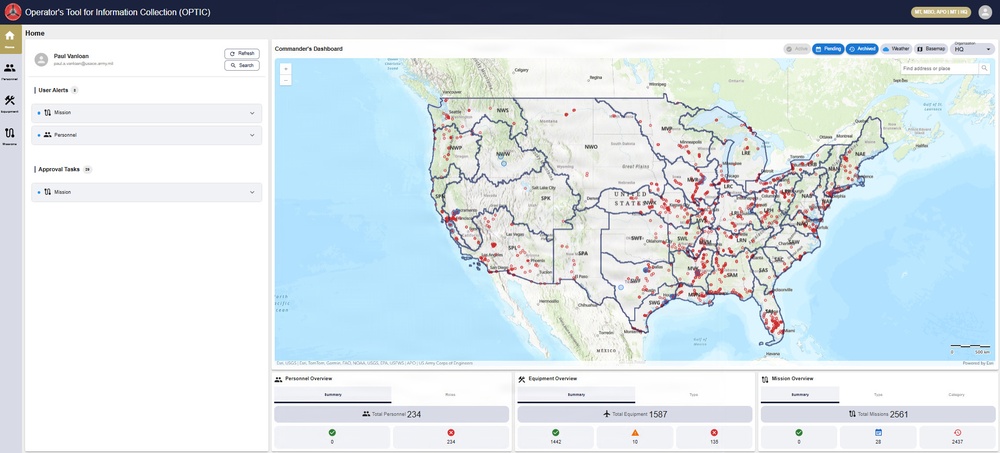
Every operator knows the frustration. You’ve got a mission window, aircraft prepped, and a checklist of tasks. The planning tools seem stuck in another decade. Between spreadsheets, PDFs, and email threads, it often takes longer to coordinate a drone mission than to fly it. Operators have long said the same thing: there must be a better way. That way is OPTIC (Operators Tool for Information Collection), designed to put mission planning back where it belongs: in the operator’s hands. Built with direct field input, OPTIC eliminates redundant steps and connects everything from personnel, equipment, and mission data into one intuitive interface. A Better Way to Plan OPTIC was developed to replace the patchwork of outdated tools that slowed down mission readiness. Traditional workflows required operators to manually enter data across multiple systems, track equipment availability separately, and coordinate approvals over email. With OPTIC, all of that happens in one secure platform that’s accessible from anywhere. Under the old workflow, mission details had to be entered manually without automatic checks and balances, creating extra steps and increasing the chance of clerical errors. OPTIC streamlines that process by integrating mission planning, equipment tracking, and personnel assignments into a single platform. Instead of jumping between programs, teams now work from one cohesive system. The previous process also forced users to redo work frequently because of version errors or missing attachments. OPTIC eliminates those frustrations through real-time updates that prevent duplication and confusion. Everyone sees the same information at the same time, which significantly improves accuracy and coordination. Approvals used to move slowly because corrections were needed, often requiring follow-up to keep things on track. With OPTIC, approval routing and digital signoffs are built directly into the system, ensuring faster movement and clearer accountability. Visibility across teams was also limited in the old workflow. Users often lacked a full understanding of overall mission status or resource availability. OPTIC addresses this by providing shared dashboards that give complete situational awareness for everyone involved. Finally, previous tracking for logs and forms used to create bottlenecks and made recordkeeping cumbersome because there were not stop gaps built in to keep information integrity. OPTIC replaces those paper trails with automated digital logs and exportable reports, making documentation easier, faster, and far more reliable. Operator Perspective “We used to spend half a day just coordinating who and what was available,” said Heng-Wei (David) Tsai, P.E., Chief of Advanced Data Section in USACE Galveston District “With OPTIC, I can see aircraft status, personnel readiness, and mission requests in one place. It’s like going from a flip phone to a smartphone overnight.” That simplicity wasn’t an accident. Every feature in OPTIC from drop-down menus to automated form fills was designed with real user feedback in mind. Operators don’t have to learn a new system; they just gain a faster one. Ready for Takeoff OPTIC isn’t just software it’s a smarter way to operate. It gives teams the situational awareness and confidence to plan missions efficiently, reduce delays, and meet operational timelines with fewer touchpoints. Training materials, walkthroughs, and user guides are available on the Aviation Program Office (APO) SharePoint site for those looking for reference materials within USACE. For those outside of USACE reach out to APO team at usace.aviation@usace.army.mil for demos and information to integrate OPTIC into your workplace.
| Date Taken: | 12.01.2025 |
| Date Posted: | 12.02.2025 08:19 |
| Story ID: | 552723 |
| Location: | US |
| Web Views: | 124 |
| Downloads: | 0 |

This work, Simplifying Mission Planning with OPTIC, by Amanda Rae Moreno, identified by DVIDS, must comply with the restrictions shown on https://www.dvidshub.net/about/copyright.


No keywords found.




