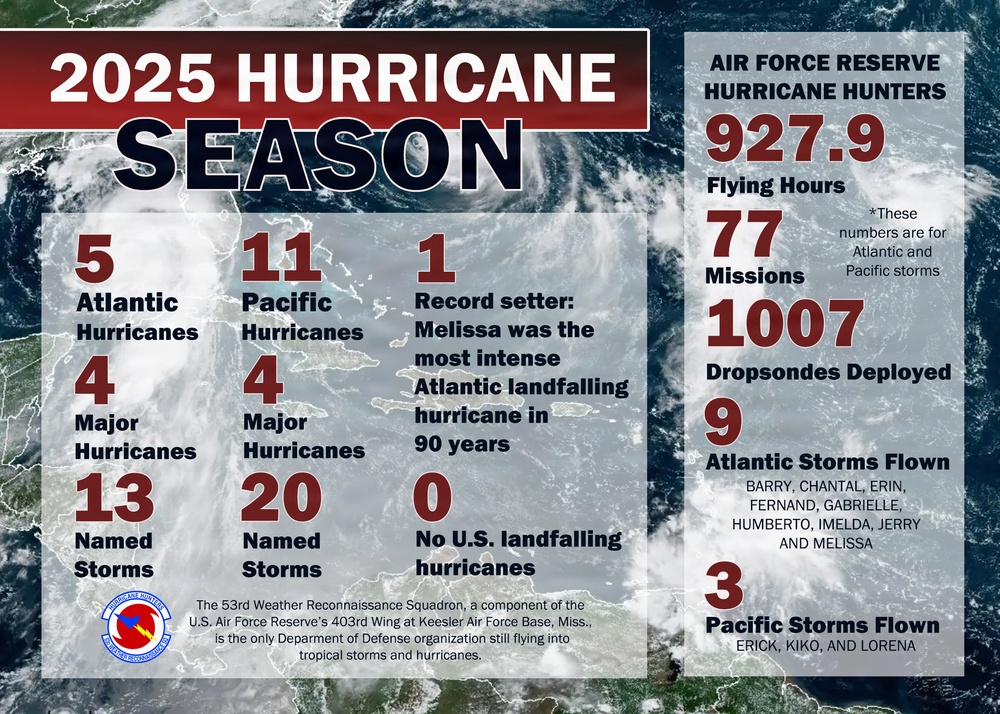
Photo By Lt. Col. Marnee Losurdo | Aircrew with the 53rd Weather Reconnaissance Squadron, known as the Air Force Reserve Hurricane Hunters wrapped up the 2025 hurricane season after flying 927.9 hours and three Category 5 storms across the Atlantic, eastern Pacific, and central Pacific. Operating from Keesler Air Force Base, Mississippi, the Air Force Reserve squadron’s WC-130J Super Hercules aircraft collected vital data that improved forecasts and saved lives. (U.S. Air Force graphic by Lt. Col. Marnee A.C. Losurdo) see less
| View Image Page
KEESLER AIR FORCE BASE, MISSISSIPPI, UNITED STATES
Hurricane Hunters wrap up 2025 season after flying three Category 5 storms
The 2025 Atlantic hurricane season officially ended Nov. 30, closing another demanding chapter for the Air Force Reserve’s 53rd Weather Reconnaissance Squadron.
The “Hurricane Hunters” flew 927.9 hours this year across the Atlantic, eastern Pacific and central Pacific basins, collecting critical data that improved forecasts, saved lives and once again demonstrated the squadron’s no-fail mission in action.
From their first flight into Hurricane Erick on June 18 to their final mission into Hurricane Melissa on Oct. 30, 53rd WRS crews faced one of the most intense storm seasons in recent memory. This year’s taskings included three Category 5 hurricanes and the second sub-900 millibar storm the squadron had flown in as many years.
The Hurricane Hunters kicked off the season when a WC-130J Super Hercules and aircrew departed Keesler Air Force Base for Hurricane Erick in the eastern Pacific. That sortie marked the first operational flight of the 2025 season and the start of what forecasters predicted would be an active year for tropical systems.
“Our job is to fly directly into the storm and collect vital information such as wind speeds, pressure, temperature and humidity,” said 1st Lt. Mark McCoy, 53rd WRS aerial reconnaissance weather officer. “While satellites provide a significant amount of information, the data we gather within the storm is unique and cannot be captured from space. That information helps the National Hurricane Center refine forecasts and gives people more time to prepare.”
The 53rd WRS, assigned to the 403rd Wing, is the only Department of Defense unit that flies into tropical systems to gather real-time atmospheric data. Using a fleet of 10 WC-130J Super Hercules aircraft, the squadron operates year-round and is prepared to support 24-hour operations during the peak of hurricane season. Data from their flights is transmitted in real-time to the National Hurricane Center and shared with NOAA, the U.S. Navy and other domestic and international forecasting agencies.
“Every time we fly into a storm, we’re collecting data that can directly impact how communities prepare and respond,” said Lt. Col. Steve Burton, 53rd WRS director of operations and the deployed detachment commander. “We train all year for this. What we do helps save lives and property.”
According to Warren Madden with the National Hurricane Center’s Chief, Aerial Reconnaissance Coordination, All Hurricanes, the squadron’s 2025 missions were defined not by quantity, but by intensity. In the Atlantic basin, the squadron flew into Hurricanes Barry, Chantal, Erin, Fernand, Gabrielle, Humberto, Imelda, Jerry and Melissa, as well as an early August invest in the northern Gulf of Mexico and another in late August near the Windward Islands. In the eastern Pacific, crews flew into Hurricanes Erick and Lorena, and in the central Pacific they supported missions into Hurricane Kiko.
"What was unusual this year was the overall lack of activity in both the Gulf and in the Caribbean,” Madden said. “We only flew one named storm in the Gulf—Barry—along with two northern Gulf invests. Chantal was the only system that produced direct wind impacts to the continental U.S., and Melissa was the only storm we flew in the Caribbean.”
What did stand out was the strength of several storms.
“Three of the systems—Erin, Humberto and Melissa—reached Category 5 strength, and Melissa became the second sub-900 millibar storm we’ve flown in as many seasons,” Madden said, referencing 2024’s Hurricane Milton. “That level of intensity in consecutive years is rare.”
The Hurricane Hunters’ most demanding mission of 2025 came late in the season when Tropical Storm Melissa rapidly intensified over the Caribbean. On Oct. 21, the 53rd WRS deployed aircrews and aircraft to a Forward Operating Location in Curaçao, positioning closer to the system as it strengthened into a Category 5 hurricane. Over a seven-day period, the squadron flew 17 missions and 170 flight hours into Melissa, conducting around-the-clock operations to support National Hurricane Center forecasts.
Flying WC-130Js at roughly 10,000 feet, the crews penetrated Melissa’s eye two to four times per mission, releasing dropsondes that measured temperature, humidity, wind speed and direction, and barometric pressure from the aircraft down to the ocean surface.
“That information was delivered directly to the National Hurricane Center to improve forecast accuracy as Melissa intensified,” said Burton.
The deployment took place during a federal government shutdown, which complicated travel, funding and coordination.
“Despite the administrative hurdles, our Hurricane Hunters continued operations uninterrupted, ensuring forecasters received the critical data needed to protect lives,” said Col. Jaret Fish, 403rd Wing commander. “Our Airmen demonstrated the flexibility and dedication that make the Reserve force vital to the nation’s readiness.”
Burton said the shutdown only underscored the team’s professionalism and focus.
“Even with the challenges, our crews stayed focused,” said Burton. “We knew communities were already feeling Melissa’s impact. Every data point we gathered fed into forecasts that helped officials make life-saving decisions. That’s why we do this mission.”
Hurricane Melissa devastated the Caribbean with 185 mph winds, torrential rain and flooding, with Jamaica hardest hit and suffering widespread destruction and infrastructure failures. The UN and U.S. State Department estimate $6–7 billion in damage to Jamaica, deadly flooding and landslides in Haiti, coastal flooding in Cuba, and at least 90 deaths across the region, including 45 in Jamaica where Melissa made landfall near New Hope Oct. 28.
By staging out of Curaçao, the Hurricane Hunters reduced flight time to the storm’s center, enabling more frequent eye penetrations and higher-density dropsonde coverage during Melissa’s peak intensity. That increased cadence provided near-real-time data that helped forecasters and emergency managers issue more accurate warnings and evacuation guidance.
With the last scheduled hurricane mission completed Oct. 30, the Hurricane Hunters spent November transitioning to winter storm reconnaissance operations in support of the National Winter Season Operations Plan. These atmospheric river missions collect data over the Pacific Ocean to help predict heavy rainfall and flooding events that affect the western United States.
“The hurricane season may be over, but our mission never really stops,” Fish said. “Whether it’s tropical cyclones or atmospheric rivers, our Airmen deliver data that directly supports national preparedness and disaster response.”
From the first flight into Erick to the last eye-wall penetration of Melissa, the 53rd WRS’s 2025 season reaffirmed the critical role of manned reconnaissance in weather forecasting.
“Our crews flew nearly 850 hours this season through some of the most intense storms on record,” Fish said. “Their work saves lives, protects property and provides the science that forecasters rely on every day. We’re proud of what they accomplished.”

 Subscribe






