WRAIR-EME protects force health with vector surveillance at Eagle Partner 2025
Courtesy Photo |
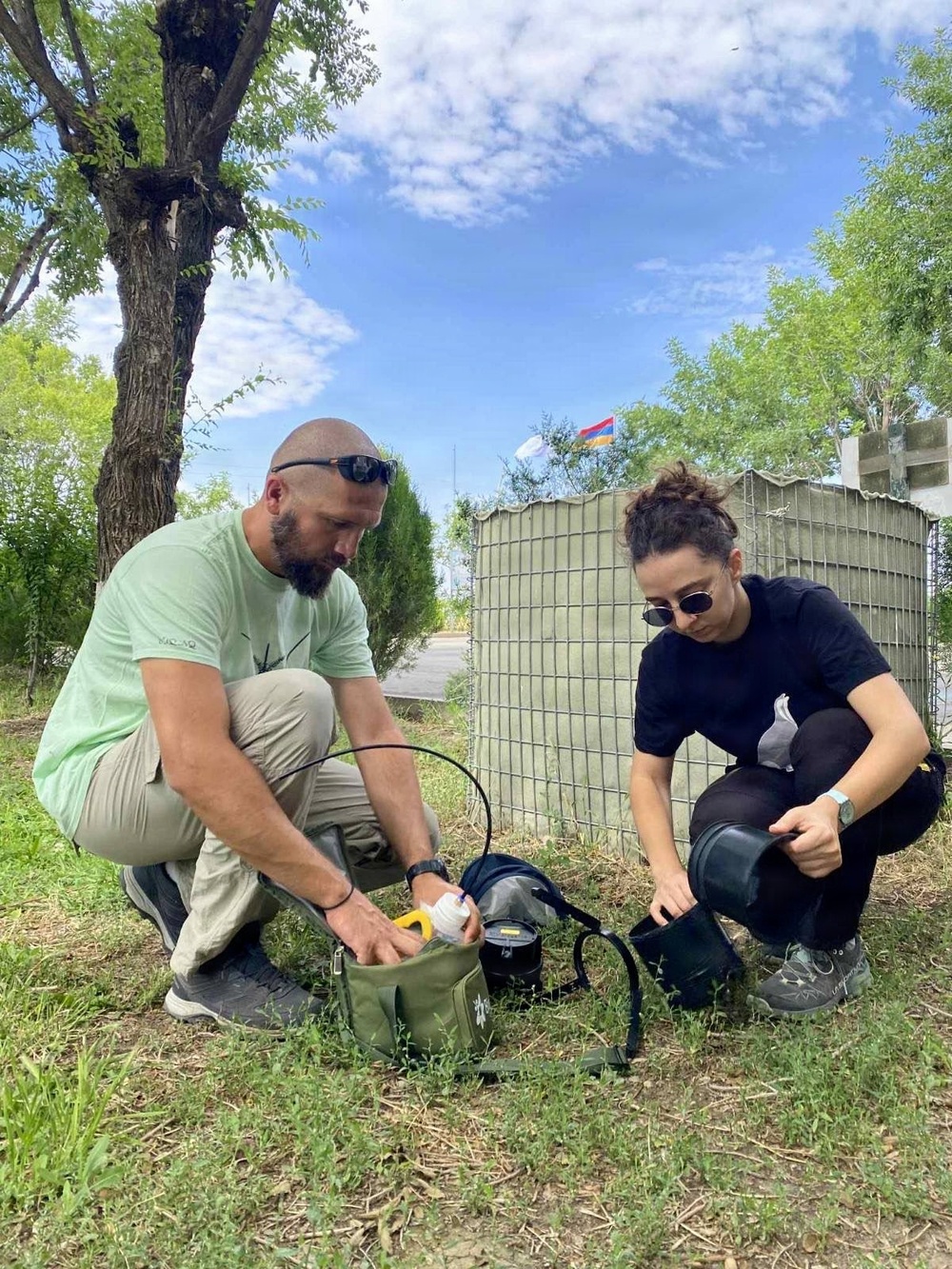
Dr. Giorgi Kirkitadze and Ms. Anano Shubashishvili (WRAIR-EME) set up mosquito traps......read moreread more
Courtesy Photo | Dr. Giorgi Kirkitadze and Ms. Anano Shubashishvili (WRAIR-EME) set up mosquito traps at locations expected to have mosquitoes. see less
| View Image Page
WRAIR-EME protects force health with vector surveillance at Eagle Partner 2025
The Walter Reed Army Institute of Research Europe-Middle East conducted vector surveillance in support of exercise Eagle Partner from 8 to 11 July at military bases in Armenia.
Eagle Partner is an annual joint exercise conducted by the peacekeeping brigade of the Armed Forces of the Republic of Armenia, U.S. Army Europe and Africa, and the Kansas National Guard to focus on preparation and execution of peacekeeping operations and on medical evacuation procedures.
WRAIR-EME supported the exercise by conducting vector surveillance at Pambak and Zar military bases, setting traps and using other techniques to collect ticks, mosquitoes, and sand flies. The team then analyzed the samples for vector-borne diseases that are known to pose a risk to the service members participating in the exercise, such as malaria, West Nile virus disease, and leishmaniasis.
“This year was the first time ever our entomology team surveilled in Armenia and conducted vector surveillance in support of the exercise,” said Maj. David Denlinger, an entomologist at WRAIR-EME. “Many non-battle injuries are caused by vectors, so it’s essential to know what is out there before the joint exercise begins.”
WRAIR-EME’s examination of the 61 collected vectors revealed no pathogens that posed a risk to force health. The results were reported to medical staff and leadership to inform preparations for Eagle Partner in August 2025.
“Eagle Partner takes place during the heat of the summer, so we collected fewer vectors than we do in the springtime or fall time,” said Denlinger. “We hope to conduct an expanded, routine schedule of vector surveillance in the fall and the spring in Armenia that will give a more complete picture of the disease threats for Eagle Partner, United States Army Europe and Africa, and the United States European Command.
One of WRAIR-EME’s central capabilities is entomological research: maintaining a record of the vectors and vector-borne diseases present in an area over time. Threat mapping of these disease vectors provides enhanced resolution on regional vector-borne threats, allowing public health leaders and Command Surgeons a greater understanding of existing and novel diseases within their areas of responsibility.
“Vectors don’t care about the flag patch or the name on your uniform,” Denlinger said. “Everyone is at risk from a disease transmitted by a vector. We do what we do to keep service members in the fight.”
To learn more about WRAIR-EME, our disease surveillance, and other capabilities, visit our website at [https://mrdg.health.mil/](https://mrdg.health.mil/)