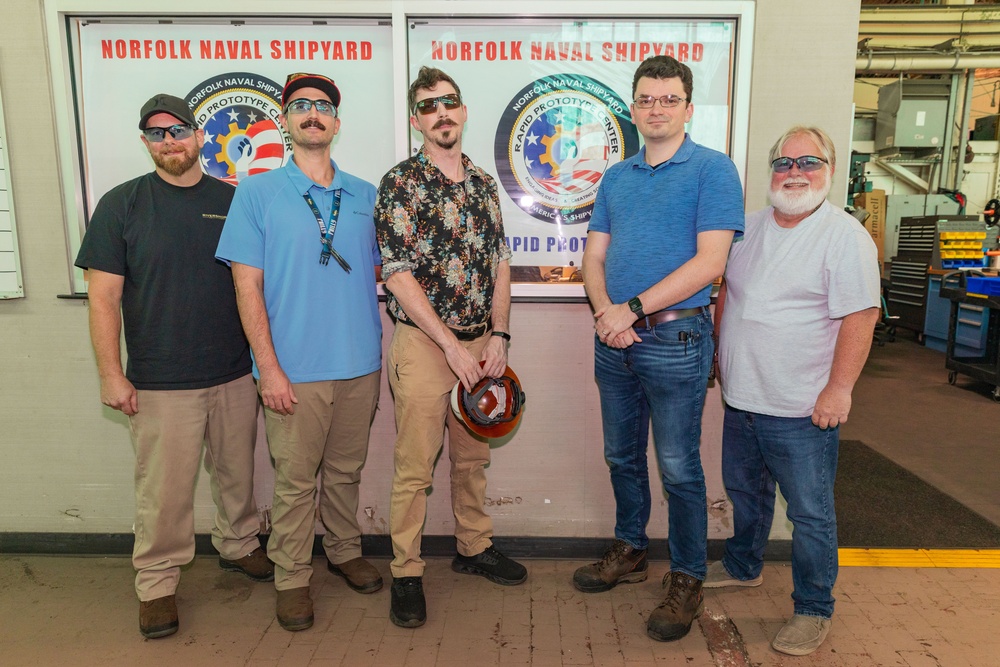
Photo By Petty Officer 1st Class Christian Victor Bautista | From left to right: Shop 31 Toolmaker Troy Elmore, Code 930 Process Manager Chris Conley, Shop 38 ALRE Supervisor Benaiah Wade, Code 263 Waterfront Lead Hydraulics and Machinery Jonathan Schwalm, and Code 100TO.32 RPC Program Analyst Kelly Carson. Not pictured: Shop 31 Toolmaker Nino Perkins and Code 100TO.32 RPC Engineering Technician John Tate. Special mention to Kenny Kinstler, who has recently retired but was integral in developing the JBD Conveyor for the RPC. see less
| View Image Page
Eye On Innovation: Rapid Prototype Center’s Jet Blast Deflector Conveyor Tool Brings Huge Savings to America’s Shipyard and the Navy
On our naval aircraft carriers, as the jet engines rev up to lift off from the flight deck, jet blast deflectors (JBD) are positioned to redirect the high energy exhaust to prevent injury and damage to those around it. The structure is built to be strong enough to withstand heat and high speed air streams and must be able to be raised and lowered when needed. As part of the shipboard repairs at Norfolk Naval Shipyard (NNSY), mechanics see to these repairs with each carrier project, yet often were faced with dilemmas due to the requirements with the 2,000 pound shaft within the JBD. Through previous tooling and processes, in order to properly lift the massive fixture to conduct those repairs, the team would have to follow extensive rigging requirements, setting up picks along the intended path and cutting out access points to support the lifting of the shaft. An extensive process that took more than three days and would require additional welding, painting, fabrication and inspections, Shop 38 Aircraft Launch and Recovery Equipment (ALRE) Supervisor Benaiah Wade knew there had to be a better way to get this done.
“I originally discussed with HII since we knew they were able to overhaul their JBDs without doing all these cuts. We ended up landing on the need for a conveyor, yet what we were able to find wasn’t reaching the low profile we needed for the job,” said Wade. “We wanted a rolling device that you could control the height, weight, and motion of this object without it being destabilized or having it ram into something and causing damage. We had an idea – we just needed help making it a reality.”
Enter Code 100TO.32 Rapid Prototype Center (RPC), a division of Rapid Innovation, a one-stop shop for shipyard workers looking to have prototypes developed to fit their needs across the waterfront. “Wade and his work leader walked through the door and shared with us the issue they were having and what they were looking for,” said RPC Engineering Technician John Tate. “If they could just have a device that didn’t fall into the major rigging requirements, something that could lift the shaft up the little bit needed to get out of the fixture assembly and motivate it sideways safely and efficiently, it would save on a lot of time and effort for the mechanics. Together, we worked through some ideas we thought could work and once we had a vision in mind, we got to work.”
With drawings developed of what they wanted to create and what materials they would be using, Code 263 Waterfront Lead for Hydraulics and Machinery Jonathan Schwalm began calculating the specs that would be required to achieve the lift they needed. “When it comes to handling large amounts of weight, we have to have a factor of safety defined,” he explained. “This was a new design and we didn’t have a full vector figured out for Code 263 [Surface Ship Auxiliary/Hydraulics Branch] to accept the process. I took those preliminary sketches that were mocked up, built in all the data from the material, went through catalogues, and I was able to make a 3-D model based on the materials specified to be used. We confirmed everything was good for the weight to be handled and balanced on the tool and with that, we were able to have Code 263’s blessing to proceed.”
The RPC then teamed up with NNSY's Mechanical Group (Code 930) and the Inside Machine Shop (Shop 31) Toolmakers to develop the prototype, Toolmaker Apprentice Nino Perkins was the first to tackle the initial prototype. And within 30 days of the request coming through the RPC’s door, the Outside Machine Shop (Shop 38) had something in hand to test shipboard on USS George H.W. Bush (CVN 77). “When it went through ship check, the team was very excited to see it work so well. We took some feedback for ways to improve the design and were already on task to work on additional kits,” said Code 100TO.32 RPC Program Analyst Kelly Carson. Four sets of six rollers have been completed so far thanks to the RPC, Perkins, and Toolmaker Troy Elmore. These rollers have been used on various repairs for the JBDs on CVN 77 and USS Dwight D. Eisenhower (CVN 69).
For a job that at its fastest used to take three 12-hour days to complete and require extensive work across various trades, could now be done in a fraction of the time. “We can move the shaft now from one spot to the other with the conveyor in 45 seconds,” said Wade. “It’s less stress on the mechanics as well as the boat itself.”
Carson added, “This has made a significant difference and it's a huge win for our shipyard. We would love to share this design with anyone who wants to utilize it!”
“This project has been a tremendous success and we’re looking at ways devices like these can be utilized across all our projects, including submarines, or if there are other ways the RPC can assist our mechanics on the waterfront,” said Code 930 Process Manager Chris Conley. “With the RPC’s help, seeing how efficient and knowledgeable they are making prototypes and being able to come up with something on the fly just from a conversation and have a piece of equipment in your hands that you can shipcheck within two weeks to 30 days is pretty insane. Seeing their skills firsthand, I can go to the boat now and doing surveillances, I can ask the mechanics how can we help, how can we make this better for you, I know there are people behind me and around me that can do what we can to see improvement on the deckplate.”
Tate noted that for a project like this, teamwork is what made it possible to achieve. “Everyone stepped up to the plate to help make this a reality and that’s something great about our shipyard family – they are ready and willing to do their part to help their teammates,” he said. “With this job, we were able to generate work for our toolmakers and apprentices, get them those added opportunities to hone their skills and develop something that could make a huge difference to our mechanics on the ship. We had Code 930 and Code 263 helping us test the product and getting it to where it needed to be so it was ready to be used shipboard. We also had our RPC teammates putting in the work to bring this idea to life and assembling it so it was ready to go.”
Tate continued, “Lots of ideas are out there, people just sometimes feel that they don’t have anywhere to go to share those ideas or that there are no resources in place to try it out and see how it goes. That’s what the RPC is for. We hear your ideas and see what we can do to make it a reality. We’re here to help and are always ready to listen and see what we can create for you to make your job easier.”
Interested in working with the Code 100TO.32 Rapid Innovation Branch? Visit the NNSY SharePoint site at https://flankspeed.sharepoint-mil.us/sites/NAVSEA_NSY_NORFOLK and click the Hot Links section to reach the 3D Print Request form. Provide your contact information and a description of what you need and the team will reach out to coordinate further details, files or designs, as well as schedule visits to the space to assess on-site. In addition, you can also visit the Code 100TO.3 Innovation & Tech Insertion Division in Bldg. 31 First Floor or the RPC on the third floor of Bldg. 171 to bring your ideas to them firsthand.
NEWS INFO
Date Taken:
11.13.2025
Date Posted:
11.17.2025 13:35
Story ID:
551392
Location:
PORTSMOUTH, VIRGINIA, US
Web Views:
153
Downloads:
0
PUBLIC DOMAIN
This work, Eye On Innovation: Rapid Prototype Center’s Jet Blast Deflector Conveyor Tool Brings Huge Savings to America’s Shipyard and the Navy, by Kristi R Britt, identified by DVIDS, must comply with the restrictions shown on https://www.dvidshub.net/about/copyright.