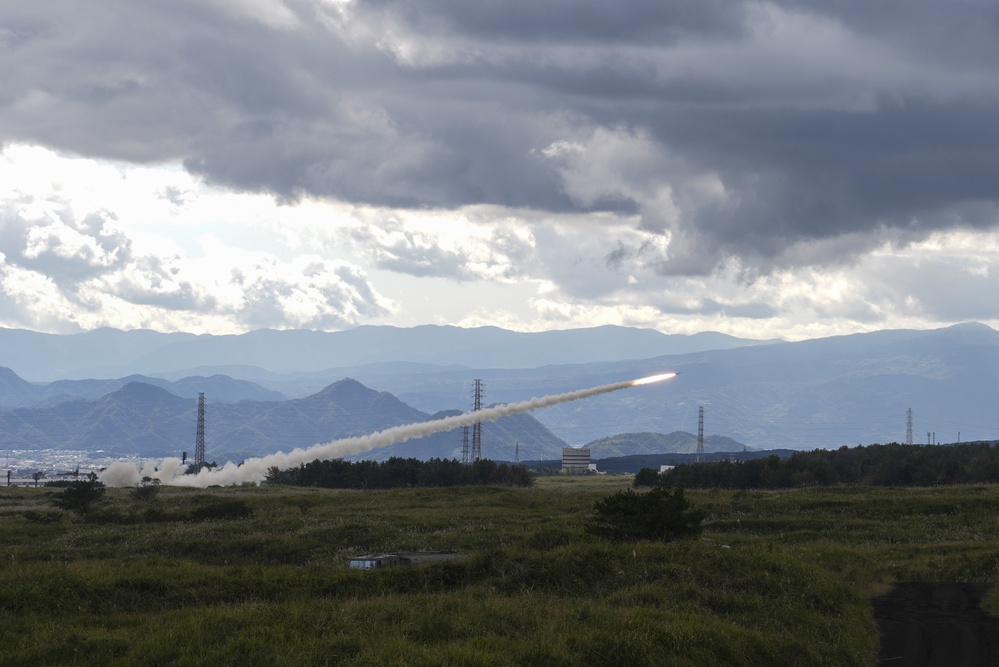
Well before the sunlight kissed the slopes of Mount Fuji, U.S. Marines prepared to make history with a display of lethality. A highly anticipated High Mobility Artillery Rocket System (HIMARS) live-fire exercise at the Combined Arms Training Center marked a turning point in U.S. defense Oct. 27, two weeks before the Marine Corps’ Birthday.
The sky lit up with a crack as the missiles fired, smothering the launch area in plumes of thick smoke. The successful exercise was a tangible illustration of a strengthening partnership, a commitment to regional security, and a powerful display of readiness and warfighting capability.
The HIMARS is a mobile rocket launch platform that can accurately obliterate targets up to 310 miles away with Precision Strike Missiles. They are capable of firing a six-rocket salvo within 45 seconds and then move to a different position after firing.
At Camp Fuji, senior officers and Japanese officials stood by the morning of the exercise, waiting for the missiles to be fired. U.S. Marine Corps Sgt. Dawson Dauzat, 3rd Battalion, 12th Marines, 1/11 Alpha Battery launcher chief, led his three-man crew to prepare their HIMARS launcher, call sign "Demon", by checking all instruments one last time.
"Key task when we arrived at the firing point was ensuring my launcher's danger area was safe with no unauthorized personnel or vehicles within 400 meters," said Dauzat. “Once the area was secured, we focused on getting the launcher ready by pointing it at the target, and checking the tolerances for the launcher to verify the elevation, slope, and azimuth are within range for the safety of the fire mission."
The process, far from a simple point-and-shoot affair, involved meticulous verification procedures, alignment of the launcher, and communication with the Fire Direction Center.
This attention to detail and focus on safety culminates in a heart-stopping moment. The signal to fire comes, arm and fire switches are flipped, circuits complete, and Dauzat’s crew sends “Demon’s” missile. The missile is so fast that, only after it has drawn a long smoke line across the sky, does its roar finally reach the spectating officers.
“I was really excited because we've been doing rehearsals for quite some time and we were told that we were going to be the first ones to shoot and make history,” said Dauzat. “My crew and I are proud and happy to be the first to do this; it was a really humbling and exciting experience!”
HIMARS training at Camp Fuji offers unique advantages, including realistic training terrain, adequate range capacity, and specialized infrastructure necessary to safely and effectively support HIMARS operations. The exercise culminated 12 years of planning and coordination between the U.S. and Japan.
“This success highlights the enduring partnership between the U.S. and Japan and our collaborative efforts in safeguarding regional security,” said U.S. Marine Corps Brig. Gen. Kelvin Gallman, United States Forces Japan deputy commander. “We extend our sincere gratitude to the government of Japan, Ministry of Defense, and Ministry of Foreign Affairs for their support in making this exercise a resounding success. This exercise is a tangible demonstration of the increasing capability and capacity of our forces here in Japan."
U.S. Army Col. Grady Lowe, USFJ J5 plans officer, emphasized the broader strategic implications. "The planning was a combined effort from both the US and Japan, showing how well we can work together," he said. "Our goals, as well as Japan's, are to remain on par with any new threats as they come out."
Now that Dauzat and the team have fired successfully, he hopes this milestone will open the door for more batteries and units to train at Camp Fuji, potentially using different types of ammunition and conducting combined-arms exercises with Japanese forces.
"What’s important now that this door has been opened is seeing the potential to do more and conduct bigger exercises like this," Lowe said. "I think as USFJ transforms into an operational and joint organization, we will see this exercise evolve and grow to fire launchers from U.S. and Japanese forces together."
The HIMARS training event aligns with priorities established by U.S. Air Force Lt. Gen. Stephen Jost, USFJ and Fifth Air Forces commander, to increase interoperability between U.S. and Japanese forces, optimize force posture, and advance the alliance.
| Date Taken: |
11.09.2025 |
| Date Posted: |
11.16.2025 21:02 |
| Story ID: |
551254 |
| Location: |
SHIZUOKA, SHIZUOKA, JP |
| Hometown: |
CAMP FUJI, SHIZUOKA, JP |
| Web Views: |
223 |
| Downloads: |
0 |
PUBLIC DOMAIN

This work, Historic HIMARS training exercise in Japan, by TSgt Emerson Nunez, identified by DVIDS, must comply with the restrictions shown on https://www.dvidshub.net/about/copyright.