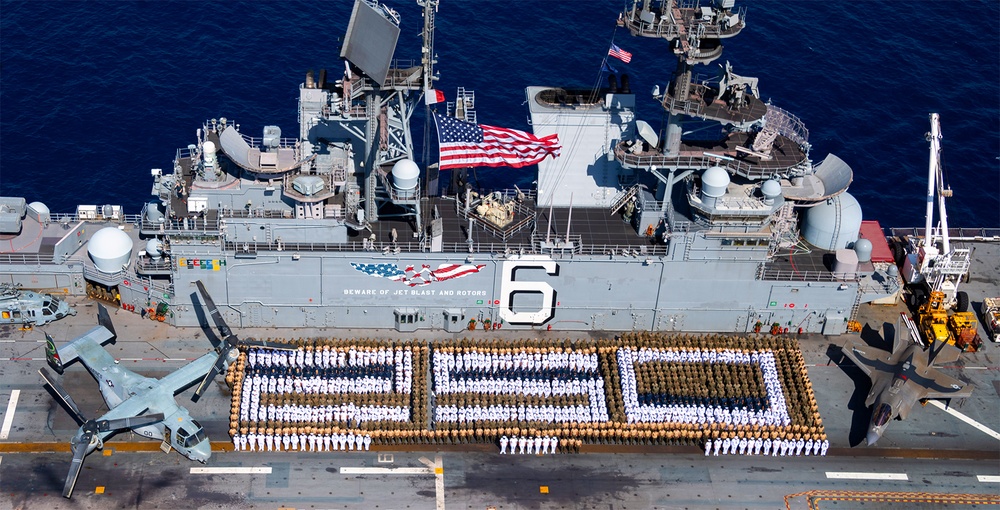
Photo By Petty Officer 2nd Class Kenneth Melseth | 250802-N-TW227-1081 CORAL SEA (Aug. 2, 2025) Sailors assigned to the forward-deployed amphibious assault ship USS America (LHA 6) and U.S. Marines with the 31st Marine Expeditionary Unit (MEU) stand in formation for a photo commemorating 250 years of naval service, while conducting operations in the Coral Sea, Aug. 2. America, lead ship of the America Amphibious Ready Group, is operating in the U.S. 7th Fleet area of operations. U.S. 7th Fleet is the U.S. Navy’s largest forward-deployed numbered fleet, and routinely interacts and operates with allies and partners in preserving a free and open Indo-Pacific region. (U.S. Navy photo illustration by Mass Communication Specialist 3rd Class Kenneth Melseth) see less
| View Image Page
America-class amphibious assault ship USS America (LHA 6) departed Sasebo, Japan for San Diego, California as part of a scheduled rotation of forces in the Pacific. This will be executed as a permanent change of station for the crew and family members.
The United States values Japan’s contributions to the peace, security and stability of the Indo-Pacific and its long-term commitment and hospitality in hosting U.S. forces forward deployed there. These forces, along with their counterparts in the Japan Self-Defense Forces, make up the core capabilities needed by the alliance to meet our common strategic objectives.
The security environment in the Indo-Pacific requires that the U.S. Navy station the most capable ships forward. This posture allows the most rapid response times possible for maritime and joint forces and brings our most capable ships with the greatest amount of striking power and operational capability to bear in the timeliest manner.
Maintaining forward-deployed naval forces capability with the most advanced ships supports the United States’ commitment to the defense of Japan and the security and stability of the vital Indo-Pacific region.

 Subscribe






