AL ANBAR PROVINCE, Iraq – The recently implemented Security Agreement between the United States and Iraq, combined with President Barack Obama's pledge to conduct a responsible and phased withdrawal of U.S. combat forces, means that fewer Marines are actively patrolling the towns and deserts of Iraq.
This decrease in overt combat operations, and the ever-increasing proficiency of the Iraqi security forces has relegated many Marines, Sailors, Soldiers and Airmen of Multi- National Force - West to established bases where they remain on alert to support Iraqi forces securing their own country.
However, one group of Marines that continues to go 'outside the wire' and venture into the once-volatile Iraqi countryside are the motor transport Marines of Truck Company, II Marine Expeditionary Force Headquarters Group (Forward). At least once a week, and often times far more frequently, these Marines leave the confines of Al Asad Air Base to deliver supplies, equipment and personnel to far-flung coalition outposts scattered throughout the Al Anbar province.
"Our primary mission is to organize and execute tactical convoys," said Capt. Tom Watson, commander of Truck Company. "We provide the ability to conduct limited operations without calling on additional assets from outside the unit."
Truck Company is a provisional unit, falling in on equipment from Marine units who have already completed their tours in Iraq, and is composed of motor transport operators, communicators, corpsmen, supply Marines, administrators and other specialists drawn from units throughout II MEF.
Some of the units represented within the ranks of the company are the 2nd Marine Division, 2nd Marine Logistics Group, 2nd Radio Battalion, 8th Communications Battalion, and II MHG, among others.
Watson went on to say that his team of drivers and mechanics also provide maintenance on all the rolling stock, or wheeled vehicles, assigned to the MNF-W command element and a number of units that report to II MHG (FWD).
Warrant Officer Ceylon Williams, the platoon commander for Truck Company's 1st Platoon, said the company's transportation mission puts them on the road while most other U.S. service members, and Iraqis, are asleep.
"We run all of our convoys at night," said Williams. "This way we have less impact on the Iraqi people's daily routine. It reduces [the U.S.] visible footprint and actually helps both sides by having less traffic and personnel on the roadway at the same time."
Operating at night provides a unique set of challenges to which the motor transport Marines have adapted by adding training and modifying daily schedules. Regardless of whether they rumble through the Iraqi countryside during the day or at night, the motor transport Marines relish the opportunity to do their jobs in a deployed environment.
"Being Motor-T is awesome," said Cpl. Sean Northcutt, a motor transport operator who normally drives the lead vehicle in his platoon's convoys. "I love it because [driving in Iraq] is such a different experience from back home. It's something to talk about later on."
When asked about the threat of insurgent attacks, Northcutt responded with typical Marine élan. "It's a little rush. I'm not scared or worried at all."
Although Northcutt is outwardly dismissive of the threat, he and his fellow Truck Company Marines take every precaution necessary to protect themselves, their vehicles, and their cargo – wearing the appropriate body armor, maintaining vehicle dispersion while on the move, conducting security checks when halted, identifying and countering potential threats, and following the correct safety procedures both on the truck lot and during convoys.
These precautions have paid off – the company has not had any major mechanical breakdowns or accidents. Although insurgents have attacked the company with improvised explosive devices at least twice since mid-January, the IEDs caused only minor damage to unit vehicles and no injuries.
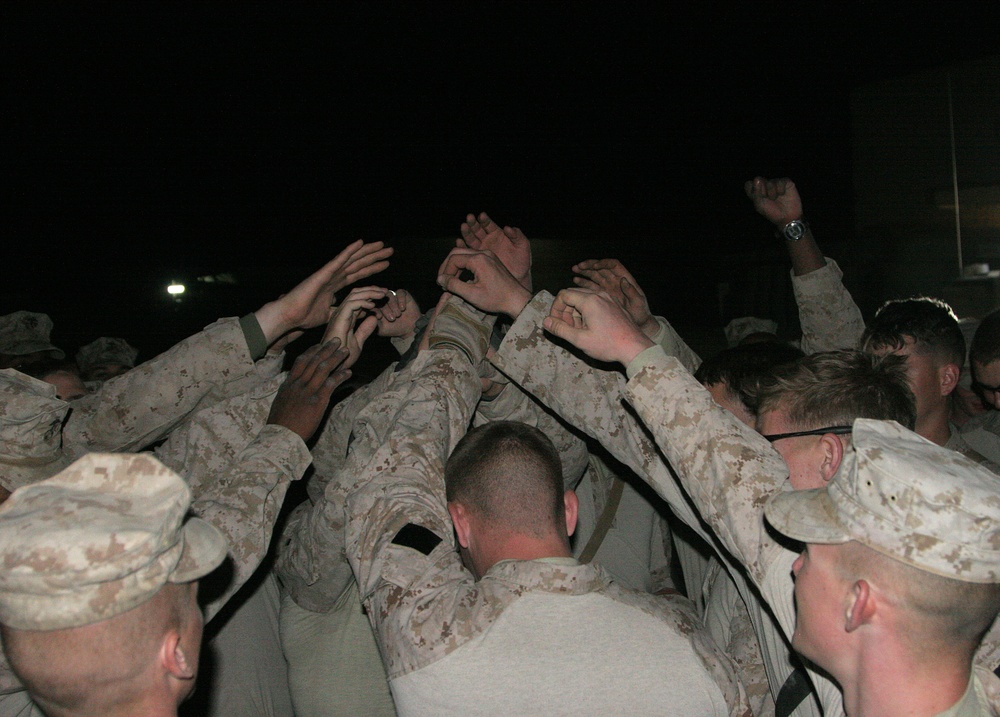
Hours before launching on a mission, the Marines begin preparing themselves and their vehicles. Tires are kicked, fuel tanks are topped off, fluids are checked, cargo is tightened, weapons are loaded, and the cabs of their humvees, 7-ton trucks, and mine resistant ambush protected vehicles are loaded down with water, food and personal equipment.
"A big part of our mission is escorting TCN [third-country national] trucks who haul every class of supply," added Williams, using a generic terms for civilian-driven, contracted rigs that haul food, vehicles, supplies and equipment from base to base within MNF-W. Working with the civilian truckers and their rigs presents a range of challenges for the Truck Company Marines.
"Dealing with them can be a pain," said Lance Cpl. Robert Thomas, a Truck Company motor transport operator, "but we're Marines so we adapt and overcome."
While the biggest problem is keeping the civilian trucks at the proper dispersion and pace, mechanical difficulties are also a constant headache for the Marines providing escort.
Lance Cpl. Matthew Shinn is one of Truck Company's wrecker operators and is the go-to guy when these civilian vehicles have problems on the road. While the Marine vehicles undergo a thorough pre-mission inspection and those deemed unfit are repaired or sidelined for further maintenance, no detailed process is in place to ensure the civilian trucks are road-worthy other than a cursory inspection before mission launch.
"My main job is to take care of everybody else," said Shinn, nicknamed 'Gator' because of his fixation on the University of Florida Gators.
When a civilian truck hauling large containers suffered a catastrophic breakdown during a recent convoy from Camp Al Taqaddum to Al Asad Air Base, Shinn and his fellow wrecker operator sprang into action. Unable to repair the truck on the road, they hitched the truck to their wrecker and towed the vehicle and its cargo the rest of the way to Al Asad – all at 3 a.m. on a desolate patch of highway in the middle of the desert.
"The hardest thing about dealing with the local drivers is not being able to talk to them," added Shinn, who was able to supplement his few words of Arabic with the drivers' broken English and hand signals to get the vehicle hitched up in a matter of moments.
Despite the long hours, unrelenting schedule and difficulty of their jobs, they are upbeat about their role in Operation Iraqi Freedom.
"I love my job," said Thomas. "In motor transport, we get a lot of experience and get to see a lot of things. This has been a great experience, and being able to get outside the wire, I get to be with the Iraqi people and see a different side of people I normally wouldn't be able to."
Lance Cpl. Cory Garrison is a maintenance management specialist within Truck Company and is normally in the lead vehicle, riding high in its turret behind an M-2 .50-caliber heavy machine gun.
"Our convoys are not the same every time so there are always new challenges," said Garrison. "It's definitely a learning experience, and a lot of responsibility because we're out here taking care of our fellow Marines."
With President Obama's vow to begin the U.S.' responsible drawdown from Iraq, Truck Company has become busier than ever positioning equipment for the Marines' eventual withdrawal.
"It's great that our Marines are so busy," added Williams. "The time is gonna fly by faster if all they do is sleep, eat and drive."
| Date Taken: |
03.22.2009 |
| Date Posted: |
03.22.2009 07:51 |
| Story ID: |
31442 |
| Location: |
AL ANBAR PROVINCE, IQ |
| Web Views: |
609 |
| Downloads: |
476 |
PUBLIC DOMAIN

This work, On the roads of Al Anbar province with Truck Company, must comply with the restrictions shown on https://www.dvidshub.net/about/copyright.

 Subscribe






