Sgt. Michael J. Carden
82nd Airborne Divison Public Affairs Office
Sept. 9, 2005
NEW ORLEANS " Hundreds of homes in the Lake View community, as well as thousands of others throughout Orleans Parish , are flooded from the aftermath of Hurricane Katrina and two broken levees. Many residents evacuated before it was too late, but many stood to face the storm and are now stranded in attics and upper-levels of their homes without food and clean water.
One can almost imagine the children who ran through the streets and played on jungle gyms and tire swings in the once quaint-suburban community, just Northwest of Downtown New Orleans.
"This was probably a really nice area to live," said Capt. Joe Geary as he steered his search and rescue team's zodiac-rescue boat through the community past flooded homes and floating children's toys.
"That was probably going to be someone's dream home," he continued, pointing to one house in particular. "The siding hasn't even been put on yet, and there are no walls inside " only a frame."
Geary is the commander of Company C, 307th Engineer Battalion, 82nd Airborne Division. He and his Paratroopers have been conducting water-borne search and rescue operations in this area since Sept. 8 -- just hours after arriving to the city.
"We didn't want to waste anytime," Geary said. "We just wanted to get on the ground, get moving and do our part to help out. That's the mindset of a Paratrooper."
On a Sept. 9 mission -- their second day of mission -- in the Lake View area, Paratroopers used street maps to maneuver their zodiac boats over the submerged roads and around floating debris to check houses for survivors.
Shouts of "U.S. Army!" and "We're here to help!" echoed from the zodiacs and throughout the neighborhoods as they followed street signs that were just barely above water level. The only other noise was that of rescue helicopters flying overhead searching for signs and signals of life in the community below.
During this mission, Geary and his team's cries went without response. Some may consider the quietness a bad thing -- that there are no survivors left in this area. But Geary and his troops look at it with a positive attitude -- that all of the survivors have been evacuated.
"I think its better that we don't find anyone," Geary said. "It's been so long since the actual hurricane occurred. I would think if there were any survivors, they would be at the end of their rope. That's why we push so hard and why we have the since of urgency that we do."
The rescue teams search door-to-door for three to four hours at a time. They knock and yell, waiting for a response or indication that someone is still alive inside. If there is an open window, troops attempt to climb through in search for residents who've endured the wait -- most of whom without food and water for as long as 10 days.
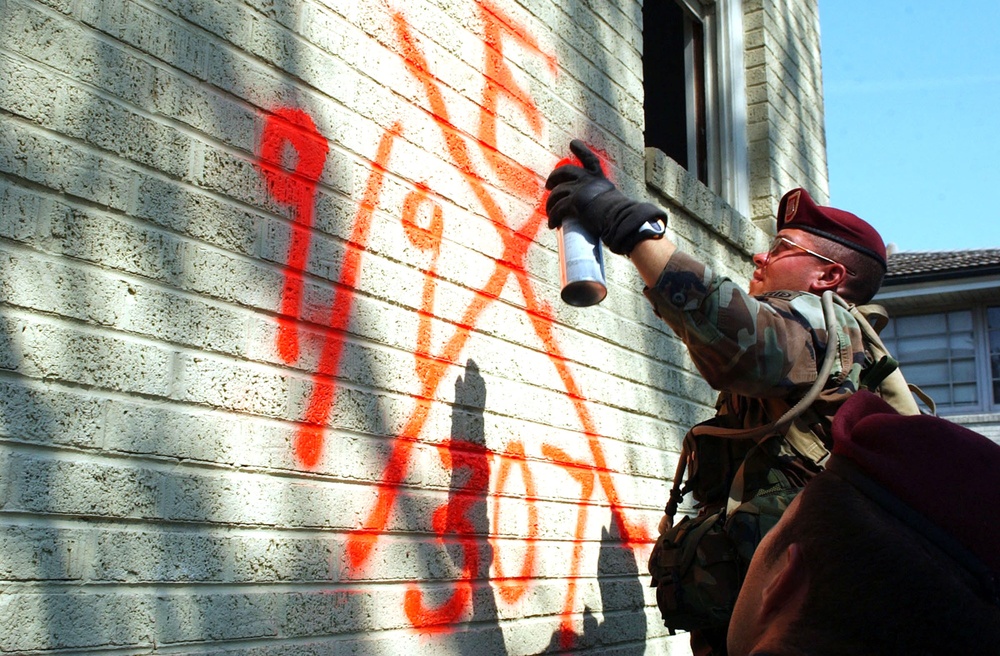
Once the homes have been checked or determined to be empty, the troops mark the house with a spray-painted "X", including the date and the unit that conducted the search, then promptly move to the next house.
The troops are careful not to make contact with the water. They take extra precautions and care when climbing from the zodiac to the house. Troops often apply sunscreen, hand sanitizer and wear gloves to minimize the possibility of being contaminated with unknown bacteria and water-borne diseases, said Spc. James O'Reilly, medic, Co. C, 307th Eng. Bn.
Chemicals from nearby food-processing and power plants, as well as fuel from vehicles, household-cleaning products and sewage are just a few contaminants that pollute the water, O'Reilly continued.
"I don't think people realize exactly what's in that water," O'Reilly said. "There are probably chemicals and pollutants in there that we don't even know about."
The water level in many areas of the community is so deep that vehicles are completely underwater. Many of the one-story homes are submerged up to the gutters that hang from the roofs. Shingles and siding are ripped away in blotches. Fallen trees and other debris from the hurricane are found crashed and collided into homes.
"I don't think you can get the full affect of what happened down here unless you get in the water and walk into these people's homes and see how their community has suffered."
If it was physically and mentally possible, Geary and his troops would work 24 hours a day. As a leader in a search and rescue situation, the decision to work around the clock or give his paratroopers time to rest is a tough one to make, he said.
"I really feel bad for these people who lost their homes," Geary said. "You can't say tragedy enough times. We just want to do the best we can to help."
So far, the Paratroopers from Co. C, 307th Eng. Bn., and their infantrymen counterparts from the 2nd and 3rd Battalions of the 505th Parachute Infantry Regiment, 82nd Abn. Div., have rescued more than 770 people to safety in only five days of having the zodiac boats.
"A lot of people left their whole lives behind," O'Reilly said. "It's really hard to believe how close to home this tragedy hit. There are a lot of people, organizations and volunteers that have come together to help this city bring its people to safety. It's the least we can do."
hkat
| Date Taken: |
09.12.2005 |
| Date Posted: |
09.12.2005 20:09 |
| Story ID: |
2986 |
| Location: |
NEW ORLEANS, LOUISIANA, US |
| Web Views: |
317 |
| Downloads: |
149 |
PUBLIC DOMAIN

This work, Search and Rescue, must comply with the restrictions shown on https://www.dvidshub.net/about/copyright.