By Master Sgt. Jeff Loftin
379th Air Expeditionary Wing Public Affairs
SOUTHWEST ASIA -- A unit in Southwest Asia has become a jack of all trades for the Global War on Terror while remaining a master in its primary mission.
Patrol Squadron 46's core mission is to provide anti-submarine coverage; but the squadron has spent the past four months in Southwest Asia providing assistance in other ways.
"We are very much a jack of all trades," said Lt. Cmdr. George Borovina, VP-46's future operations officer. "We can do anything and have done pretty much anything here in the area of responsibility."
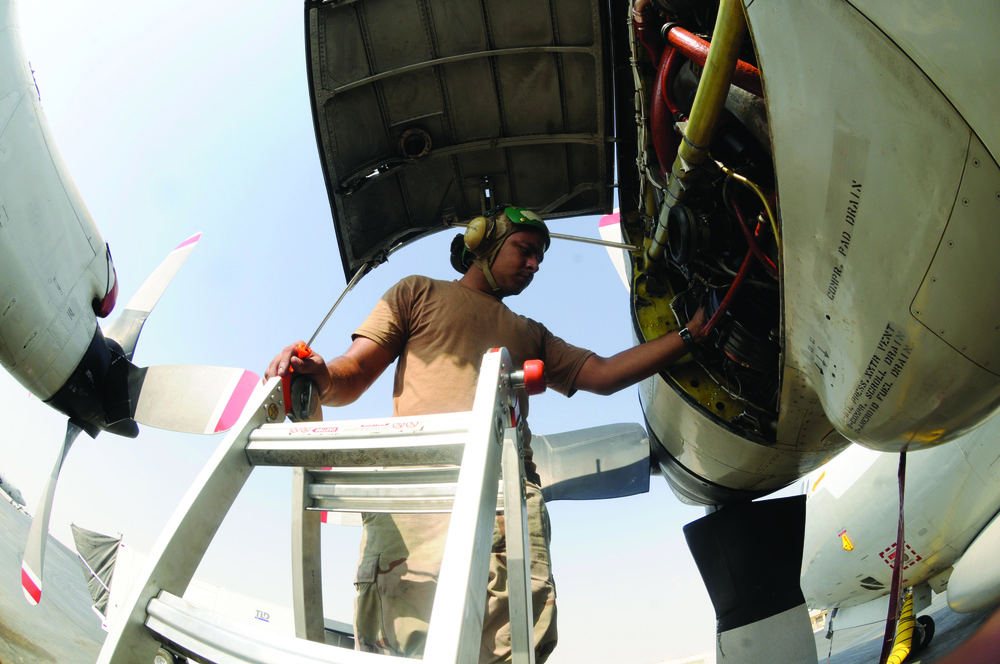
The unit operates a handful of Lockheed P-3 Orion aircraft, which is one of the top platforms used to hunt for submarines. But now, these aircraft are often focused on land operations to assist ground commanders.
"What we've found is our systems can really help the War on Terror," said Cmdr. Borovina. "We're not looking for ships; we're looking for things on the ground instead. We've been able to work with troops directly on the ground and give them live intelligence. With our help they can see over the next hill. They can see around the building. Saving lives is the most rewarding thing for us."
The most successful of these new 'trades' is intelligence, surveillance and reconnaissance.
"Within the AOR our ISR piece is in high demand," he said. "In fact, a higher demand than we could possibly provide. Judging by how many people want us to do different things and how high our results go, we are very successful in that regard."
Another of the new 'trades' for the Whidbey Island, Wash.,-based unit is patrolling for piracy, drugs and smuggling operations.
"We have been successful in interdicting some pirate acts," said the Richardson, Texas, native. "We had a crew that was able to prevent the boarding of a ship. They were patrolling and dropped some smokes and scared away the pirates through non-violent means."
The squadron has 12 aircrews to provide coverage for all their 'trades.' The 11-member crews consist of three pilots, two naval flight officers, two enlisted flight engineers, two acoustic operators, one non-acoustic operator and an in-flight technician.
One of the flight officers handles aircraft navigation and the other is a tactical coordinator in charge of the crew during the mission.
"The three operators gather the intelligence," explained aviation warfare Petty Officer 1st Class Luis Diaz, an enlisted acoustic operator. "They get it to the tactical coordinator. He is the one who puts everything together. He is the one who sends everything out to the ground commanders."
Acoustic operators handle several systems that can tell them if there are any other radar systems in the area and "fingerprint" them, identifying surface units and metallic objects in the water. Non-acoustic operators deal with radar and magnetic anomaly detection.
Not only is the unit a jack of all trades, so are its members.
"I've got about five or six systems to work on the aircraft," said Diaz. "On the ground I have another five or six jobs ... I'm not the only one. Our job isn't just to go out and fly, then come back and go to bed. We have ground jobs to take care of so the squadron can operate."
The same people who continually fly missions for the GWOT also perform all the command and administrative functions for the unit.
Squadron members not only balance their flying jobs with their ground jobs, they have to learn about everyone else's jobs as well.
"Once you get good at a job you are rotated into another job," said Borovina. "You really become versed in every department and every part of the unit. We succeed as a team and we really become a family."
Crewmembers can't just focus on their particular specialty on the aircraft, they must continually learn the other positions, said Diaz.
"The one thing I like about this squadron is every position knows about every other position's job," said the San Juan, Puerto Rico, native. "They understand how the systems work together. You have an 11-member crew, and those 11 members can all put in information ... It's a pretty cool environment. We all try to help each other out so we can get the mission done fast for the ground commanders."
Learning all the new 'trades' and doing the many jobs the unit is responsible for has proven time consuming and demanding, according to Borovina. Many VP-46 members have not found time to leave the base in four months.
"You always have something to do," said Diaz. "If you're bored, there is something wrong."
Even with the extra hours and extra missions the commander said, "You'd be hard pressed to find someone who doesn't like their job in our squadron.
"We were designated to do this direct-support mission, which we're very proud of," he said. "It takes extra training. But, you're not sorry waking up early and losing sleep when you're going to go [to where] people are being shot at and you're able to tell them where the bad guys are. The reward is immediate. Rather than just doing your duty, you talk to people you're actually saving. That's the most special thing we do here."
| Date Taken: |
11.10.2008 |
| Date Posted: |
11.11.2008 01:11 |
| Story ID: |
26179 |
| Location: |
(UNDISCLOSED LOCATION) |
| Web Views: |
181 |
| Downloads: |
129 |
PUBLIC DOMAIN

This work, VP-46: Global War on Terrorism Jack of all trades, by 1SG Jeffery Loftin, identified by DVIDS, must comply with the restrictions shown on https://www.dvidshub.net/about/copyright.

 Subscribe






