By Sgt. 1st Class Brent Hunt
Combat Aviation Brigade, 4th Infantry Division Public Affairs
CAMP TAJI, Iraq – At high noon the call came.
With temperatures sizzling at 130 degrees, on a make-shift temperature gauge, 14 injured American Soldiers were unloaded off a Black Hawk helicopter with only minutes to spare.
The time had come for the medics of the Combat Aviation Brigade, 4th Infantry Division, Multi-National Division – Baghdad, to throw on their combat gear, grab their medical bags and rush to the airfield in their combat ambulances to provide immediate emergency care to their buddies.
The Soldiers on the battlefield had given their all; now it was the medics turn to return the favor.
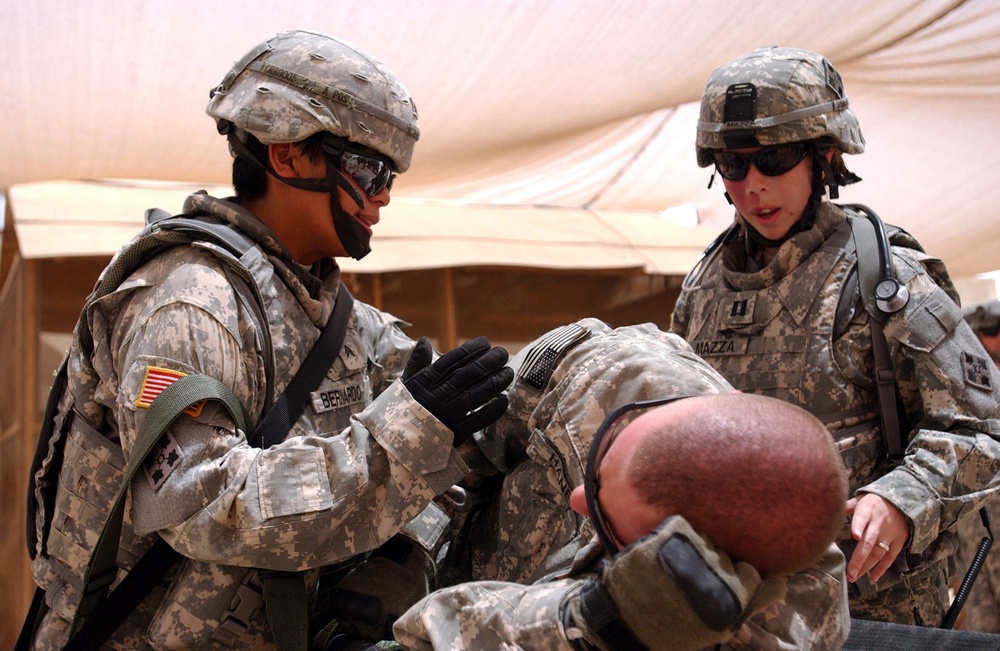
That was the scenario medics from the CAB faced during a mass casualty training exercise at the aviation brigade's Forward Arming and Refueling Point on Camp Taji, July 18.
"We do these [MASCAL exercises] in case four or more people are medically evacuated into one place," said Staff Sgt. Robert Dominguez, medic, Headquarters Support Company, 404th Avn. Spt. Battalion, CAB, from Tucson, Ariz. "This gives us the chance to get some hands on training, so we know what to do. It also gets us physically ready in case an event like this ever happens."
During the training, injured Soldiers were rushed to a triage area where doctors evaluate them and medics evacuate the patients based on the severity of their injuries. Their goal is to save as many lives as possible.
Soldiers suffering blood loss and airway injuries are priority number one. They are treated first and evacuated.
"A massive hemorrhage will only take two to four minutes before it will kill someone and those numbers are optimistic," said Maj. Scott Orr, brigade surgeon, Headquarters and Headquarters Co., CAB. "Stopping massive blood loss with the use of combat tourniquets, emergency bandages and clotting agents such as HemCon or Quickclot, can reduce preventable causes of death by 66 percent. If a non-medical Soldier comes up on a casualty, no matter if you have one or even 100 casualties, the most important thing to remember is tourniquets and airways for each casualty."
During the day's training, Soldiers from the CAB treated a collapsed lung, shrapnel to the abdomen and a patient with second and third degree burns. After the patients were treated and evaluated, Soldiers secured the injured to gurneys and loaded them in the ambulances.
Medics from the CAB train evacuating and treating patients constantly because if a mass casualty situation ever occurred they could do their job with confidence.
"Today, I learned about teamwork, being organized and the importance of urgency," said Cpl. Ronnie Bernardo, medic, HSC, 404th Avn. Spt. Bn., from San Diego, Calif. "This training helps with your confidence and really helps if you ever had to do it for real. Practicing for a situation like this makes doing it second nature. That's what you want if something like this ever happened."
| Date Taken: |
07.21.2008 |
| Date Posted: |
07.21.2008 08:29 |
| Story ID: |
21685 |
| Location: |
TAJI, IQ |
| Web Views: |
229 |
| Downloads: |
85 |
PUBLIC DOMAIN

This work, CAB medics hone MASCAL scenario skills, by SFC Brent Hunt, identified by DVIDS, must comply with the restrictions shown on https://www.dvidshub.net/about/copyright.

 Subscribe






