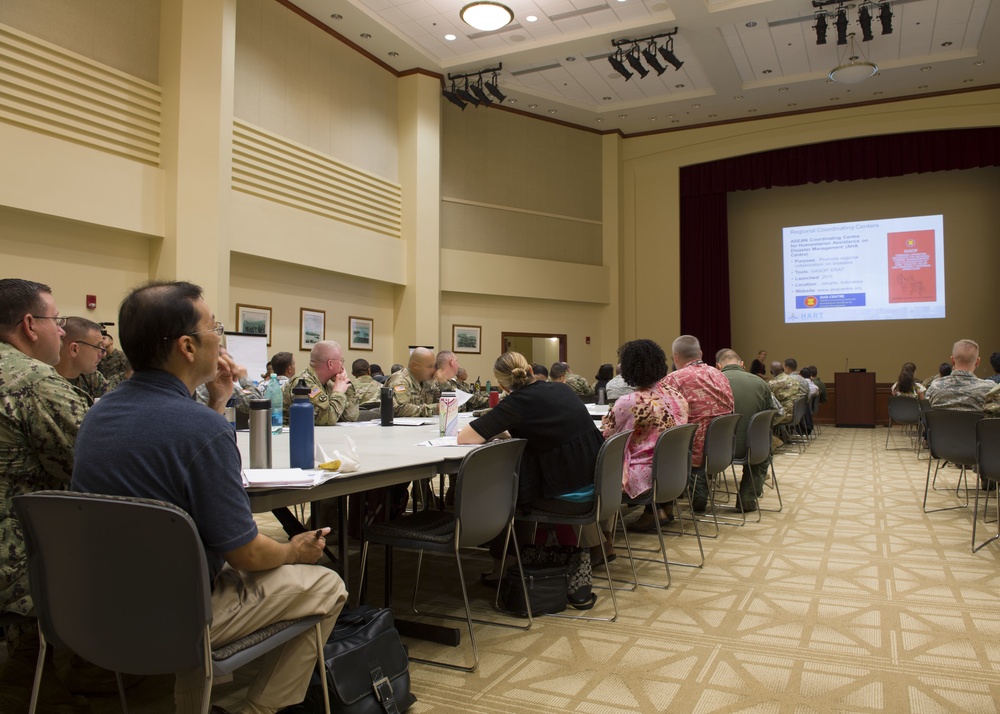
PEARL HARBOR (Nov. 30, 2016) – A Humanitarian Assistance Response Training (HART) course was held Nov. 29-Dec. 2 at Joint Base Pearl Harbor-Hickam, to help prepare the United States military commanders and their staffs to respond more effectively during civilian-led humanitarian assistance and foreign disaster response missions.
The course focused on the military interaction aspect of disaster response operations and included approximately 170 participants from the five branches of the U.S. military.
“On a day-to-day basis, the odds are that a Humanitarian Assistance Disaster Relief mission is the type of operation the U.S. military is most likely to conduct here in the Pacific region,” said Jim Welsh, the branch chief of education and training for the Center for Excellence in Disaster Management and Humanitarian Assistance. “Given that more than 4.3 billion people populate the Indo-Asia-Pacific region, and the fact that over 41 percent of the world’s disasters occur in this region, it’s very important that we hold a course like HART so we can better inform and prepare our military leadership on what to expect when leading a disaster relief operation.”
Welsh emphasized that the current HART course is the most expansive its been in 10 years, and is heavily geared towards interaction amongst the attendees as opposed to lectures and briefings on disaster relief operations.
“It’s important to remember that from a military standpoint, we’re there to support the affected country with what they need,” said Welsh. “Disaster relief is a unique mission, in that the military aspect of it is ultimately led by civilians, but we’re essentially taking our guidance from the affected state. Of course, everybody loves to help. But we have to wait for the affected state to establish the requirements of what they need from us, and that’s just one of the main aspects we go over during this course.”
One of the most rewarding aspects of offering military relief assistance is the atmosphere of goodwill it creates between the U.S. and the affected country, Welsh said.
“In order to be good neighbors to the other countries in this region, it’s important that we’re prepared, and the objective of this course is to familiarize our military leaders on the principles and context of disaster response operations. It helps make it a great diplomatic tool, both for us and our allies,” said Welsh.
“From a Navy standpoint, this course is a great way for us to learn more about humanitarian relief, so that when we plan future exercises, we can incorporate key objectives and goals to accomplish certain tasks or missions that Pacific Fleet is responsible for,” said Cmdr. Jason Ward, a maritime planner for U.S. Pacific Fleet. “As a large Navy, we have a presence in a lot of the countries contained within this region. We’re often times looked upon to provide immediate assistance during a natural disaster in the region, and this course enables us to understand how civilian agencies work and coordinate their organizations so that our military can better support them during those times when our assistance is needed.”
Viviana De Annuntiis, a humanitarian affairs officer for the United Nations Office for the Coordination of Humanitarian Affairs, said one of the key objectives of the HART course was to help educate military leaders of relief operations to understand the cultural sensitivities and role the military plays in a relief effort, when working in conjunction with civilian organizations who are spearheading the operation.
“In a relief operation, the appropriate liaison approach is dependent on the nature of the emergency,” said De Annuntiis. “We want to recognize and respect the humanitarian needs, but also fulfill the military objectives for the mission as well. This makes it possible for civilians and military personnel to closely work together to achieve common goals, like saving lives and relieving human suffering during a relief operation.”
For more information on the HART course, visit the Center for Excellence in Disaster Management and Humanitarian Assistance website at https://www.cfe-dmha.org/
| Date Taken: |
11.30.2016 |
| Date Posted: |
12.08.2016 02:35 |
| Story ID: |
216204 |
| Location: |
PEARL HARBOR, HAWAII, US |
| Web Views: |
84 |
| Downloads: |
0 |
PUBLIC DOMAIN

This work, HART Course Prepares U.S. Military Members For Disaster Relief Operations, by PO1 Jeffrey Troutman, identified by DVIDS, must comply with the restrictions shown on https://www.dvidshub.net/about/copyright.

 Subscribe






