
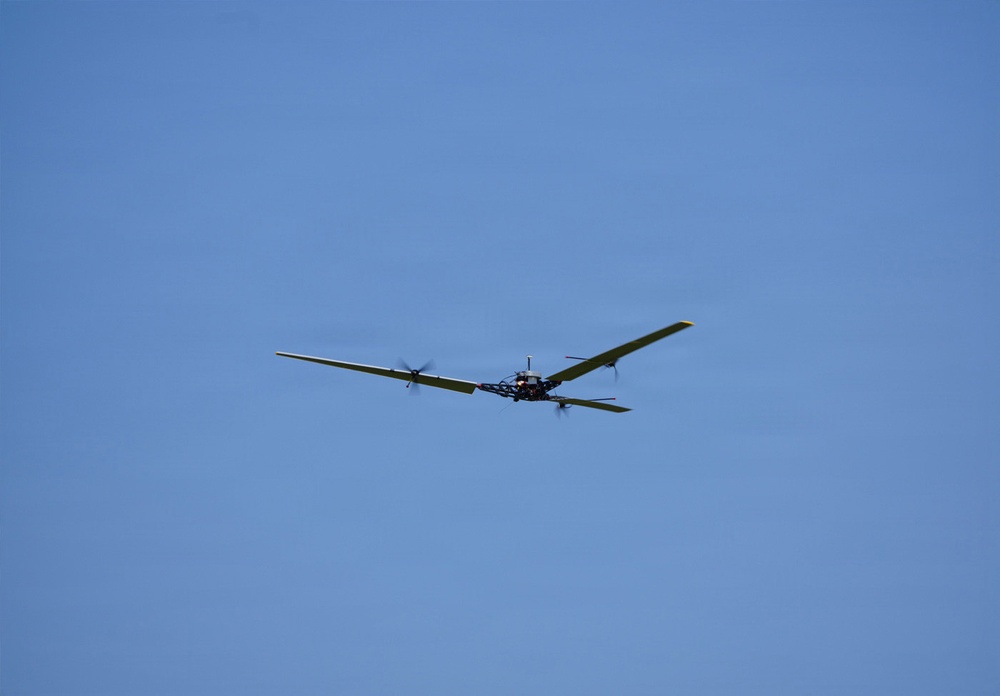
The University of Maryland Autonomous Micro Air Vehicle Team aircraft won the Most Revolutionary
Aerodynamic Design award of $500,000. The team's design blended a tri-rotor into the propulsive design of a propeller-driven rotor by using servos to change blade and motor angles. Their craft takes off and lands like a multi-rotor craft and then transitions to a propeller-driven rotor once airborne.
The DARPA Lift Challenge was conducted on Aug. 2 - 9, 2026, with 100 teams at the National Museum of the U.S. Air Force in Dayton, Ohio.
The challenge aimed to revolutionize heavy vertical lift aviation by seeking novel drone designs capable of carrying payloads more than four times their weight. This would revolutionize how we use drones across all sectors.
As military missions become more complicated, warfighters need more capable drones to use across diverse scenarios. The same applies to infrastructure inspection, package delivery, disaster response, and other civilian applications.
Current multirotor drones, also known as unmanned aircraft systems (UAS), are simple, affordable, and easy to operate. But their payload-to-weight ratio is low, typically 1:1 or less.
Learn more: https://www.darpa.mil/research/challenges/lift?utm_source=dvids&utm_medium=referral&utm_campaign=lift&utm_term=umd-aircraft
| Date Taken: | 08.09.2026 |
| Date Posted: | 08.25.2026 11:01 |
| Photo ID: | 9887832 |
| VIRIN: | 260809-O-MX102-9689 |
| Resolution: | 1400x974 |
| Size: | 99.9 KB |
| Location: | DAYTON, OHIO, US |
| Web Views: | 3 |
| Downloads: | 0 |

This work, DARPA Lift Challenge: University of Maryland aircraft [Image 9 of 9], by Paul Flacks, identified by DVIDS, must comply with the restrictions shown on https://www.dvidshub.net/about/copyright.


No keywords found.





