
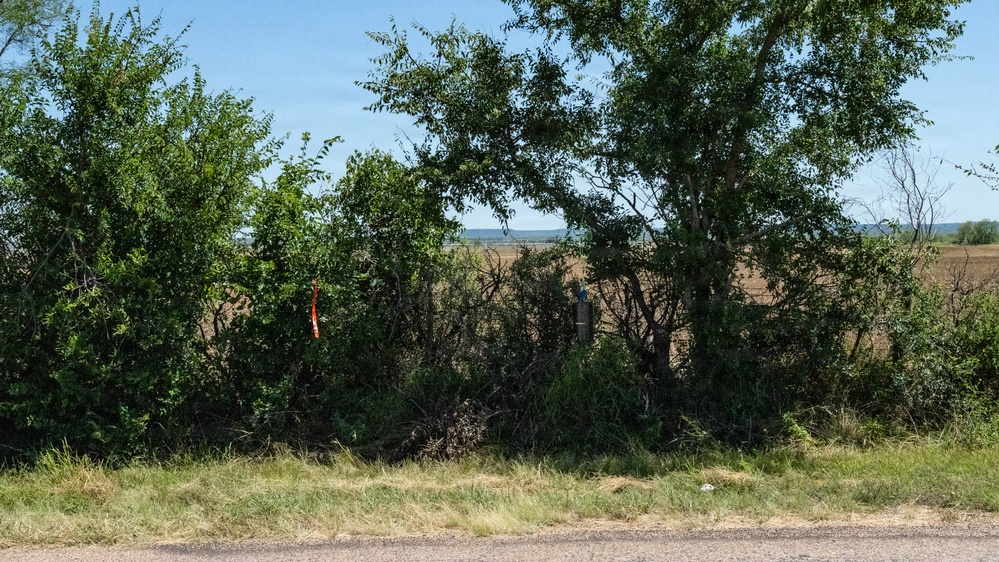
As part of the ongoing U.S. Department of Agriculture (USDA) Animal and Plant Health Inspection Service (APHIS) and other Federal agencies alongside State, Tribal, local, and Territorial partners and industry response to a confirmed New World Screwworm (NWS) case in Tom Green County, Strike Team 2–San Angelo has deployed a network of baited lure traps designed to detect any remaining wild screwworm flies, Thursday, June 17, 2026, in San Angelo, Texas region. These traps—ranging from live capture “gator traps” to adhesive coated PVC sticky traps—provide critical surveillance data guiding federal field operations.
When selecting trap locations, teams prioritize areas near standing water, livestock, warm blooded wildlife activity, or recently deceased animals—sites where screwworm attracting odors and host species are most likely to be present.
The gator trap, a key component of this effort, uses fermenting liver to produce strong odors that attract screwworm and related fly species. When flies are drawn in, they are captured alive, allowing specialists to determine whether wild screwworms remain in or near the affected zone. These trap results help outline the boundaries of the infestation and ensure rapid detection if flies move beyond the initial case area.
After a few days, traps are collected and brought to their worksite temporarily setup at the Texas Parks and Wildlife facility at San Angelo, Texas. There the flies will be euthanized, recorded, and inspected under digital microscopes for suspect NWS flies. All suspect screwworm specimens gathered from the field—whether captured alive in gator traps or adhered to sticky traps—are forwarded for official confirmation to the USDA National Veterinary Services Laboratories (NVSL) in Ames, Iowa, the national reference lab responsible for screwworm diagnostics. This laboratory analysis determines whether any wild screwworm flies remain active in the region and directs next steps in the response.
Complementing the gator traps are the team’s sticky lure traps, created from roughly 18 inch black PVC tubes coated with a dense adhesive. Equipped with dual lures on either side, these traps draw flies from the surrounding area. Field crews revisit each trap every two to three days to remove and analyze the captured insects. This helps determine whether sterile flies, wild screwworms, or non target species are present and provides a broader understanding of fly movement across the landscape.
Together, these surveillance methods form the backbone of the field intelligence needed to support sterile fly ground dispersal operations. By monitoring fly activity in real time, teams can verify the effectiveness of ongoing control measures and react quickly if fly movement indicates changing conditions.
This unified response brings together multiple Federal agencies alongside State, Tribal, local, and Territorial partners and industry. The United States has defeated NWS before—together, we will do it again. For more information go to https://www.aphis.usda.gov/animals/animal-health/livestock-and-poultry-disease/stop-screwworm. For high-resolution photos and additional close-up views of the flies, go to https://flic.kr/s/aHBqjCXiWn.
USDA Media by Lance Cheung.
| Date Taken: | 06.27.2026 |
| Date Posted: | 07.04.2026 20:06 |
| Photo ID: | 9777093 |
| VIRIN: | 260617-P-RD001-6873 |
| Resolution: | 6217x3497 |
| Size: | 14.85 MB |
| Location: | SAN ANGELO, TEXAS, US |
| Web Views: | 32 |
| Downloads: | 3 |

This work, San Angelo Strike Team Uses Baited Sticky Lure Traps to Track Screwworm Activity in Texas [Image 26 of 26], by Lance Cheung, identified by DVIDS, must comply with the restrictions shown on https://www.dvidshub.net/about/copyright.


No keywords found.





