
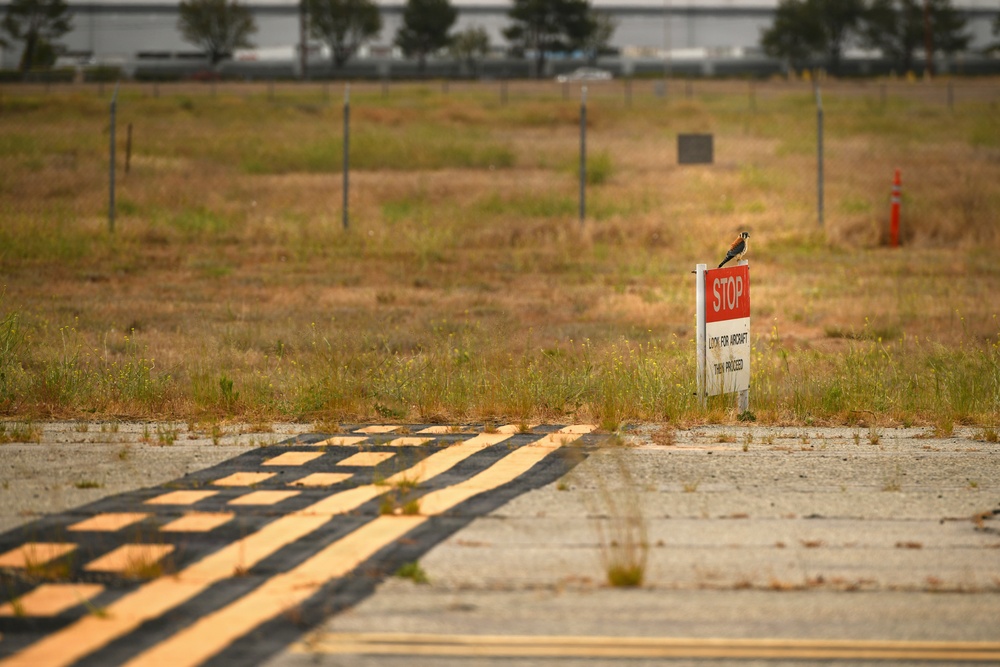
Nicholas Filippelli, a USDA Wildlife Biologist, pinpoints the location of a new bird nesting area in a hangar frequently used by the 163d Maintenance Group to store and maintain MQ-9 Reapers, March Air Reserve Base, Calif., June 18, 2026. Dropping and debris caused by nests like these pose a health risk to personnel and can cause damage to aircraft. Filippelli will initiate trap and release efforts to mitigate these hazards. In 2025, 60 predatory birds were humanely trapped and successfully relocated to surrounding mountainous areas away from the base. As part of the Bird/Wildlife Aircraft Strike Hazard program, USDA Wildlife Biologists continuously monitor the airfield for wildlife activity, disperse flocks, conduct wildlife depredation, perform bird activity surveys, disease testing, and coordinate with flying units to provide bird activity heat maps and times to lower strike-incidence opportunities. (U.S. Air National Guard Photograph by Senior Master Sgt. Julianne Sitterding)
| Date Taken: | 06.18.2026 |
| Date Posted: | 06.24.2026 15:07 |
| Photo ID: | 9770647 |
| VIRIN: | 260618-Z-RZ465-1329 |
| Resolution: | 7058x4706 |
| Size: | 7.03 MB |
| Location: | MORENO VALLEY, CALIFORNIA, US |
| Web Views: | 15 |
| Downloads: | 2 |

This work, Cleared for Takeoff: Wildlife Biologists mitigate wildlife hazards at March [Image 13 of 13], by SMSgt Julianne Sitterding, identified by DVIDS, must comply with the restrictions shown on https://www.dvidshub.net/about/copyright.


Cleared for Takeoff: Wildlife Biologists mitigate wildlife hazards at March
No keywords found.





