
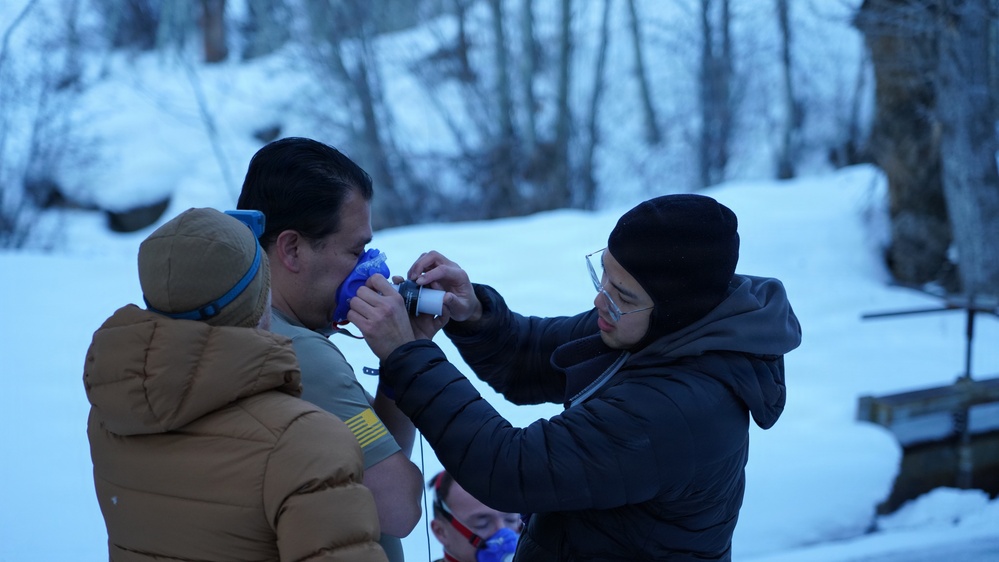
BRIDGEPORT, Calif. (Feb. 23, 2026) Tony Duong, an exercise physiologist with Naval Health Research Center’s (NHRC) Environmental & Thermal Physiology research team, outfits a military medical student with a metabolic mask and portable spirometer prior to a cold-water immersion. The spirometer monitors breathing patterns, allowing for observation into the effects of cold-water shock response. The cold-water shock response is an involuntary and potentially life-threatening reaction to sudden exposure to water below 59°F; this response typically involves a sudden gasp, increased breathing and heart rate. Through its cold-water immersion studies, NHRC develops life-saving strategies that enable the warfighter to overcome the initial, lethal shock of entering frigid water. This vital research provides U.S. Naval, Marine Corps, and joint forces with the tools to maintain cognitive function and enhance survivability in the most extreme maritime environments. (U.S. Navy photo by Matthew Reyes/released)
| Date Taken: | 02.23.2026 |
| Date Posted: | 03.10.2026 14:54 |
| Photo ID: | 9559448 |
| VIRIN: | 260223-N-VK447-5895 |
| Resolution: | 7952x4472 |
| Size: | 6.55 MB |
| Location: | BRIDGEPORT, CALIFORNIA, US |
| Web Views: | 28 |
| Downloads: | 8 |

This work, Mastering the First Breath: Navy Medicine Research Fortifies the Warfighter Against the Cold's Lethal Shock [Image 8 of 8], by Matthew Reyes, identified by DVIDS, must comply with the restrictions shown on https://www.dvidshub.net/about/copyright.


No keywords found.





