
 Subscribe
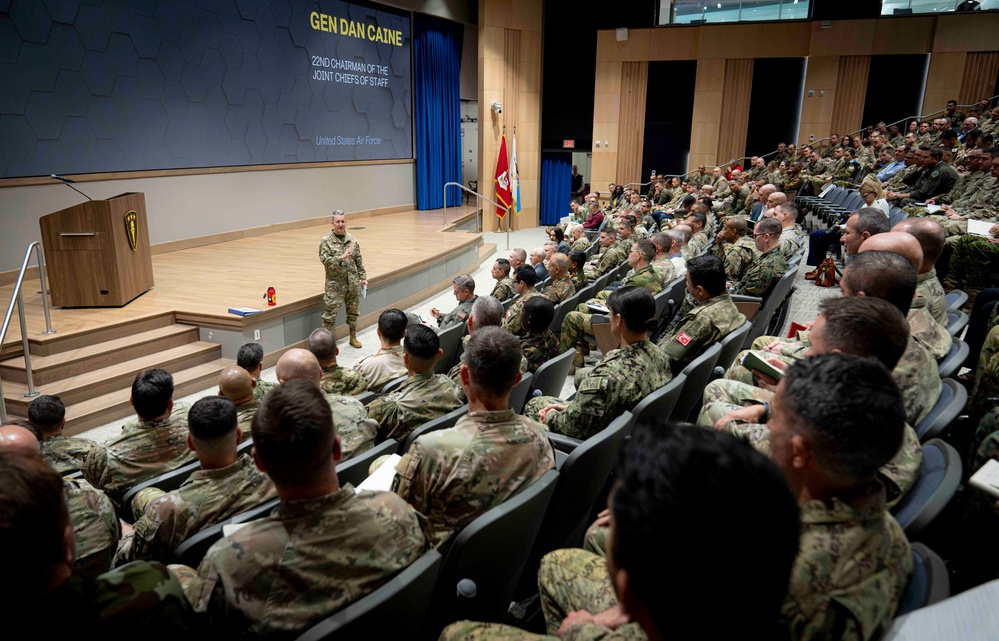
Chairman of the Joint Chiefs of Staff Gen. Dan Caine speaks to students at the U.S. Army War College (USAWC) at Carlisle Barracks in Carlisle, Pennsylvania, November 17, 2026. Gen Caine said:
“My brothers and sisters, you are going to serve, because you’re here, you are going to serve in important jobs in the future. You are going to help inform decisions of enormous consequence. And that’s why I’m here today. About two weeks ago, I was in Newport and Maxwell, and I wanted to come here today. As you continue on your leader’s journey, I wanted to talk to you today about my role as the chairman, my approach to this job, and so that you have that context as you move forward through the rest of your academic year and ultimately move back into the joint force in whatever pathway your service or tribe is going to take you.
Simply stated, beyond the statute, I think of my job having two major categories. The first part of my job is current operations. That’s the one that most of us know and see day to day, and that’s serving as the principal military adviser to the president, the National Security Council, the Homeland Security Council, the Secretary of War, and other senior leaders, and bring the views of the Joint Chiefs of Staff into that dialogue. To do this job, I’ve gotta do three things along with an extraordinary team.
. . . When the president and the Secretary of War give us a policy or political objective, it is our job in the Joint Staff to develop a range of military options. One is not an option. To include all of the associated risks, assumptions, secondary and tertiary consequences that go along with each of those military options and ultimately make a military recommendation that will best meet the president’s intent. And all of that work to build those options with all of the risks and all of the secondary and tertiary consequences. . . .
. . .The third part of my current ops bucket is the advise portion of it. It’s the final component that brings it all together, and that is advising those decision makers. And if you imagine sitting in the Oval Office in front of the Resolute Desk, the president is sitting behind that desk and there is a small group of leaders sitting there, including, the Secretary (of War). My job is to sit in front of the Resolute Desk alongside those civilian leaders and provide the president military advice and a military recommendation.
. . There’s another part, and particularly in this environment, my friends, that I want you to understand. And that’s the importance of our nation’s senior leaders having the space for candid counsel and candid consideration. Some of the hardest questions that any president considers is whether or not to use military force and put Americans at risk. A president must be able to consider those questions privately. My advice to the president must be delivered privately, where he and other leaders can explore ideas, have frank discussions about risks and consequences before decisions are made. That’s why you see me so careful, so thoughtful about staying out of the political policy dialogue in the American media.”
(DoW Photo by Benjamin Applebaum)
| Date Taken: | 11.17.2026 |
| Date Posted: | 11.23.2026 10:19 |
| Photo ID: | 10112269 |
| VIRIN: | 261117-D-LS763-1030 |
| Resolution: | 8211x5267 |
| Size: | 1 MB |
| Location: | WASHINGTON, DISTRICT OF COLUMBIA, US |
| Web Views: | 17 |
| Downloads: | 1 |

This work, CJCS Speaks to USAWC [Image 6 of 6], by Benjamin D Applebaum, identified by DVIDS, must comply with the restrictions shown on https://www.dvidshub.net/about/copyright.


No keywords found.