
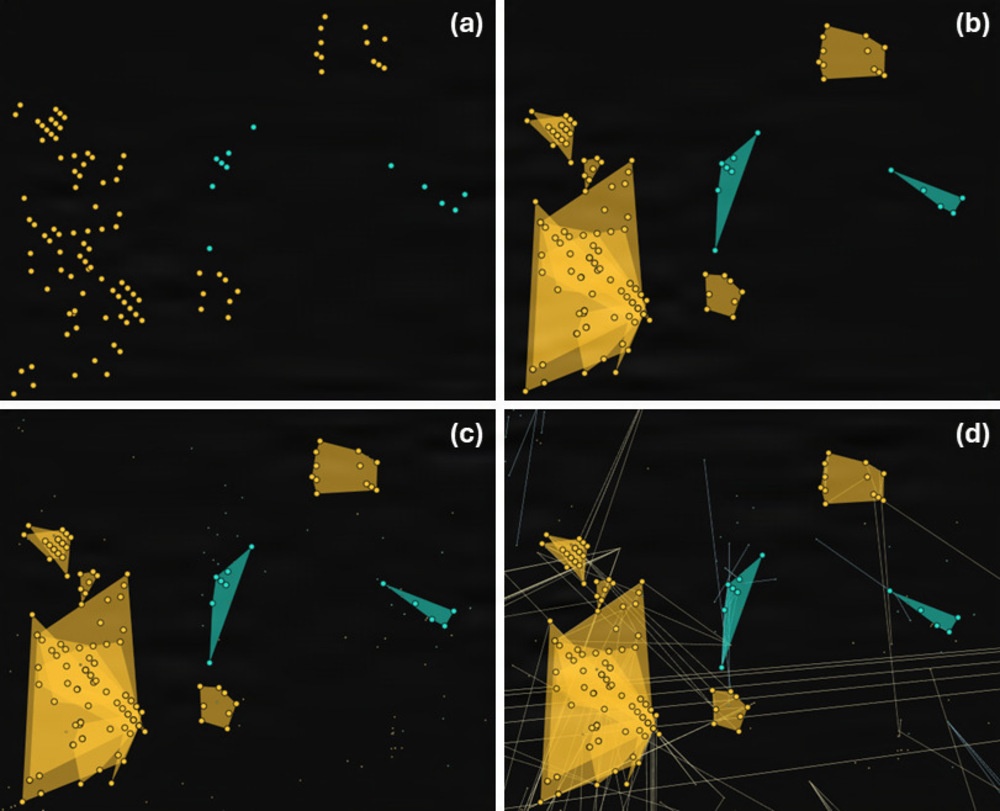
The sequence above shows the locations where discrete electromagnetic emissions were detected in a battlefield over an extended period of time. Blue shades represent very high frequency (VHF) emissions and yellow shades represent ultrahigh frequency (UHF) emissions. Spatial, temporal, and frequency relationships are illustrated by clusters and networks. The different shading delineates the individual clusters and networks. Though some individual clusters overlap spatially, they are not part of the same cluster because their emission data points are outside frequency or temporal thresholds. The diagrams depict (a) emission data points that belong to clusters, (b) added polygons that show emission data points connected together as parts of individual clusters, (c) added emission data points that don’t belong to clusters, and (d) added lines between emission data points and clusters that show connections of individual networks. (U.S. Navy graphic illustration by Dan Linehan)
| Date Taken: | 04.28.2026 |
| Published: | 04-28-26 04:28 PM |
| Graphic ID: | 42177 |
| VIRIN: | 260428-D-RB169-1001 |
| Size: | 133.73 KB |
| Location: | MONTEREY, CALIFORNIA, US |
| Web Views: | 26 |
| Downloads: | 2 |

This work, Decoding the Battlefield: NPS Students Develop Solution to Support Urgent U.S. and NATO Need, by Daniel Linehan, identified by DVIDS, must comply with the restrictions shown on https://www.dvidshub.net/about/copyright.





