
Video by Pierre Courtejoie | Training Support Activity Europe | 02.11.2016
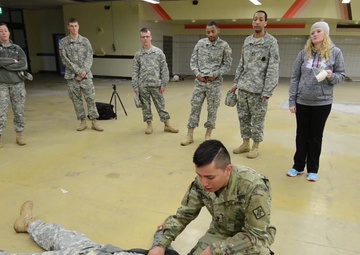
U.S. Army Sgt. Esai Valenzuela, with 128th Signal Company, 39th Signal Battalion, explains the importance of the naso-pharyngeral airway (NPA), Shelby Diaz performs the insertion of a NPA on her husband Sgt. William Diaz during the unit's Jane Wayne day, in the old Commissary, on Chièvres Air Base, Chièvres, Belgium, Feb. 11, 2016. (U.S. Army video by Visual Information Specialist......
Video by Pascal Demeuldre | Training Support Activity Europe | 12.14.2014
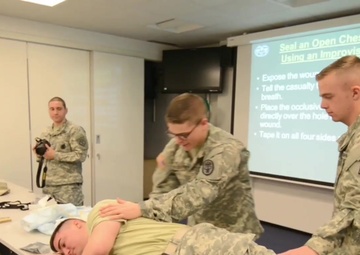
U.S. Army Spc. Kyle Borsody, medic with Supreme Headquarters Allied Powers Europe (SHAPE) Healthcare Facility, explains how to apply an improvised chest seal and place a chest decompression needle on the correct location during the Combat Life Saver portion of the unit's Quartely Commander's prime time training,in SHAPE, Belgium, Dec. 10, 2014. Also available in high definition. (U.S. Army......
Video by Pascal Demeuldre | Training Support Activity Europe | 12.10.2014
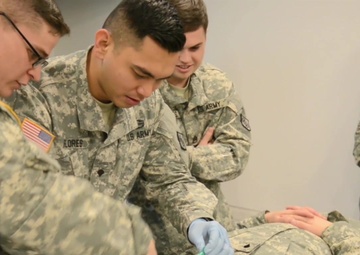
U.S. Army Spc. Darrel Flores with 128th Signal Company, 39th Signal Battalion, carefully introduces and removes the nasopharyngeal airway into Spc Nathaniel Smith's nose during the Combat Life Saver portion of the unit's Quarterly Commander's prime time training, in Supreme Headquarters Allied Powers Europe, Belgium, Dec. 10, 2014. Also available in high definition. (U.S. Army video by Visual......
Video by Pierre Courtejoie | Training Support Activity Europe | 12.09.2014
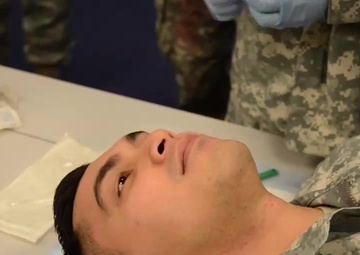
U.S. Soldiers with 128th Signal Company and Headquarters and Headquarters Company, 39th Signal Battalion, 2nd Signal Brigade place a Nasopharyngeal Airway for Combat Life Saver classes during the unit's quarterly commanders prime time training, in the Supreme Headquarters Allied Powers Europe, Belgium, Dec. 10, 2014. (U.S. Army video by Visual Information Specialist Pierre-Etienne......
Video by Timothy Sproles | Camp Atterbury Indiana | 06.24.2011
Every soldier who is Combat Lifesaving (CLS) trained is able to stop wounds soldiers suffer on the battlefield from getting progressively worse. The course introduces soldiers with very basic medical training to several critical elements of field care such as performing rapid medical assessments, establishing intravenous access, performing needle chest decompressions and the placement of......




