
Courtesy Story | Defense Threat Reduction Agency's Chemical and Biological Technologies Department | 07.25.2016
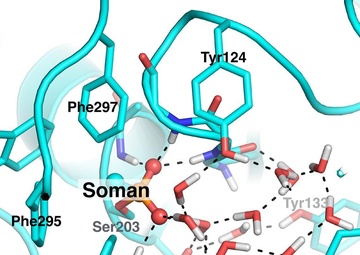
If an adversary wanted to stop an army in its tracks, a chemical and biological weapon designed to incapacitate the central nervous system (CNS) would be devastating to our warfighters. With this in mind, the Defense Threat Reduction Agency’s Joint Science and Technology Office and the French company CEA are diligently trying to improve existing medical countermeasures (MCMs) by using......
Courtesy Story | Defense Threat Reduction Agency's Chemical and Biological Technologies Department | 07.25.2016
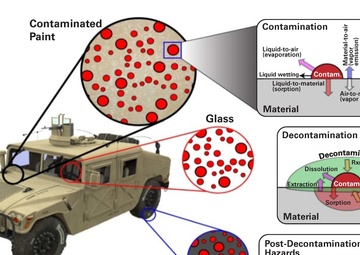
Our adversaries are becoming increasingly skilled in chemical and biological warfare and continue to engineer new dissemination methods, putting the warfighter and military operations at risk. To combat this, experts from the Defense Threat Reduction Agency’s Joint Science and Technology Office and the Edgewood Chemical and Biological Center are getting creative with a new decontamination......
Courtesy Story | Defense Threat Reduction Agency's Chemical and Biological Technologies Department | 06.30.2016
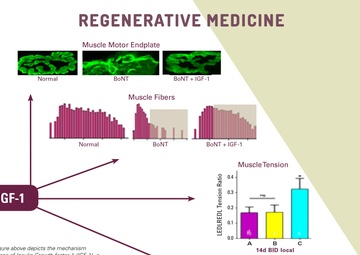
Engineered by the Canadian weapons program in 1939, Botulinum neurotoxins (BoNTs), once known as Agent X, are some of the most lethal toxins available. Although Canada did not produce a biological weapon using BoNTs, the United States, Japan, Germany, former Soviet Union and Iraq successfully engineered BoNTs for use as a weapon of mass destruction....
Courtesy Story | Defense Threat Reduction Agency's Chemical and Biological Technologies Department | 06.30.2016
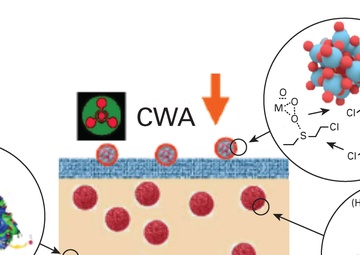
The development of novel catalysts and catalytic processes for Department of Defense chemical and biological defense applications is challenging. This challenge is largely due to a lack of detailed structure-function relationships necessary to drive the development of predictive capabilities toward new catalytic material design and catalyst process concepts capable of meeting current and......
Courtesy Story | Defense Threat Reduction Agency's Chemical and Biological Technologies Department | 05.24.2016
Harvard University principal investigator Professor Federico Capasso, one of the inventors of the quantum cascade lasers (QCLs), and Harvard researcher, Dr. Patrick Rauter, report recent progress in the development of multi-wavelength QCL arrays citing significant extensions in lengths. This recent Defense Threat Reduction Agency-funded research program highlighted impressive scientific......

Courtesy Story | Defense Threat Reduction Agency's Chemical and Biological Technologies Department | 05.24.2016
Much like the skin is the body’s first line of protection, a warfighter’s uniform acts in a similar way against chemical and biological threats. However, the research, development and production of uniforms to equip more than two million troops does not come at a small cost. To address this issue, the Defense Threat Reduction Agency’s Joint Science and Technology Office, in collaboration......
Courtesy Story | Defense Threat Reduction Agency's Chemical and Biological Technologies Department | 04.29.2016
Exposure to a chemical or biological agent poses serious risks to warfighters. Accurately modelling the trajectory patterns of chemical and biological warfare agents is critical to ensure the safety of our combat forces....
Courtesy Story | Defense Threat Reduction Agency's Chemical and Biological Technologies Department | 04.29.2016
There have been 24 Ebola outbreaks since 1976 though none as deadly as the recent West African epidemic. New research conducted by the Defense Threat Reduction Agency’s Joint Science and Technology Office, uses neutralizing antibodies to reduce mortality rates in Ebola infected animals. This research could inspire medical countermeasures to better protect warfighters, civilians and......




