
Photo by Daniel Parry | U.S. Naval Research Laboratory | 08.22.2019
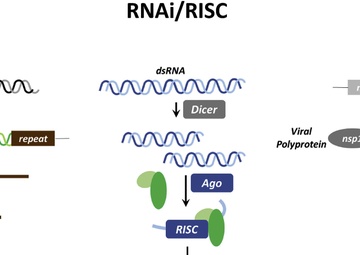
DNA, RNA, Protein? Three mechanisms of silencing that are guided by a short sequence. In each case a short sequence is used to identify a larger target sequence; these mechanisms are analogous to “search and delete” programs that utilize a “keyword” that have been written in three different languages. Each system has an enzyme that recognizes the match between the short sequence and......
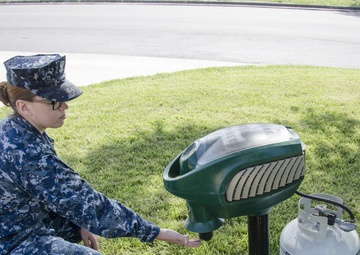
Photo by Rod Hafemeister | Naval Health Clinic Corpus Christi, Texas | 07.11.2018
180711-N-WO852-008 KINGSVILLE, Texas (July 11, 2018) -- Hospital Corpsman 2nd Class Jessica Wright, a preventive medicine technician at Naval Branch Health Clinic Kingsville, Texas, checks the gas flow on a ‘mosquito magnet’ trap. The trap uses propane to create a carbon dioxide flow to attract mosquitoes into a mesh bag. The mosquitoes are then sent to a state laboratory to determine......

Courtesy Photo | U.S. Army Acquisition Support Center | 01.01.2018
The Zika virus, which originated in the Zika forest in Uganda, has now infected humans around the world, causing fevers and rashes along with more serious nervous system complications such as Guillain-Barre syndrome and microcephaly. U.S. service members and their families are at higher risk for Zika virus infection than the general U.S. population as they often deploy to areas with active......
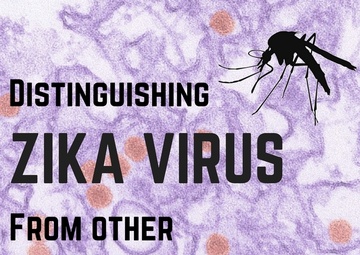
Photo by Katherine Berland | Naval Medical Research Command | 11.13.2017
Distinguishing Zika Virus from other arboviral infections. Graphic Courtesy Naval Medical Research Center Public Affairs
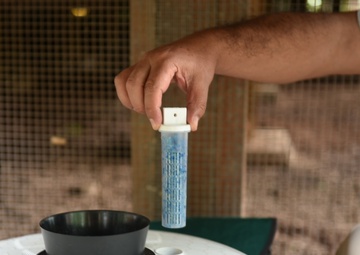
Photo by Maria Pinel | Joint Task Force Bravo | 08.11.2017
Personnel from the Naval Medical Research Unit No. 6 inspects a vector trap at Soto Cano Air Base, Honduras, Aug. 11, 2017. The Joint Task Force-Bravo Medical Element, NAMRU-6 and the Uniformed Service University of the Health Sciences partnered for an ongoing tropical disease study in Trujillo and Soto Cano Air Base early August, testing live samples and collecting vectors that could be......
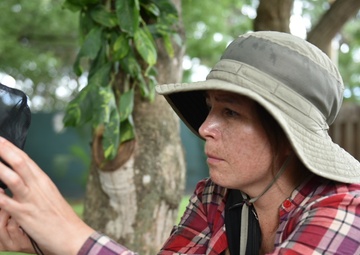
Photo by Maria Pinel | Joint Task Force Bravo | 08.11.2017
Dr. Gissella Vasquez, deputy director of the Entomology Department at the U.S. Naval Medical Research Unit No. 6 inspects a vector trap at Soto cano Air Base, Honduras, Aug. 11, 2017. The Joint Task Force-Bravo Medical Element,NAMRU- 6 and the Uniformed Service University of the Health Sciences partnered for an ongoing tropical disease study in Trujillo and Soto Cano Air Base early August,......
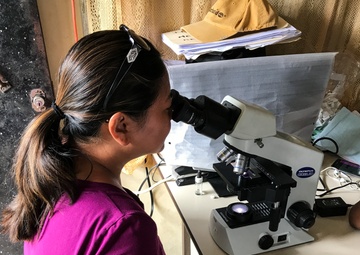
Photo by Maria Pinel | Joint Task Force Bravo | 08.09.2017
U.S. Army 1st Lt. Isavelita Goodearly, Joint Task Force-Bravo Medical Element community health nurse, looks at vector samples through a microscope at Trujillo, department of Colón, Honduras, Aug. 09,2017. Colón and the Misquito Coast have the highest incidence of malaria in the country, areas where JTF-Bravo participates in multiple humanitarian missions. (Courtesy photo)...
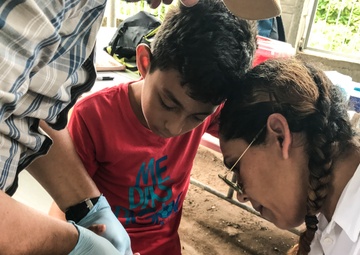
Photo by Maria Pinel | Joint Task Force Bravo | 08.07.2017
A Honduran Ministry of health representative collects a blood sample from a young boy at Trujillo, department of Colón, Honduras, Aug. 07, 2017 for a joint tropical disease study with the Joint Task Force-Bravo Medical Element, the U.S. Naval Medical Research Unit No. 6 and the Uniformed Service University of the Health Sciences. The team, comprised of preventive medicine personnel,......




