
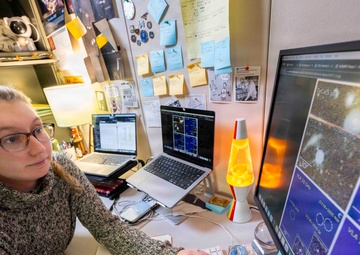
Photo by Sarah Peterson | U.S. Naval Research Laboratory | 12.15.2025
Emma Schwartzman, Ph.D., U.S. Naval Research Laboratory astrophysicist, analyzes her research confirming the first known case of three radio-emitting active galactic nuclei within a single ongoing galaxy merger in Washington, D.C., Dec.15, 2025. The discovery provided new evidence of how supermassive black holes grow and interact during galaxy mergers. (U.S. Navy photo by Sarah Peterson)...
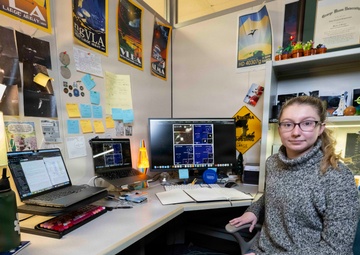
Photo by Sarah Peterson | U.S. Naval Research Laboratory | 12.15.2025
Emma Schwartzman, Ph.D., U.S. Naval Research Laboratory astrophysicist, poses for a photo beside her research confirming the first known case of three radio-emitting active galactic nuclei within a single ongoing galaxy merger in Washington, D.C., Dec.15, 2025. The discovery provided new evidence of how supermassive black holes grow and interact during galaxy mergers. (U.S. Navy photo by Sarah......
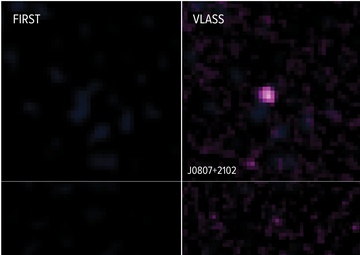
Photo by Daniel Parry | U.S. Naval Research Laboratory | 10.26.2020
Examples of before and after radio maps taken by the Vary Large Array (VLA) twenty years apart. The differences illustrate the dramatic radio brightening of distant supermassive black holes caught launching newborn radio jets. The left column shows the absence of radio emission in VLA maps taken in the late 1990's as part of the Faint Images of the Radio Sky at Twenty-Centimeters (FIRST)......
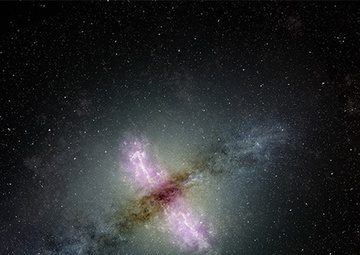
Photo by Daniel Parry | U.S. Naval Research Laboratory | 10.26.2020
Illustration of a young radio jet launching from a supermassive black hole in the center of a distant galaxy.
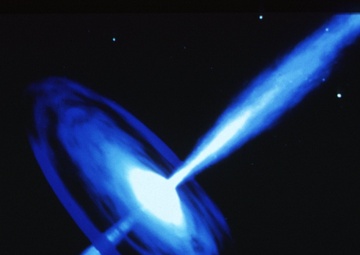
Courtesy Photo | NASA | 09.21.2009
*Description*: The energy source needed to create and maintain the galactic let in galaxy PKS 0521-36 is generated deep within the core of the galaxy, and is far too small to resolved. The favored mechanism behind these cosmic fireworks is a spinning, massive black hole. The hole is fueled by a continual in-fall of nearby gas and stars. This gravitational accretion process is far more......




