

Photo by Tech. Sgt. Sarah Mattison | Joint Force Headquarters - Vermont National Guard Public Affairs | 08.14.2016
U.S. Airmen with the 229th Information Operations Squadron, Joint Force Headquarters, Vermont National Guard, meet with Command Chief Master Sergeant of the Air National Guard Ronald C. Anderson in Northfield, Vt., Aug. 14, 2016. Anderson also had the opportunity to visit with Airmen from the 158th Fighter Wing, as the Vermont Air National Guard was celebrating their 70th Anniversary. (U.S.......

Photo by Tech. Sgt. Sarah Mattison | Joint Force Headquarters - Vermont National Guard Public Affairs | 08.14.2016
Chief Master Sgt. of the Air National Guard, Ronald C. Anderson, speaks with Airmen from the 229th Information Operations Squadron, Joint Force Headquarters, Vermont National Guard, Northfield, Vt., Aug. 14, 2016. Anderson also had the opportunity to visit with Airmen from the 158th Fighter Wing, as the Vermont Air National Guard was celebrating their 70th Anniversary. (U.S. Air National Guard......
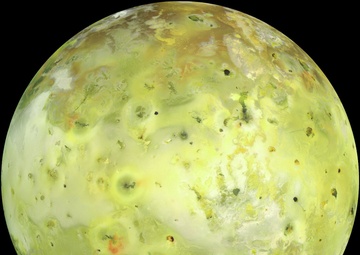
Courtesy Photo | NASA | 12.08.2009
NASA's Galileo spacecraft acquired its highest resolution images of Jupiter's moon Io on July 3, 1999 during its closest pass to Io since orbit insertion in late 1995. This color mosaic uses the near
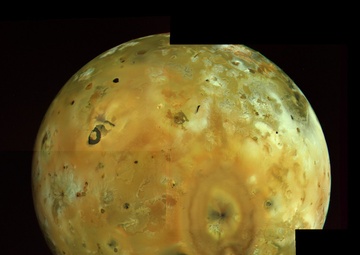
Courtesy Photo | NASA | 10.14.2009
Perhaps the most spectacular of all the Voyager photos of Io is this mosaic obtained by Voyager 1 on March 5 at a range of 400,000 kilometers. A great variety of color and albedo is seen
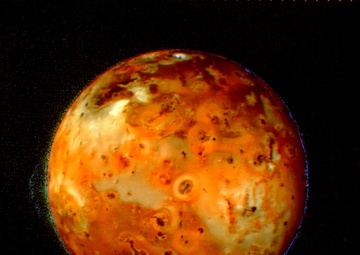
Courtesy Photo | NASA | 10.14.2009
Io's volcanos continually resurface it, so that any impact craters have disappeared. JPL manages the Voyager project for NASA's Office of Space Science. NASA Identifier: PLAN-PIA01530
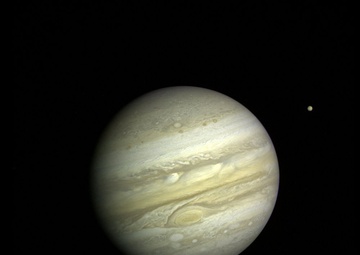
Courtesy Photo | NASA | 10.15.2009
Voyager 1 took this photo of Jupiter Feb. 1, 1979, at a range of 20 million miles (32.7 million kilometers). Voyager scientists can now see that different colors in clouds around the Great Red Spot imply that the clouds swirl around the spot at varying altitudes. They also observe apparently regular spacing between the small white spots in the southern hemisphere and similar positioning of......
Courtesy Photo | NASA | 10.15.2009
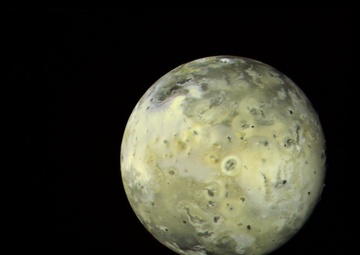
This full-disk image of Jupiter's satellite Io was made from several frames taken by Voyager 1 on March 4, 1979, as the spacecraft neared the satellite. Io is about 862,000 kilometers (500,000 miles
Courtesy Photo | NASA | 09.17.2009
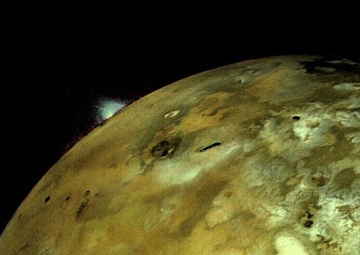
Voyager 1 acquired this image of Io on March 4, 1979 at 5:30 p.m. (PST) about 11 hours before closest approach to the Jupiter moon. The distance to Io was about 490,000 kilometers (304,000 miles




