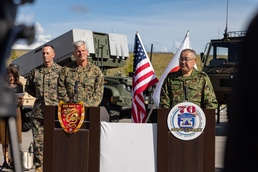
MARINE CORPS BASE CAMP SMEDLEY D. BUTLER, Okinawa, Japan – For decades, III Marine Expeditionary Force has stood as a beacon of readiness and capability in the Indo-Pacific region. As the Marine Corps marks 250 years of service, III MEF shows no signs of slowing down.
Throughout 2025, III MEF pushed beyond maintaining a forward presence in the region. Alongside allies and partners, Marines sharpened their ability to respond to crisis and contingency through rigorous, realistic training across a spectrum of military operations. Operating across all domains, the force demonstrated stand-in tactics, executed rapid and distributed island operations, and advanced Marine Corps’ modernization and Force Design initiatives.
“Our Marines and sailors are trained, integrated, and lethal. If called upon, we are ready,” said Lt. Gen. Roger Turner, III MEF commanding general. “Every exercise, deployment, and partnership this year sharpened our ability to respond to crisis and contingency, ensuring peace and security in this region.”
Advancing expeditionary capabilities
As part of III MEF’s 2025 strategy to address emerging Indo-Pacific challenges, the Marines and Sailors focused on strengthening existing Expeditionary Advanced Basing Operations (EABO) capabilities. Throughout the year, III MEF participated in complex, realistic training exercises designed to enhance interoperability, refine tactics, techniques, and procedures, and improve collective warfighting readiness across the region's challenging and fragmented maritime terrain.
The largest of these efforts was Resolute Dragon 25, Japan’s premier bilateral exercise held in September. III MEF and the Japan Self-Defense Force (JSDF) practiced EABO and cross-domain operations in the defense of key maritime terrain. The exercise brought together approximately 5,200 U.S. Marines and Sailors alongside 14,000 JSDF service members, making it the largest Resolute Dragon to date. It tested the combined force at both operational and tactical levels.
During the exercise, 1st Marine Aircraft Wing (MAW) and the Japan Air Self-Defense Force transported various joint and combined fires capabilities across Japan. Using a mix of U.S. and Japanese MV-22B Ospreys, C-130 Hercules, and CH-47 Chinooks, the two nations deployed Navy Marine Expeditionary Ship Interdiction Systems (NMESIS), Marine Air Defense Integrated Systems (MADIS), Patriot missile batteries, and Japanese missile systems. From Hokkaido to Ishigaki, this bilateral team demonstrated their ability to rapidly position combat forces and equipment on key terrain.
One of the hallmark features of the NMESIS is its ability to rapidly deploy and operate in austere, expeditionary environments. The system is designed to be transported on various platforms, making it highly mobile and adaptable to different terrain and operational scenarios. Once positioned in the Sakishima Islands, the 12th Marine Littoral Regiment (MLR) collaborated with JSDF units to integrate the NMESIS and MADIS systems with Japan’s Type 12 Surface-to-Ship Missile and Type 03 Medium-Range Surface-to-Air Missile systems. This integration created the opportunity to rehearse notional fire missions and enhanced the Japanese and U.S. combined fires capabilities.
Meanwhile, at Camp Kengun in Kyushu, the 3rd Marine Expeditionary Brigade (MEB), fully integrated with the JSDF Western Army Headquarters to provide bilateral coordination and information-sharing in a time-sensitive environment. The exercise validated the MEB’s ability to establish forward command-and-control nodes operating seamlessly with bilateral formations across Japan.
In October, the 3rd Marine Logistics Group (MLG) joined forces with the 12th MLR for Japan Exercise 07. Operating alongside the Japan Ground Self-Defense Force (JGSDF) on Ishigaki Island, Marines transformed humanitarian assistance and disaster relief scenarios into powerful demonstrations of integrated support. They provided demonstrations of critical medical support and transportation capabilities, including an acute-care ward to rapidly stabilize and treat patients with severe injuries.
In another bilateral achievement during Japan Exercise 07, the 1st MAW established a forward arming and refueling point (FARP) on Yonaguni Island with the JSDF. FARPs extend the operational reach of military aircraft by providing expeditionary fuel sources in key locations. Using the nimble Tactical Aviation Ground Refueling System, 1st MAW showcased its ability to quickly establish and dismantle essential sites in austere environments, enhancing response capabilities alongside Japanese forces and securing shared objectives across the first island chain.
Deepening relationships
The year was filled with training opportunities and events designed to strengthen III MEF’s relationships with regional allies and partners through major exercises and alliance-building activities.
From February to April, Marines from the 4th Marine Regiment and 3rd MLG deepened their relationship with the Republic of Korea Marine Corps during the Korea Marine Exchange Program and Freedom Banner 25. These exercises, featuring amphibious and air assault training, showcased the enduring strength of the 72-year U.S.-ROK partnership. Additionally, the combined force conducted complex logistical exercises, including bilateral air resupply missions and casualty extraction drills, further enhancing combined readiness and underscoring commitment to deterrence and stability on the Korean Peninsula.
Later in the year, 1st MAW demonstrated increased interoperability by conducting flight training with the MQ-9A Reaper unmanned aircraft system in the Republic of Korea. This training advanced joint intelligence, surveillance, and reconnaissance capacity, strengthening bilateral ties through advanced simulations, wargaming, and joint exercises like ANNUALEX. This evolution also saw 1st MAW transition to Multifunction Air Operations Centers, in which air command and control forces provide tactical control of aircraft and missiles throughout the battlespace. The Marines rehearsed MAOC employment in the defense of key terrain and demonstrated their ability to enables strikes on adversary targets with both kinetic weapons and non-kinetic means, such as electromagnetic warfare.
In November, III MEF Marines implemented valuable lessons learned from previous training events throughout Japan to provide real-world Foreign Disaster Relief in the Philippines. The 3rd Marine Expeditionary Brigade led U.S. military efforts to deliver 10,000 family food packs to communities impacted by Typhoons Kalmaegi and Fung-Wong. Working in close coordination with the Armed Forces of the Philippines, the Philippine National Disaster Risk Reduction and Management Council, and other agencies, the Marines provided rapid assistance and highlighted the U.S.-Philippine alliance and our shared commitment to regional resilience and crisis response.
Naval integration
As one of the Nation’s most capable crisis response forces, the 31st Marine Expeditionary Unit (MEU) is persistently forward deployed and ready, providing combatant commanders the flexibility to employ amphibious forces from anywhere in the Pacific Ocean. Over the summer, the 31st MEU served as the region’s premier crisis response force while conducting operations and exercises across Australia, Japan, the Philippines, and the Republic of Korea. This deployment marked a new milestone, with the 31st MEU employing Amphibious Combat Vehicles which operated with complete crews in open water and through surf zones in the Indo-Pacific.
Following the patrol, the MEU prepared for its next deployment by closely collaborating with the U.S. Navy’s 7th Fleet and JSDF counterparts. In a show of readiness, the MEU transported approximately 400 Marines and their combat equipment more than 1,100 miles in just 36 hours. This rapid complex movement from Okinawa to Combined Arms Training Center Camp Fuji, involving MV-22B Ospreys, CH-53E Super Stallions, and C-130J Hercules aircraft, culminated in live-fire ranges and a decisive helicopter-borne raid, demonstrating the MEU’s rapid power projection capabilities. To cap off the year, the MEU embarked on the USS George Washington (CVN-73) and, for the first time, supported anti-submarine warfare operations in the Philippine Sea using MV-22B Ospreys.
Modernizing the force
Throughout the year, III MEF focused on improving readiness and lethality, equipping forces with the latest technologies and tactics for success on the modern battlefield. This continued commitment to adapt reflects III MEF’s long-standing warrior ethos and its ability to confront future adversarial challenges, as detailed in the Marine Corps’ Force Design.
In April and May, during Exercise Balikatan’s 40th iteration in the Philippines, the 3rd MLR expanded the boundaries of EABO by evaluating new sensing capabilities and rehearsing the defense of key maritime terrain. Notably, the 3rd MLR integrated U.S. Army maneuver support vessels, demonstrating a persistent combat presence in contested coastal areas.
To address the challenge of sustaining distributed forces, 3rd MARDIV and 3rd MLG advanced logistics technologies to support operations across vast areas. Training with autonomous low-profile vessels (ALPVs) and unmanned resupply systems, 12th MLR improved their ability to sustain forces in remote regions.
In August, the 5th Air Naval Gunfire Liaison Company (5th ANGLICO) played a pivotal role in coordinating fires for Republic of Korea and Japanese forces during Pacific Vanguard 25. This multilateral exercise tested maritime operations, anti-submarine warfare, and advanced maneuvering. The 5th ANGLICO team also participated in bilateral training for joint terminal attack controllers and fire coordinators from allied nations, reinforcing a modern and integrated network for delivering fires throughout the area of operations.
In September, the 9th Engineer Support Battalion became the first Marine Corps unit to be trained by the U.S. Army Corps of Engineers on automated 3D concrete printing, a groundbreaking technology that reduces labor, materials, and logistics while accelerating construction timelines. The technology allows Marines to quickly “print” gap crossings, obstacles like road barriers, shelters, and protective structures using locally available materials without relying on acquisition or procurement processes.
In the cyber domain, III MEF Information Group demonstrated its capabilities during Exercise Kaiju Rain 25, where they delivered cyber effects in support of joint operations. Additionally, the 3rd Cyber Warfare Company earned first place in the Department of Defense’s Cyber Blue Zone competition, showcasing its expertise in defending against sophisticated cyber threats.
Way ahead
III MEF’s ability to support and defend allies and partners, provide credible deterrence, and operate forward across the Indo-Pacific remains more vital than ever. III MEF will continue working closely with the Marine Corps Warfighting Laboratory and the U.S. Navy in developing and proving concepts for the future of expeditionary and amphibious operations. Innovative concepts will be balanced with crisis response capabilities to ensure the force has the best training, proper equipment, and most importantly, the right people to fight now and in future.
As III MEF looks toward 2026, it does so fueled by the momentum of a successful 2025. Standing shoulder to shoulder with allies and partners in the region, III MEF is more ready than ever before to contribute to a safe and prosperous Indo-Pacific.