By Lance Cpl. Juan D. Alfonso
III Marine Expeditionary Force PAO
CAMP FOSTER, OKINAWA, Japan - Without proper training, even the most high-tech equipment is useless. That is why Marine Corps Bases Japan firefighters spend the time they need to train with new equipment.
Firefighters with the Foster Fire Station, MCBJ Fire Department, conducted hazardous material training March 28 behind the Globe and Anchor Enlisted Club on Camp Foster.
The hazardous material training was supervised by instructors from EAI Corporation, a military contractor, who introduced the MCBJ firefighters to new equipment, according to Eric Rhodes, the MCBJFD training chief.
The scenario began when a simulated ambulance drove into the parking lot behind the enlisted club and powder from a package with a nuclear symbol fell out of the vehicle.
The instructors called the firefighters, who immediately dispatched to the scene.
After preparing a decontamination area and donning bulky protective clothing, the firefighters took samples of the powder for analysis. The protective suits made the job difficult.
"Those suits are really confining," said Tatsuya Kudeken, a firefighter with the department. "It's really hard to see what you're doing, and it feels like your hands don't really fit into the gloves."
The training took a realistic turn when half of the firefighters involved were sent to fight an actual fire during the exercise.
"In a real-life situation, if we were going to respond to a hazmat situation, we would call another fire station to handle the other fire," said Anthony Toguchi, the battalion chief for southern district, MCBJFD. "But this situation gave us a realistic look at how to handle multiple problems in case that wasn't possible."
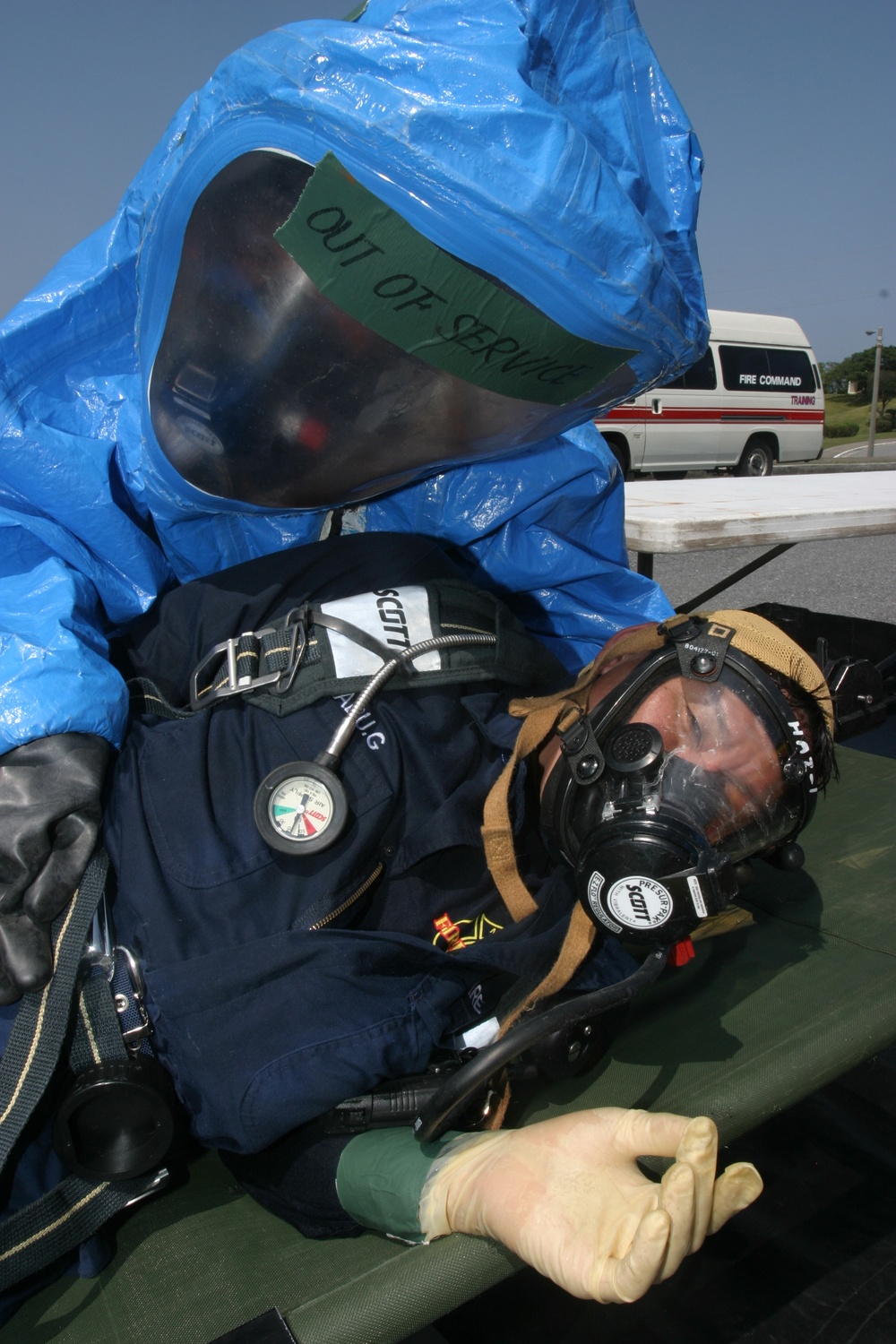
In addition to the real life problem, the instructors decided to implement another problem into the scenario. Shortly after the firefighters retrieved a sample, one of the firefighters collapsed from the heat, which is considerably increased due to the suit, Toguchi said.
Another two firefighters immediately ran into the contaminated area, wearing their own protective gear as well, with a wheeled stretcher to evacuate their injured teammate. After decontaminating all personnel involved, the scenario came to an end.
"It's good to do training like this because it keeps up efficiency," Toguchi said. "These suits are hard to work in, but they protect us. Hazmat isn't a rushing thing. It's important to take our time and make sure we get the job done right."
| Date Taken: |
04.08.2007 |
| Date Posted: |
04.10.2007 11:43 |
| Story ID: |
9848 |
| Location: |
|
| Web Views: |
103 |
| Downloads: |
33 |
PUBLIC DOMAIN

This work, Base firefighters conduct hazardous material training, prepare for real-life scenarios, must comply with the restrictions shown on https://www.dvidshub.net/about/copyright.

 Subscribe





