
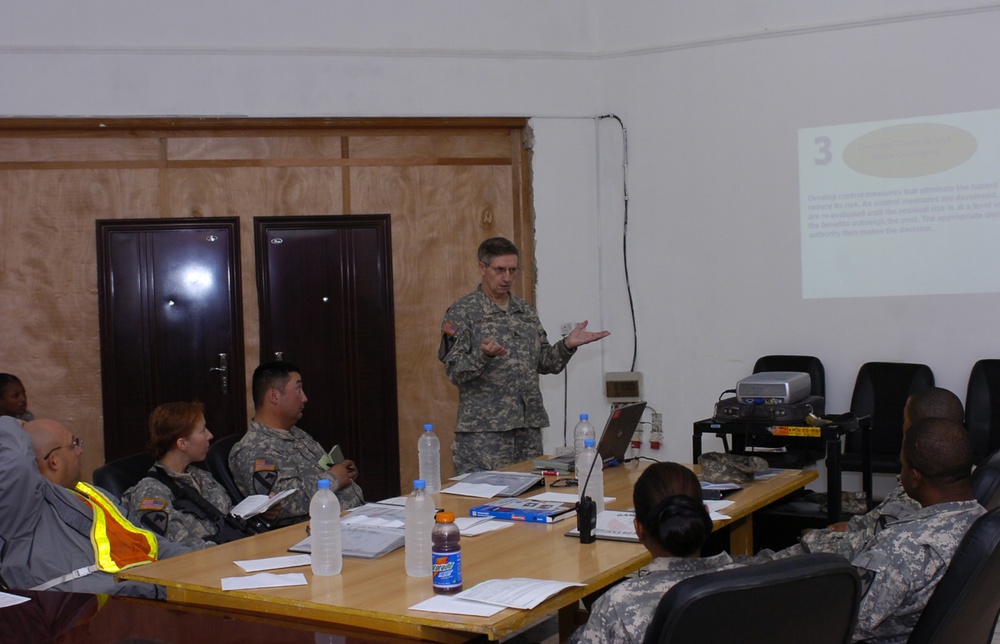
Photo By Sgt. Robert Yde | Wendell Moore, a native of Waco, Texas and the safety manager for the 2nd Brigade...... read more read more
 Subscribe
By Sgt. Robert Yde
2nd BCT, 1st Cav. Div. Public Affairs
FORWARD OPERATING BASE PROSPERITY, Iraq – "A safety culture is a mindset; it's an attitude, and it's one that you have to have everyday," Wendell Moore, the safety manager for the 2nd Brigade Combat Team, 1st Cavalry Division, told a small group of representatives from the 15th Brigade Support Battalion during a recent meeting with the battalion's safety representatives.
Although it could have been considered just a routine meeting, Moore said that the meeting offered an important opportunity to get some face time with safety officers from throughout the "Gambler" battalion.
"This is the first time in four months, since I've been in theater, that I've had the opportunity to do this," Moore said of the meeting with company and battalion level safety officers. "That doesn't mean that I don't communicate individually with them, but as a group, this is a rare setting."
According to Moore, the Gambler battalion has had an impressive safety record since their arrival to Iraq, despite the significant amount of time that its Soldiers spend on the road making sure the "Black Jack" Brigade is always well supplied.
"They've run well in excess of a thousand miles with no accidents. That's pretty amazing," Moore, a native of Waco, Texas said. "With as many vehicles, and Soldiers that are involved, and as many hours as they are on the road, that's incredible to say the least."
According to the battalion's safety officer, 1st Lt. Jamie Cook, the Gamblers have been so successful when it comes to safety issues because of their conscious focus on them – especially when it comes to running their convoy logistics patrols.
"I think a lot of it right now has to do with our CLP procedures because that is our primary mission," Cook, a native of Swansea, S.C., explained. "We just do it very deliberate and everything is a step-by-step process."
Cook said that the credit for ensuring the safety of the CLP's and the Soldiers who conduct them falls directly on the non-commissioned officers and junior officers who command the CLP's.
"They're the ones on the ground; they're the ones where the action is happening," she said. "We do briefings and presentations, but they're the ones with the Soldiers ensuring that every one is doing what they're supposed to be doing."
While Moore commended the battalion and its leadership for its focus on safety during missions, he cautioned that some of the biggest risks for personal injury could occur on the FOB.
"We haven't seen any vehicle accidents or any non-battle injuries out in the AO (area of operations) other than a lot of sprained ankles. It's been more from sports and lifting weights – things of that nature - more than anything else," Moore said.
Moore said that since the beginning of the year, the brigade has seen 35 personal injuries and that the majority of these occurred while the Soldiers were engaged in some type of sport or physical activity. Moore said that most sports injuries occur during football or basketball games though and chalks a lot of this up to the intensity that the Soldiers bring to the field or court with them.
"They play combat rules, and they get very intense the way they play," Moore explained. "One of the things that leaders have to do is caution their Soldiers about how much intensity and how much of their full self that they put into playing sports and that it's not a life or death game."
Moore also noted that Soldiers should take the time to stretch out and warm up before taking part in any sport.
"It's no different than stretching before PT or running," Moore said, "You should take the same kind of precautions."
With summertime fast approaching, Moore also mentioned that Soldiers would have to be aware of new dangers that they haven't had to deal with up till now.
"Summertime's coming on, so we've started publishing the summer safety campaign. Specifically, heat injuries, snakes ... things we don't see in the winter time that we're going to see in the summer time," Moore said. "We have to start trying to prepare the Soldiers and get them thinking along the lines of 'what can take me out of the fight?' A snake bite can take you out of the fight as sure as a bullet."
The best safety precaution that Soldiers can take is to stop and think about what they're about to do before they do it.
"That's the bottom line. Nine times out of 10 if a person will stop and take 60 seconds to think about what they're going to do, it would probably decrease our accidents by 50 percent," Moore said.
Moore said that while the safety message comes from the top, implementation of the practices has to happen at the unit level and lower.
"The more we can get that safety message out, the more we can build a safety culture," Moore said. "After all, we've got the best Soldiers in the world. The best trained, best equipped – there's no reason not to do it right."
| Date Taken: | 03.30.2007 |
| Date Posted: | 03.30.2007 14:26 |
| Story ID: | 9697 |
| Location: | BAGHDAD, IQ |
| Web Views: | 147 |
| Downloads: | 135 |

This work, Gamblers place winning bet on safety, by SGT Robert Yde, identified by DVIDS, must comply with the restrictions shown on https://www.dvidshub.net/about/copyright.

No keywords found.




