
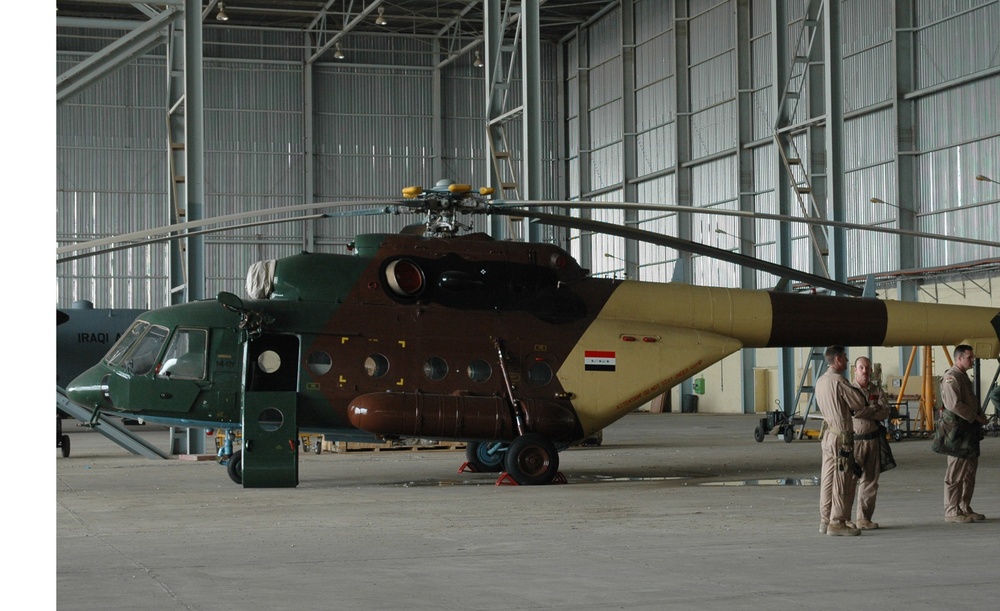
Photo By Tech. Sgt. Kevin Williams | Military Transition Team members talk with Iraqi air force airmen next to a newly...... read more read more
 Subscribe
By Tech. Sgt. Kevin Williams
506th Air Expeditionary Group Public Affairs
KIRKUK REGIONAL AIR BASE, Iraq – The Iraqi air force is taking off once again with the help of U.S. Air Force Airmen who serve with the Coalition Air Force Transition Team in Iraq.
While it is widely publicized that with the help of the U.S. Army, the Iraqis are rebuilding their own army and police forces, the U.S. Air Force is simultaneously helping to rebuild the Iraqi air force and assisting the country's airmen in providing for their own air defense.
The U.S. Air Force's contribution to enabling the IAF to build and sustain itself is focused through the CAFTT, composed of four Air Force Military Transition Teams located at bases in Kirkuk, Baghdad, Basra and Taji.
"The Iraqi army has matured, and they are almost ready to carry out operations without the U.S. Army," said Col. Gary Kirk, CAFTT training advisor to the IAF. "However, the air force started (rebuilding) later, and this will take longer."
Under Saddam Hussein's rule, the IAF had some 900 aircraft in its inventory during the early 1990s, but did not have the necessary infrastructure, explained Kirk. If an aircraft broke, a contractor was called in to fix it. Now, Iraqi airmen are learning how to provide their own maintenance and logistics support to establish themselves as a self-sustaining air force.
At Taji Air Base, Iraqi airmen recently took delivery of several refurbished helicopters, and Kirkuk Air Base is about to receive new aircraft at the end of March. With new aircraft coming into the IAF inventory, expectations can get ahead of training. However, the proper steps will be followed to make sure all qualifications are met before actual missions are flown.
"Every time we deploy aircraft, we deploy fully trained crew chiefs and pilots to fly," said Brig. Gen. Stephen Hoog, CAFTT commander. "In this case (introduction to new aircraft), the first two to three months is going to consist of basic aircraft checks and learning how to do the various things to each of the airplanes. It'll take two or three months to get enough folks qualified to fly the basic missions as they start to ease their way into the program."
The four squadrons in the IAF perform different missions throughout various regions of the country. Their missions depend on the needs of their geographic locations and the type of aircraft assigned to each squadron.
At IAF Squadron 70 in Basra and IAF Squadron 3 in Kirkuk, Iraqi airmen fly intelligence, surveillance and reconnaissance missions over oil pipelines and other areas of interest - all the while keeping an eye out for insurgent activity.
"They protect the oil pipelines and infrastructure, and perform general counter-terrorism and intelligence gathering," said Maj. Gary Lyles, CAFTT intelligence and surveillance program manager. "They have the game plan, and now they are starting to run with the ball."
"We look for recent construction or cars gathering in the middle of the road," said Col. Sami, IAF Sqdn. 70 commander. "We look for anything that doesn't look normal."
They use a forward-looking infrared system to take photographs and video of their missions. The information collected is used to gather intelligence on what's going on in the area.
At IAF Sqdn. 23, located at New Al Muthana Air Base in Baghdad, Iraqi airmen fly C-130E aircraft missions to deliver troops and cargo in support of the Iraqi government. As the largest and most seasoned IAF squadron, Sqdn. 23 has around 45 aircrew, 120 maintenance and 130 support personnel assigned.
"The C-130 program is the most advanced," said Hoog. "It's been in place for two and a half years, and we've been training Iraqi pilots side-by-side with our Air Force advisors. They fly each and every day doing cargo missions, and they are already flying troops in from Basra and Irbil."
Squadron 23 originally stood up at Ali Base in 2005 and moved to Baghdad around one year ago. The unit's aircrew members were first sent to Little Rock Air Force Base, Ark., for initial training before returning to Iraq. Now they are training their own recruits.
"They have 5-levels and 7-levels," Hoog explained. "The Iraqi 7-levels are training Iraqi 3-levels."
At Taji Air Base, home of IAF Squadrons 2, 4 and 12, helicopters are flown. These units' airmen are advised by the largest MiTT in the CAFTT program.
Squadron 12 has three flying squadrons which operate Bell 206 Jet Rangers, UH-1HP Huey II's and Mi-17 helicopters.
Squadron 12 trains Iraqi helicopter pilots in the Bell 206 Jet Ranger. Over the past six months, five Iraqi student pilots flew solo in the Jet Rangers and logged over 188 combat hours, including three aerial reconnaissance missions.
Huey II helicopters, gifted from Jordan in 2003, and completely retrofitted at a plant in Alabama, are flown by Sqdn. 2. Aircraft were delivered last month and have logged more than 62 flying hours.
The Hueys have completed five operational missions, including the first operational test mission, evaluation mission and the first distinguished visitor transport mission for the new IAF helicopter wing.
Squadron 4 received delivery of the Mi-17 aircraft and have logged 67 flying hours, including two operational missions. They are training to perform air transportation missions later this year.
| Date Taken: | 03.29.2007 |
| Date Posted: | 03.29.2007 09:43 |
| Story ID: | 9664 |
| Location: | KIRKUK, IQ |
| Web Views: | 272 |
| Downloads: | 226 |

This work, Iraqi Air Force taking flight, performing daily surveillance and cargo missions, must comply with the restrictions shown on https://www.dvidshub.net/about/copyright.


No keywords found.




